
MSI P35 Platinum: Redux
- Posted in
- Motherboards
Quick Thoughts
Looking at the first results from the P03 BIOS on the MSI P35 Platinum, it is clear that MSI abided by their promise to bring this board's performance up to par with the top DDR2 offerings from ASUS and Gigabyte. In memory bandwidth or latency sensitive applications at stock speeds, it is every bit equal to or better than the ASUS/Gigabyte boards, even though the differences are minimal in most cases.
As far as the new P03 BIOS goes, there are no additional settings when compared to the P01 BIOS in our first look at the P35 Platinum. When compared to the settings offered in the ASUS and Gigabyte P35 boards, the MSI BIOS looks downright barren. While the options are fairly limited, the basic items generally required for properly overclocking and tuning a board are available. That brings us to our main concern about this BIOS.
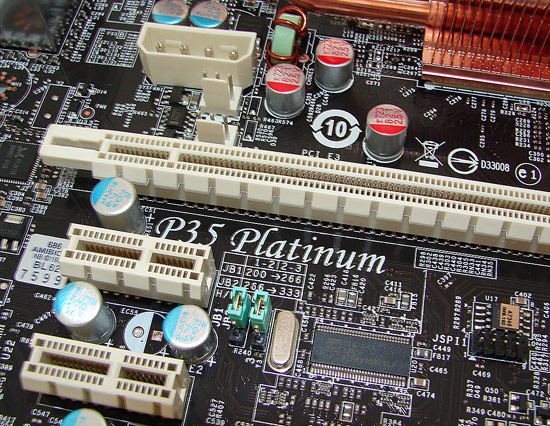
We had a very difficult time manually changing our memory timings to settings other than what was available in the SPD. MSI has thoroughly tuned this particular BIOS to offer outstanding memory and chipset latencies but in so doing has ensured the user will have to follow a narrow path when choosing memory settings. The board generated excellent memory performance at or near the stock 1066 memory speeds we utilize even though the memory timings were somewhat handicapped at 5-5-5-18. However, any chance at improving our memory timings while remaining in the 800/1066 strap generally met with frustration or failure.
For certain enthusiasts, this can be very frustrating, but for those users who believe and trust in auto settings this board will reward them with outstanding performance and stability. We generally let the board set itself and after a couple of weeks of testing, we also became believers of the "set and forget" auto performance settings that MSI has built into the board. This did limit us in our attempts to fine tune the board's memory settings or find that extra little bit of performance on the memory strap bubble, but overall any differences other than those for competitive benchmarking purposes would never be noticed in actual usage.
Overclocking with our quad core processor was excellent and in our preliminary testing with an E4300, E6320, E6600, and E6850 we are seeing FSB results in the 535~550 FSB range on the lower multipliers. However, we generally had to run the memory strap at 1333 above 500FSB and have found in testing that staying in the 1066 strap on the board around 485FSB offers the best overall performance if your CPU has the necessary range of multipliers.
Overall, we are very pleased with the performance that MSI has extracted from this board now. The only question that remains is how well it compares to new P35 boards from Biostar, abit, Foxconn, and Gigabyte in this price range. That question will be answered in our roundup shortly but for now those looking for great "set and forget" stock performance cannot go wrong with this board... unless of course the rollercoaster themed heatpipe system is a deal breaker.
Looking at the first results from the P03 BIOS on the MSI P35 Platinum, it is clear that MSI abided by their promise to bring this board's performance up to par with the top DDR2 offerings from ASUS and Gigabyte. In memory bandwidth or latency sensitive applications at stock speeds, it is every bit equal to or better than the ASUS/Gigabyte boards, even though the differences are minimal in most cases.
As far as the new P03 BIOS goes, there are no additional settings when compared to the P01 BIOS in our first look at the P35 Platinum. When compared to the settings offered in the ASUS and Gigabyte P35 boards, the MSI BIOS looks downright barren. While the options are fairly limited, the basic items generally required for properly overclocking and tuning a board are available. That brings us to our main concern about this BIOS.
We had a very difficult time manually changing our memory timings to settings other than what was available in the SPD. MSI has thoroughly tuned this particular BIOS to offer outstanding memory and chipset latencies but in so doing has ensured the user will have to follow a narrow path when choosing memory settings. The board generated excellent memory performance at or near the stock 1066 memory speeds we utilize even though the memory timings were somewhat handicapped at 5-5-5-18. However, any chance at improving our memory timings while remaining in the 800/1066 strap generally met with frustration or failure.
For certain enthusiasts, this can be very frustrating, but for those users who believe and trust in auto settings this board will reward them with outstanding performance and stability. We generally let the board set itself and after a couple of weeks of testing, we also became believers of the "set and forget" auto performance settings that MSI has built into the board. This did limit us in our attempts to fine tune the board's memory settings or find that extra little bit of performance on the memory strap bubble, but overall any differences other than those for competitive benchmarking purposes would never be noticed in actual usage.
Overclocking with our quad core processor was excellent and in our preliminary testing with an E4300, E6320, E6600, and E6850 we are seeing FSB results in the 535~550 FSB range on the lower multipliers. However, we generally had to run the memory strap at 1333 above 500FSB and have found in testing that staying in the 1066 strap on the board around 485FSB offers the best overall performance if your CPU has the necessary range of multipliers.
Overall, we are very pleased with the performance that MSI has extracted from this board now. The only question that remains is how well it compares to new P35 boards from Biostar, abit, Foxconn, and Gigabyte in this price range. That question will be answered in our roundup shortly but for now those looking for great "set and forget" stock performance cannot go wrong with this board... unless of course the rollercoaster themed heatpipe system is a deal breaker.
Originally published at https://www.anandtech.com/show/2258 (Wayback Machine).