
MSI P35 Platinum: Redux
- Posted in
- Motherboards
Synthetic Graphics Performance
The 3DMark series of benchmarks developed and provided by Futuremark are among the most widely used tools for benchmark reporting and comparisons. Although the benchmarks are very useful for providing apples-to-apples comparisons across a broad array of GPU and CPU configurations they are not a substitute for actual application and gaming benchmarks. In this sense we consider the 3DMark benchmarks to be purely synthetic in nature but still very valuable for providing consistent measurements of performance.
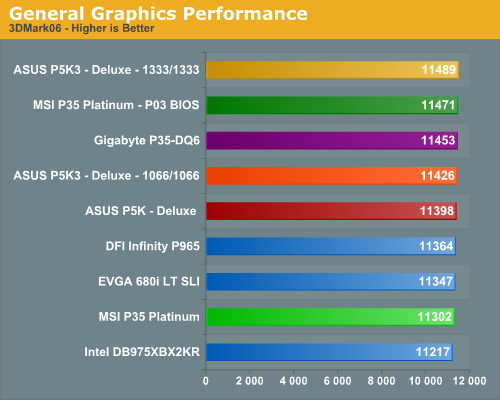
In our 3DMark06 test, all of the boards are bunched together with a 2.4% spread from top to bottom. The 975X board takes last place by a small margin; things have improved with the 7.6 drivers but those test results are not available yet. The MSI board with the new P03 BIOS tops the DDR2 based boards and improves by 1.4% over the board with the P01 BIOS.
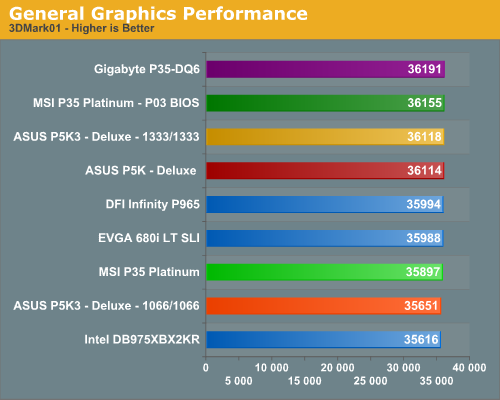
In the more memory sensitive 3DMark01 benchmark we see our Gigabyte P35T-DQ6 board taking top honors with the MSI board finishing second in the DDR2 grouping. Our 975X board is slightly handicapped at the 1066/800 settings, but this chipset continues to offer excellent memory performance in this type of benchmark. The spread from top to bottom is only 2.6%, however, so minor differences in performance are not really noticeable in either 3DMark unless you're looking to reach the top of the ORB.
General System Performance
The PCMark05 benchmark developed and provided by Futuremark was designed for determining overall system performance for the typical home computing user. This tool provides both system and component level benchmarking results utilizing subsets of real world applications or programs. This benchmark is useful for providing comparative results across a broad array of Graphics, CPU, Hard Disk, and Memory configurations along with multithreading results. In this sense we consider the PCMark benchmark to be both synthetic and real world in nature, and it again provides for consistency in our benchmark results.
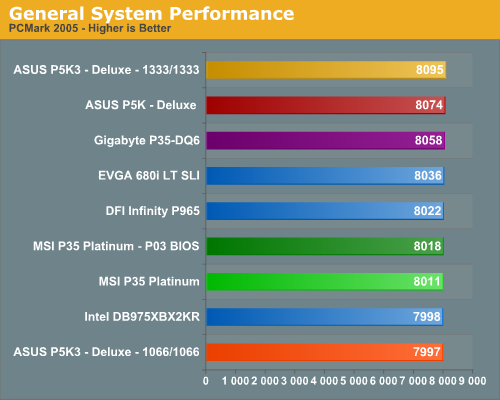
The ASUS boards have always done well in this benchmark due to very strong multitasking performance and the same holds true once again with our MSI board basically scoring the same regardless of BIOS version. We found this to be peculiar considering the improvements noticed in other applications. It turns out the first multitasking test is a disaster for the P03 based board for reasons that we cannot explain at this time; MSI is working to remedy the situation. The spread in overall scores is only 1.5%, although in individual areas the differences between the boards may be more or less pronounced.
The 3DMark series of benchmarks developed and provided by Futuremark are among the most widely used tools for benchmark reporting and comparisons. Although the benchmarks are very useful for providing apples-to-apples comparisons across a broad array of GPU and CPU configurations they are not a substitute for actual application and gaming benchmarks. In this sense we consider the 3DMark benchmarks to be purely synthetic in nature but still very valuable for providing consistent measurements of performance.
In our 3DMark06 test, all of the boards are bunched together with a 2.4% spread from top to bottom. The 975X board takes last place by a small margin; things have improved with the 7.6 drivers but those test results are not available yet. The MSI board with the new P03 BIOS tops the DDR2 based boards and improves by 1.4% over the board with the P01 BIOS.
In the more memory sensitive 3DMark01 benchmark we see our Gigabyte P35T-DQ6 board taking top honors with the MSI board finishing second in the DDR2 grouping. Our 975X board is slightly handicapped at the 1066/800 settings, but this chipset continues to offer excellent memory performance in this type of benchmark. The spread from top to bottom is only 2.6%, however, so minor differences in performance are not really noticeable in either 3DMark unless you're looking to reach the top of the ORB.
General System Performance
The PCMark05 benchmark developed and provided by Futuremark was designed for determining overall system performance for the typical home computing user. This tool provides both system and component level benchmarking results utilizing subsets of real world applications or programs. This benchmark is useful for providing comparative results across a broad array of Graphics, CPU, Hard Disk, and Memory configurations along with multithreading results. In this sense we consider the PCMark benchmark to be both synthetic and real world in nature, and it again provides for consistency in our benchmark results.
The ASUS boards have always done well in this benchmark due to very strong multitasking performance and the same holds true once again with our MSI board basically scoring the same regardless of BIOS version. We found this to be peculiar considering the improvements noticed in other applications. It turns out the first multitasking test is a disaster for the P03 based board for reasons that we cannot explain at this time; MSI is working to remedy the situation. The spread in overall scores is only 1.5%, although in individual areas the differences between the boards may be more or less pronounced.
Originally published at https://www.anandtech.com/show/2258 (Wayback Machine).