
ASUS P5K3-Deluxe: Beta BIOS Update
- Posted in
- Motherboards
Everest Memory Performance-
We are providing results with Everest 4.0 as this program is widely available and generates reliable results that can be replicated easily. Our results are based on the best possible memory timings and strap choices we could manage at each setting listed. Please remember, this is not a memory review or in-depth analysis of the memory and motherboard (those are coming along with application results). We are providing a few initial results with this new beta BIOS to show a glimpse of its current capabilities.
10x266FSB 2672MHz 5-5-5-15 1T 800 Strap DDR3-1066
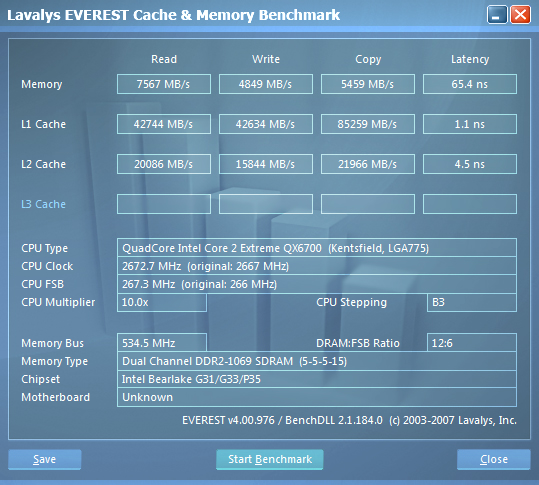
8x333FSB 2671MHz 6-6-6-18 1T 800 Strap DDR3-1333
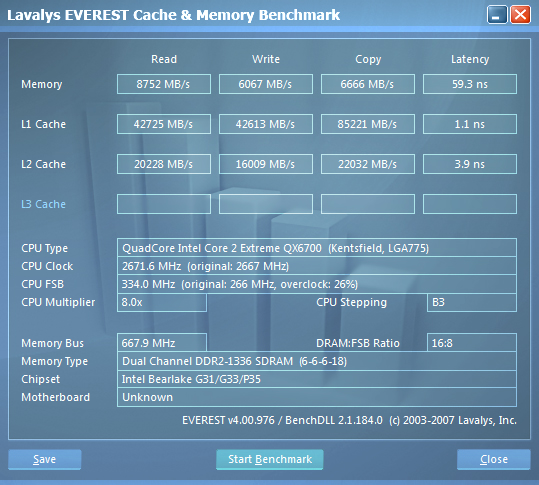
10x360FSB 3600MHz 7-7-7-18 1T 800 Strap DDR3-1440
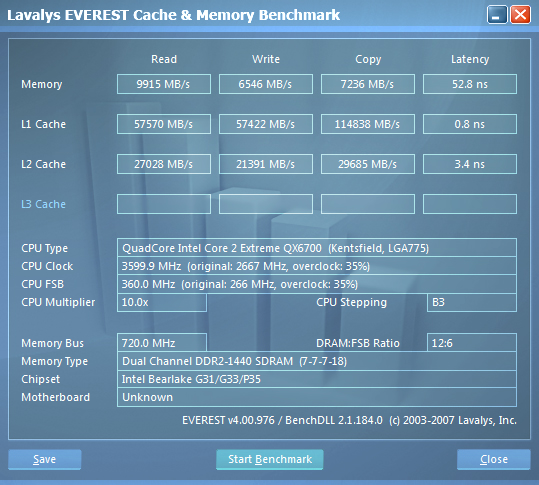
9x400FSB 3600MHz 7-7-7-24 1T 1066 Strap DDR3-1600
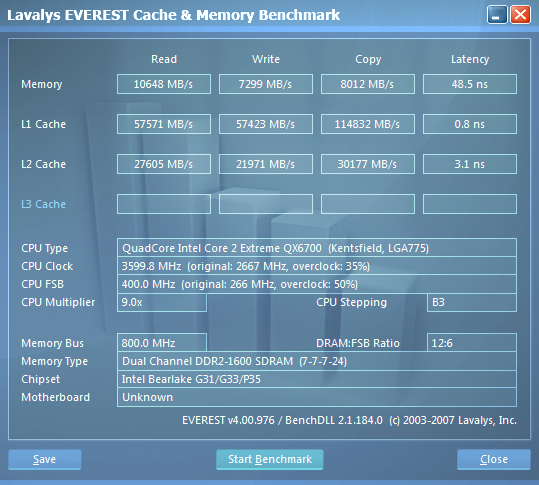
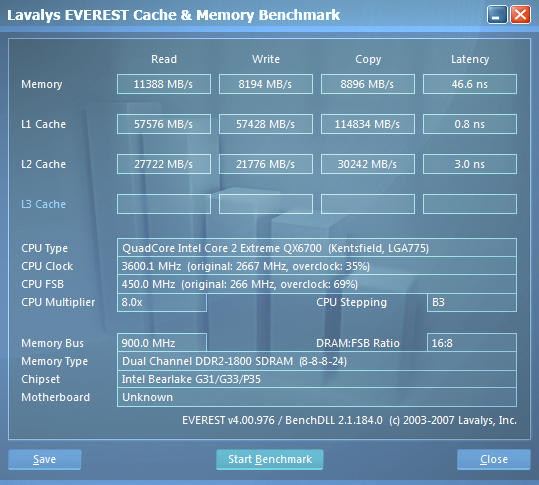
8x450FSB 3600MHz 8-8-8-24 2T 1066 Strap DDR3-1800
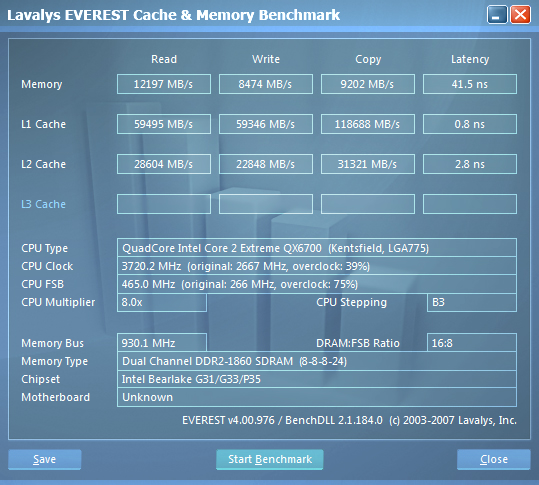
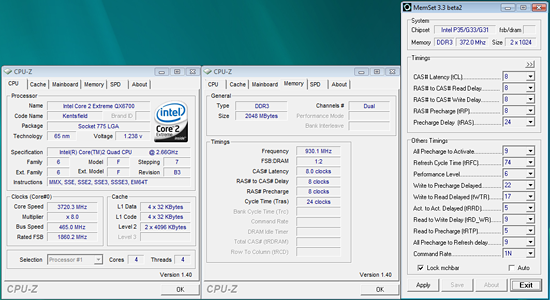
8x465FSB 3720MHz 8-8-8-24 1T 1066 Strap DDR3-1860
Our first two tests are with the processor set to its stock speed setting of 2660 although the final speed is at 2671+MHz due to a slight difference with the true FSB speeds. Read speeds improve by 15%, write speeds by 25%, and latency by 10% between our 1066 and 1333 memory speeds. We were able to run the system at the 800 memory strap easily up to the 333FSB setting which was impressive to us at first.
However, the actual difference between this and the 1066 strap was less than 2% in our initial comparison tests. The reason being that internal chipset latencies are really loosened up starting about 310FSB in order for the memory to run on the 800 strap. This is an area where ASUS is still fine tuning the BIOS for both performance enhancements and stability. We are also hoping they will allow us to eventually manipulate the chipset strap and latencies. Once the BIOS is finalized we will provide actual comparisons between each strap change but for now the differences between the 800, 1066, and 1333 straps average around 2% between each setting.
Our limit on the 800 strap was around the 360FSB mark with this particular processor. Our E6600 was unable to do more than 320FSB stable yet our E6420 was able to reach 380FSB on the 800 strap. Once we switched over to the 1066 strap for the 3600MHz settings things got interesting between the 400FSB and 450FSB results. We have a 12% increase in the FSB setting that results in read speeds increasing by 7%, latency improves by 4%, and write speeds improve linearly by 12%. We were running 1T settings at DDR3-1600 but had to fall back to 2T at DDR3-1800 as two of our game benchmarks would not run at 1T.
Our previous best overclock results with this board and processor combination was 7x485 and 8x453 at the 1333 strap, but the memory was regulated to DDR3-1500 or under at relaxed timings of 9-7-7-20. ASUS had promised us additional overclocking potential and 1T performance on the Micron memory up to 1900MHz in dual channel mode. We hit a final 8x465FSB setting on the 1066 strap at 1.4825V which is our limit on air cooling for this processor. This resulted in a memory setting at DDR3-1860 at 8-8-8-24 1T settings at 1.95V. Unlike our 450FSB settings, 1T stability was simply superb at this setting. Although we only had a 3% increase in CPU and FSB speeds, we see read speeds improving by 7%, write speeds linearly at 3%, and latency drops by an impressive 12%.
We are providing results with Everest 4.0 as this program is widely available and generates reliable results that can be replicated easily. Our results are based on the best possible memory timings and strap choices we could manage at each setting listed. Please remember, this is not a memory review or in-depth analysis of the memory and motherboard (those are coming along with application results). We are providing a few initial results with this new beta BIOS to show a glimpse of its current capabilities.
10x266FSB 2672MHz 5-5-5-15 1T 800 Strap DDR3-1066
8x333FSB 2671MHz 6-6-6-18 1T 800 Strap DDR3-1333
10x360FSB 3600MHz 7-7-7-18 1T 800 Strap DDR3-1440
9x400FSB 3600MHz 7-7-7-24 1T 1066 Strap DDR3-1600
8x450FSB 3600MHz 8-8-8-24 2T 1066 Strap DDR3-1800
8x465FSB 3720MHz 8-8-8-24 1T 1066 Strap DDR3-1860
Our first two tests are with the processor set to its stock speed setting of 2660 although the final speed is at 2671+MHz due to a slight difference with the true FSB speeds. Read speeds improve by 15%, write speeds by 25%, and latency by 10% between our 1066 and 1333 memory speeds. We were able to run the system at the 800 memory strap easily up to the 333FSB setting which was impressive to us at first.
However, the actual difference between this and the 1066 strap was less than 2% in our initial comparison tests. The reason being that internal chipset latencies are really loosened up starting about 310FSB in order for the memory to run on the 800 strap. This is an area where ASUS is still fine tuning the BIOS for both performance enhancements and stability. We are also hoping they will allow us to eventually manipulate the chipset strap and latencies. Once the BIOS is finalized we will provide actual comparisons between each strap change but for now the differences between the 800, 1066, and 1333 straps average around 2% between each setting.
Our limit on the 800 strap was around the 360FSB mark with this particular processor. Our E6600 was unable to do more than 320FSB stable yet our E6420 was able to reach 380FSB on the 800 strap. Once we switched over to the 1066 strap for the 3600MHz settings things got interesting between the 400FSB and 450FSB results. We have a 12% increase in the FSB setting that results in read speeds increasing by 7%, latency improves by 4%, and write speeds improve linearly by 12%. We were running 1T settings at DDR3-1600 but had to fall back to 2T at DDR3-1800 as two of our game benchmarks would not run at 1T.
Our previous best overclock results with this board and processor combination was 7x485 and 8x453 at the 1333 strap, but the memory was regulated to DDR3-1500 or under at relaxed timings of 9-7-7-20. ASUS had promised us additional overclocking potential and 1T performance on the Micron memory up to 1900MHz in dual channel mode. We hit a final 8x465FSB setting on the 1066 strap at 1.4825V which is our limit on air cooling for this processor. This resulted in a memory setting at DDR3-1860 at 8-8-8-24 1T settings at 1.95V. Unlike our 450FSB settings, 1T stability was simply superb at this setting. Although we only had a 3% increase in CPU and FSB speeds, we see read speeds improving by 7%, write speeds linearly at 3%, and latency drops by an impressive 12%.
Originally published at https://www.anandtech.com/show/2251 (Wayback Machine).