
Scythe Andy Samurai Master vs. Thermaltake MaxOrb
- Posted in
- Cases/Cooling/PSUs
Thermaltake MaxOrb
Thermaltake started business in 1999 in Taiwan, and has since become one of the most recognized brands in computer cooling as well as cases. Since 1999 the company has grown into a world-class company with a state-of-the-art testing and R&D; facility based in Taiwan. Thermaltake employs 60+ engineers covering each application segment such as Liquid Cooling, Air Cooling, PC Enclosure and Power Supply for main-stream users, high-end solutions, system integrators and industrial applications. Today you will find Thermaltake cooling solutions around the world.
The MaxOrb is the latest in a long line of Thermaltake "orb" coolers. The Orb name was first used in 2000 when Thermaltake launched the Golden Orb cooler for Pentium processors. The name has been revived recently with the MaxOrb cooler, which combines radial fins and heatpipes in a down-facing CPU cooler.
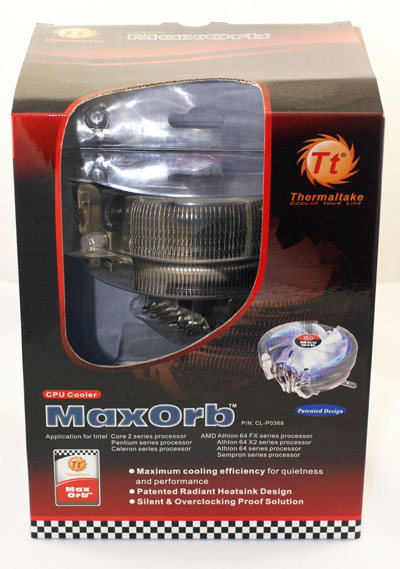
This cooler stands out with distinctive red and black packaging, and the package itself is huge. The MaxOrb and a box of accessories are protected by a plastic clamshell inside the box.
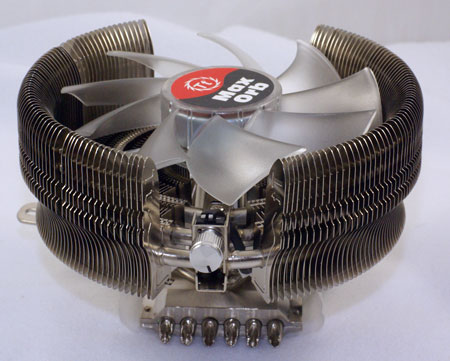
The cooler uses large radial aluminum fins and a large 110mm fan. As you can see there is also a built-in fan speed control that allows fan output to be adjusted up to a claimed 86.5cfm at 2000rpm. The embedded 110mm fan is lit by a blue LED. 110mm is a non-standard fan size, but that is somewhat a moot point since the fan was not designed to be changed.
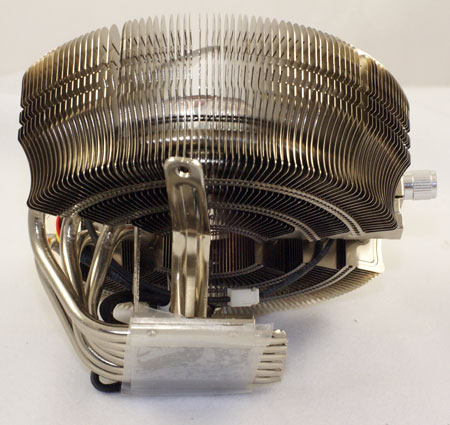
The cooling is further enhanced by six heatpipes extending from the copper base. These turn and pass horizontally through the radial fins to dissipate heat from the processor.
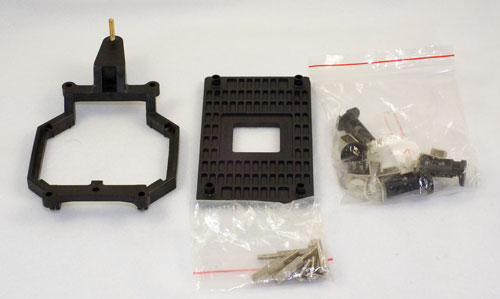
Accessories include mounting brackets for Intel socket 775 and AMD 754/939/940/AM2. The key component is the universal mounting base.
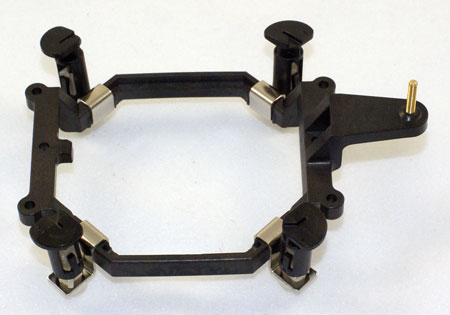
The base attaches the MaxOrb cooler, and four pop-clips slip onto the base for mounting to an Intel socket 775. You don't need to remove the motherboard to mount this cooler.
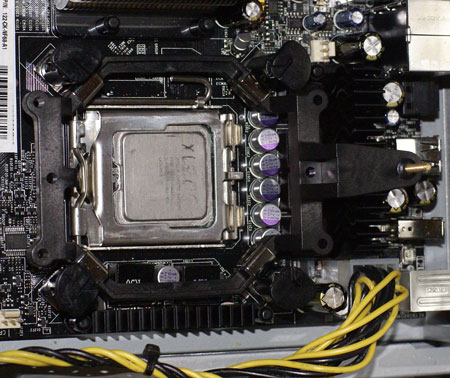
The base pops on first, then the cooler attaches by clipping to the base lug and attaching a single screw. Unlike other coolers that claim simple installation without board removal, this one actually works. The only awkward task is attaching the single screw since there's just no good way on a board mounted in a case to hold the screw while trying to screw it on.
Specifications
Our test system is Intel socket 775, but the Thermaltake MaxOrb will mount on any recent AMD socket as well - including socket 754/939/940 as well as the more recent and AM2. All the needed hardware is included.
The MaxOrb is a big cooler, but it is much shorter than the typical heatsink towers we have been reviewing. The EVGA 680i is a difficult to fit board due to the copper-finned heatsink and fan cooling the Northbridge. It is a snug fit, but the MaxOrb mounted fine on the 680i, the ASUS Striker and ASUS Commando, and on the two new P35 boards - the ASUS P5K Deluxe and P5K3 Deluxe. The P5K3 Deluxe is almost a fit test for any motherboard, since the heatpipes completely circle the CPU socket and connect various cooling heatsinks around the CPU socket. The only precaution on the P5K3 is to mount the MaxOrb with the screw "tongue" over the lower heatpipes near the DIMM sockets. It clears everything in this mount position.
Thermaltake started business in 1999 in Taiwan, and has since become one of the most recognized brands in computer cooling as well as cases. Since 1999 the company has grown into a world-class company with a state-of-the-art testing and R&D; facility based in Taiwan. Thermaltake employs 60+ engineers covering each application segment such as Liquid Cooling, Air Cooling, PC Enclosure and Power Supply for main-stream users, high-end solutions, system integrators and industrial applications. Today you will find Thermaltake cooling solutions around the world.
The MaxOrb is the latest in a long line of Thermaltake "orb" coolers. The Orb name was first used in 2000 when Thermaltake launched the Golden Orb cooler for Pentium processors. The name has been revived recently with the MaxOrb cooler, which combines radial fins and heatpipes in a down-facing CPU cooler.
This cooler stands out with distinctive red and black packaging, and the package itself is huge. The MaxOrb and a box of accessories are protected by a plastic clamshell inside the box.
The cooler uses large radial aluminum fins and a large 110mm fan. As you can see there is also a built-in fan speed control that allows fan output to be adjusted up to a claimed 86.5cfm at 2000rpm. The embedded 110mm fan is lit by a blue LED. 110mm is a non-standard fan size, but that is somewhat a moot point since the fan was not designed to be changed.
The cooling is further enhanced by six heatpipes extending from the copper base. These turn and pass horizontally through the radial fins to dissipate heat from the processor.
Accessories include mounting brackets for Intel socket 775 and AMD 754/939/940/AM2. The key component is the universal mounting base.
The base attaches the MaxOrb cooler, and four pop-clips slip onto the base for mounting to an Intel socket 775. You don't need to remove the motherboard to mount this cooler.
The base pops on first, then the cooler attaches by clipping to the base lug and attaching a single screw. Unlike other coolers that claim simple installation without board removal, this one actually works. The only awkward task is attaching the single screw since there's just no good way on a board mounted in a case to hold the screw while trying to screw it on.
Specifications
Our test system is Intel socket 775, but the Thermaltake MaxOrb will mount on any recent AMD socket as well - including socket 754/939/940 as well as the more recent and AM2. All the needed hardware is included.
| Thermaltake MaxOrb Specifications | ||||
| Heatsink | ||||
| Dimensions | 143(L) X 114(D) X 85.2(H)mm | |||
| Weight | 465g (including fan) | |||
| Material | Pure Copper Base and Aluminum Fins | |||
| Heatpipes | Six 6mm copper heatpipes | |||
| Fan | ||||
| Fan Size | 110 mm x 25mm | |||
| Bearing Type | Sleeve Bearing | |||
| Fan Life | 50,000 hours | |||
| Connector | 3-pin with integral fan-speed rheostat, 3.0 Watt Input | |||
| Speed | Silent Mode | 1,300rpm | Low-noise Mode | 2,000rpm |
| Noise Level | Silent Mode | 16.0dBA | Low-noise Mode | 24.0dBA |
| Fan Output | Silent Mode | Low-noise Mode | 85.5cfm | |
The MaxOrb is a big cooler, but it is much shorter than the typical heatsink towers we have been reviewing. The EVGA 680i is a difficult to fit board due to the copper-finned heatsink and fan cooling the Northbridge. It is a snug fit, but the MaxOrb mounted fine on the 680i, the ASUS Striker and ASUS Commando, and on the two new P35 boards - the ASUS P5K Deluxe and P5K3 Deluxe. The P5K3 Deluxe is almost a fit test for any motherboard, since the heatpipes completely circle the CPU socket and connect various cooling heatsinks around the CPU socket. The only precaution on the P5K3 is to mount the MaxOrb with the screw "tongue" over the lower heatpipes near the DIMM sockets. It clears everything in this mount position.
Originally published at https://www.anandtech.com/show/2244 (Wayback Machine).