
AMD - The Road Ahead
- Posted in
- CPUs
The Road to Acquisition
The CPU and the GPU have been on this collision course for quite some time; although we often refer to the CPU as a general purpose processor and the GPU as a graphics processor, the reality is that they are both general purpose. The GPU is merely a highly parallel general purpose processor, which is particularly well suited for particular applications such as 3D gaming. As the GPU became more programmable and thus general purpose, its highly parallel nature became interesting to new classes of applications: things like scientific computing are now within the realm of possibility for execution on a GPU.
Today's GPUs are vastly superior to what we currently call desktop CPUs when it comes to things like 3D gaming, video decoding and a lot of HPC applications. The problem is that a GPU is fairly worthless at sequential tasks, meaning that it relies on having a fast host CPU to handle everything else other than what it's good at.
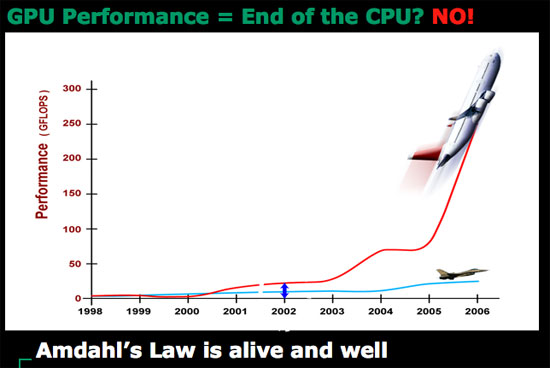
ATI discovered that long term, as the GPU grows in its power, it will eventually be bottlenecked by the ability to do high speed sequential processing. In the same vein, the CPU will eventually be bottlenecked by the ability to do highly parallel processing. In other words, GPUs need CPUs and CPUs need GPUs for all workloads going forward. Neither approach will solve every problem and run every program out there optimally, but the combination of the two is what is necessary.
ATI came to this realization originally when looking at the possibilities for using its GPU for general purpose computing (GPGPU), even before AMD began talking to ATI about a potential acquisition. ATI's Bob Drebin (formerly the CTO of ATI, now CTO of AMD's Graphics Products Group) told us that as he began looking at the potential for ATI's GPUs he realized that ATI needed a strong sequential processor.
We wanted to know how Bob's team solved the problem, because obviously they had to come up with a solution other than "get acquired by AMD". Bob didn't directly answer the question, but he did so with a smile, by saying that ATI tried to pair its GPUs with as low power of a sequential processor as possible but always ran into the same problem of the sequential processor becoming a bottleneck. In the end, Bob believes that the AMD acquisition made the most sense because the new company is able to combine a strong sequential processor with a strong parallel processor, eventually integrating the two on a single die. We really wanted to know what ATI's "plan-B" was, had the acquisition not worked out, because we're guessing that ATI's backup plan is probably very similar to what NVIDIA has planned for its future.
To understand the point of combining a highly sequential processor like modern day desktop CPUs and a highly parallel GPU you have to look above and beyond the gaming market, into what AMD is calling stream computing. AMD perceives a number of potential applications that will require a very GPU-like architecture to solve, things that we already see today. Simply watching an HD-DVD can eat up almost 100% of some of the fastest dual core processors today, while a GPU can perform the same decoding task with much better power efficiency. H.264 encoding and decoding are perfect examples of tasks that are better suited for highly parallel processor architectures than what desktop CPUs are currently built on. But just as video processing is important, so are general productivity tasks, which is where we need the strengths of present day Out of Order superscalar CPUs. A combined architecture that can excel at both types of applications is clearly a direction that desktop CPUs need to target in order to remain relevant in future applications.
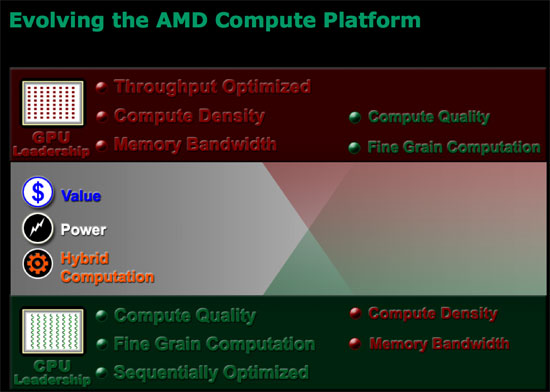
Future applications will easily combine stream computing with more sequential tasks, and we already see some of that now with web browsers. Imagine browsing a site like YouTube except where all of the content is much higher quality and requires far more CPU (or GPU) power to play. You need the strengths of a high powered sequential processor to deal with everything other than the video playback, but then you need the strengths of a GPU to actually handle the video. Examples like this one are overly simple, as it is very difficult to predict the direction software will take when given even more processing power; the point is that CPUs will inevitably have to merge with GPUs in order to handle these types of applications.
The CPU and the GPU have been on this collision course for quite some time; although we often refer to the CPU as a general purpose processor and the GPU as a graphics processor, the reality is that they are both general purpose. The GPU is merely a highly parallel general purpose processor, which is particularly well suited for particular applications such as 3D gaming. As the GPU became more programmable and thus general purpose, its highly parallel nature became interesting to new classes of applications: things like scientific computing are now within the realm of possibility for execution on a GPU.
Today's GPUs are vastly superior to what we currently call desktop CPUs when it comes to things like 3D gaming, video decoding and a lot of HPC applications. The problem is that a GPU is fairly worthless at sequential tasks, meaning that it relies on having a fast host CPU to handle everything else other than what it's good at.
ATI discovered that long term, as the GPU grows in its power, it will eventually be bottlenecked by the ability to do high speed sequential processing. In the same vein, the CPU will eventually be bottlenecked by the ability to do highly parallel processing. In other words, GPUs need CPUs and CPUs need GPUs for all workloads going forward. Neither approach will solve every problem and run every program out there optimally, but the combination of the two is what is necessary.
ATI came to this realization originally when looking at the possibilities for using its GPU for general purpose computing (GPGPU), even before AMD began talking to ATI about a potential acquisition. ATI's Bob Drebin (formerly the CTO of ATI, now CTO of AMD's Graphics Products Group) told us that as he began looking at the potential for ATI's GPUs he realized that ATI needed a strong sequential processor.
We wanted to know how Bob's team solved the problem, because obviously they had to come up with a solution other than "get acquired by AMD". Bob didn't directly answer the question, but he did so with a smile, by saying that ATI tried to pair its GPUs with as low power of a sequential processor as possible but always ran into the same problem of the sequential processor becoming a bottleneck. In the end, Bob believes that the AMD acquisition made the most sense because the new company is able to combine a strong sequential processor with a strong parallel processor, eventually integrating the two on a single die. We really wanted to know what ATI's "plan-B" was, had the acquisition not worked out, because we're guessing that ATI's backup plan is probably very similar to what NVIDIA has planned for its future.
To understand the point of combining a highly sequential processor like modern day desktop CPUs and a highly parallel GPU you have to look above and beyond the gaming market, into what AMD is calling stream computing. AMD perceives a number of potential applications that will require a very GPU-like architecture to solve, things that we already see today. Simply watching an HD-DVD can eat up almost 100% of some of the fastest dual core processors today, while a GPU can perform the same decoding task with much better power efficiency. H.264 encoding and decoding are perfect examples of tasks that are better suited for highly parallel processor architectures than what desktop CPUs are currently built on. But just as video processing is important, so are general productivity tasks, which is where we need the strengths of present day Out of Order superscalar CPUs. A combined architecture that can excel at both types of applications is clearly a direction that desktop CPUs need to target in order to remain relevant in future applications.
Future applications will easily combine stream computing with more sequential tasks, and we already see some of that now with web browsers. Imagine browsing a site like YouTube except where all of the content is much higher quality and requires far more CPU (or GPU) power to play. You need the strengths of a high powered sequential processor to deal with everything other than the video playback, but then you need the strengths of a GPU to actually handle the video. Examples like this one are overly simple, as it is very difficult to predict the direction software will take when given even more processing power; the point is that CPUs will inevitably have to merge with GPUs in order to handle these types of applications.
Originally published at https://www.anandtech.com/show/2229 (Wayback Machine).