
Intel Santa Rosa Preview: Centrino V Evolves
- Posted in
- Laptops
Power Consumption:
As we mentioned on our test page, we couldn't do an apples to apples comparison of battery life between the old Centrino and the new Santa Rosa platform due to having two very different notebooks. That being said, we did want to look at power consumption to get a vague idea of how these systems compared in power draw.
We looked at power consumption at idle and under 100% load while running our WME9 test:
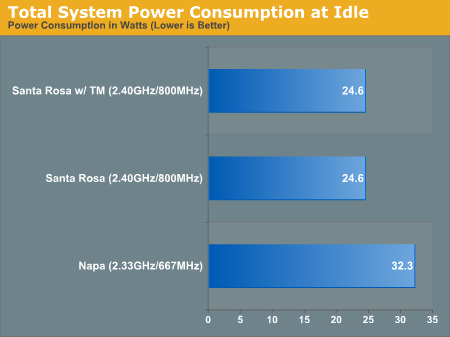
At idle, our new Santa Rosa platform actually uses less power than its predecessor. We wouldn't put too much weight in this number because it could be due to a number of factors unrelated to the new platform, although the ability to run at a lower FSB at idle could most definitely play a large part.
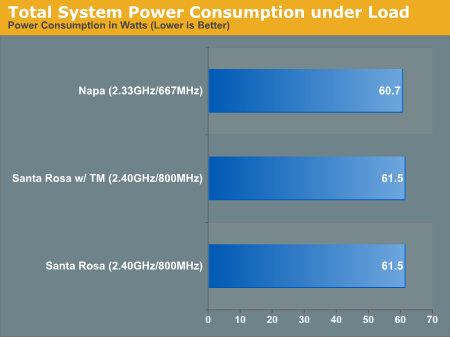
Under load, we have Santa Rosa consuming a bit more power than its predecessor, which is honestly what we'd expect. With a faster FSB and no real improvements to power management when the CPU is under load, Santa Rosa will eat up the minutes left on your battery quicker than its predecessor when you're actually getting work done. At idle, we'd honestly expect it to be a toss up between Santa Rosa and its predecessor, with the new platform possibly even coming in a bit lower on the power meter thanks to the enhancements made to the platform. Remembering that the two power management features Intel added to Santa Rosa (adjustable FSB frequency and chipset-CPU handshaking improvements) only work during idle periods, this generalization about battery life makes sense.
Adding Turbo Memory into the mix could change things as it is supposed to increase battery life, but we simply don't know at this point. We didn't see any change in power consumption with Intel's Turbo Memory enabled or disabled, but that could be the fault of our test platform.
As we mentioned on our test page, we couldn't do an apples to apples comparison of battery life between the old Centrino and the new Santa Rosa platform due to having two very different notebooks. That being said, we did want to look at power consumption to get a vague idea of how these systems compared in power draw.
We looked at power consumption at idle and under 100% load while running our WME9 test:
At idle, our new Santa Rosa platform actually uses less power than its predecessor. We wouldn't put too much weight in this number because it could be due to a number of factors unrelated to the new platform, although the ability to run at a lower FSB at idle could most definitely play a large part.
Under load, we have Santa Rosa consuming a bit more power than its predecessor, which is honestly what we'd expect. With a faster FSB and no real improvements to power management when the CPU is under load, Santa Rosa will eat up the minutes left on your battery quicker than its predecessor when you're actually getting work done. At idle, we'd honestly expect it to be a toss up between Santa Rosa and its predecessor, with the new platform possibly even coming in a bit lower on the power meter thanks to the enhancements made to the platform. Remembering that the two power management features Intel added to Santa Rosa (adjustable FSB frequency and chipset-CPU handshaking improvements) only work during idle periods, this generalization about battery life makes sense.
Adding Turbo Memory into the mix could change things as it is supposed to increase battery life, but we simply don't know at this point. We didn't see any change in power consumption with Intel's Turbo Memory enabled or disabled, but that could be the fault of our test platform.
Originally published at https://www.anandtech.com/show/2228 (Wayback Machine).