
NVIDIA GeForce 8M: DirectX 10 Goes Mobile
- Posted in
- GPUs
Additional Features
The DirectX 10 unified architecture is common to all of NVIDIA's GeForce 8 series hardware. All of the midrange solutions incorporate the new PureVideo HD video processing engine. The mobile offerings do have one other technology that's not present on desktop hardware: PowerMizer. Similar to Intel's SpeedStep technology, PowerMizer allows an NVIDIA mobile graphics chips to reduce clock speeds and voltages in order to conserve battery life and reduce heat output.
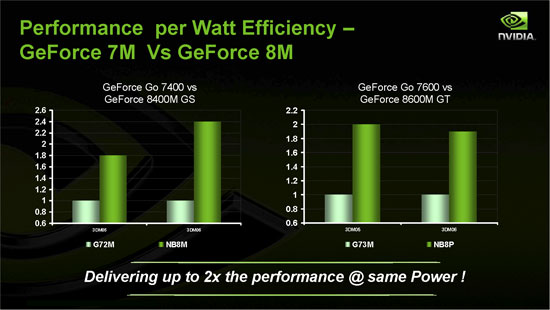
It wasn't clear from NVIDIA's presentation whether or not the latest GeForce 8M hardware makes any significant changes to the PowerMizer technology. However, here's a quick overview of the PowerMizer 7.0 technology. Again NVIDIA claims a twofold increase relative to last generation hardware (G72M vs. NB8M and G73M vs. NB8P), only this time the increase is in performance per watt efficiency. We would be very unimpressed if the new hardware wasn't at least better than the previous generation hardware, but we will hold off on saying more until we have had a bit more time to test NVIDIA's latest mobile GPUs.
PowerMizer 7.0
The DirectX 10 unified architecture is common to all of NVIDIA's GeForce 8 series hardware. All of the midrange solutions incorporate the new PureVideo HD video processing engine. The mobile offerings do have one other technology that's not present on desktop hardware: PowerMizer. Similar to Intel's SpeedStep technology, PowerMizer allows an NVIDIA mobile graphics chips to reduce clock speeds and voltages in order to conserve battery life and reduce heat output.
It wasn't clear from NVIDIA's presentation whether or not the latest GeForce 8M hardware makes any significant changes to the PowerMizer technology. However, here's a quick overview of the PowerMizer 7.0 technology. Again NVIDIA claims a twofold increase relative to last generation hardware (G72M vs. NB8M and G73M vs. NB8P), only this time the increase is in performance per watt efficiency. We would be very unimpressed if the new hardware wasn't at least better than the previous generation hardware, but we will hold off on saying more until we have had a bit more time to test NVIDIA's latest mobile GPUs.
PowerMizer 7.0
- Starts with upfront power efficient architecture design
- GPU-level and system-level power savings
- Activity based switching between performance modes
- Adaptive Clocking dynamically tunes power to match demand
- Dynamic Clock Gating intelligently shuts down unused circuitry
- Enhanced Analog Circuitry power savings - PLLs, TMDS, PCIE (ASPM and ASLM)
- New low-power memory modes of operation -- dynamic drive and termination switching
- CPU power savings -- maximum CPU offload for graphics and video applications
- Power panel savings -- SmartDimmer 2.0 dynamically modulate backlight-lamp power
Originally published at https://www.anandtech.com/show/2227 (Wayback Machine).