
Super Talent SSD: 16GB of Solid State Goodness
- Posted in
- Storage
First Thoughts
We think Solid State Drives have an excellent future ahead of them. We are in the early stages of testing drives designed for the more performance oriented consumer market under an operating system (Vista) designed for them. However, we are still impressed with the overall performance of the Super Talent SSD16GB25/25M Flash Drive considering its design limitations for the target commercial and industrial markets.
Our limited testing shows both the strengths and weaknesses of this particular drive. Considering the read and write speeds are limited to around 25 MB/sec, the drive was forced to rely upon its superior access and random read rates to generate very competitive scores in our gaming and Windows XP operating system tests. However, we do see one of the major weaknesses of this drive being tested in a consumer centric test such as encoding where the write performance was up to four times slower than the hard disk. We expect these results to improve greatly with the consumer based drives, especially under Vista. In the meantime, the Super Talent SSD16GB25/25M is perfectly suited for its commercial or industrial target markets.
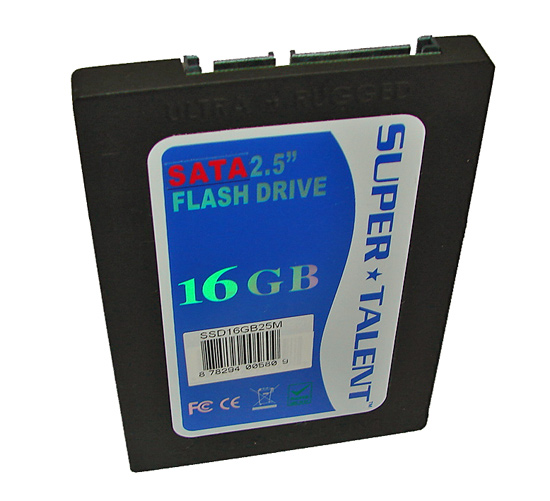
For now, the strengths of the technology behind Solid State Drives are significant for the portable market and eventually could be for the desktop market in specialized uses such as general office machines or portable workstations. The failure rates of the drive should be significantly lower since the drive has no moving parts; it can withstand extreme vibration and shock rates, and is designed for a wide variety of environmental conditions. There are other advantages as well.
Unlike the typical hard drive which has read access times in the 11ms range, most SSD products have access times less than a 1ms with the newer consumer drives being around .12ms at this time. This extremely low latency can significantly improve system resume times and random file access speeds when compared to a hard drive. A hard drive requires a motor, bearings, and moving head components that result in additional heat, power usage, and noise when compared to a SSD. Since the SSD does not have any moving parts it generates less heat, uses up to 80% less power, and is totally silent. Other benefits include improved data integrity, especially during power failures, power surges, or physical shock to the drive. The performance of the drive is fixed and remains stable over a long period of time unlike a hard drive that is subject to file fragmentation and slower access rates over time as the drive is filled up.
Of course, with strengths come weaknesses. The major weakness at this time is the cost of SSD products. The average cost at this time is $17 per GB of storage compared to as little as $0.25 per GB for hard drives. Also, overall performance of the SSD is dependent upon the NAND memory utilized and more importantly, the flash controller design at this juncture. We are just now seeing flash controllers and supporting software designs that can offer similar performance to a typical 7200rpm hard drive in most applications. This is one area that we expect to see improve significantly and quickly over the next nine months based upon our discussions with the manufacturers.
These weaknesses will diminish over time, especially with NAND memory decreasing in price by 40% per year based on current averages. We doubt the SSD product will make significant headway into the desktop market over the next three years due to the continued explosion of storage space requirements for digital entertainment. However, we do see it becoming a relatively significant part of the portable market over the same time period along with exceptionally fast double digit growth into the commercial and industrial markets.
We want to thank Super Talent again for providing our first benchmark-stable SSD sample and we look forward to their entry into the consumer market later this year. Until then, if you are a road warrior who is constantly afraid of losing data and can live with limited capacities, you might want to take a look at the consumer SSD products. And for those who are bound to ask, we only had a single drive for testing so we were unable to perform any RAID tests at this time, not to mention that definitely isn't the target market of this particular SSD. We hope to take a look at RAID performance of the consumer SSDs in the future, though the cost of such a configuration is likely to be prohibitive to all but the most affluent of users.
We think Solid State Drives have an excellent future ahead of them. We are in the early stages of testing drives designed for the more performance oriented consumer market under an operating system (Vista) designed for them. However, we are still impressed with the overall performance of the Super Talent SSD16GB25/25M Flash Drive considering its design limitations for the target commercial and industrial markets.
Our limited testing shows both the strengths and weaknesses of this particular drive. Considering the read and write speeds are limited to around 25 MB/sec, the drive was forced to rely upon its superior access and random read rates to generate very competitive scores in our gaming and Windows XP operating system tests. However, we do see one of the major weaknesses of this drive being tested in a consumer centric test such as encoding where the write performance was up to four times slower than the hard disk. We expect these results to improve greatly with the consumer based drives, especially under Vista. In the meantime, the Super Talent SSD16GB25/25M is perfectly suited for its commercial or industrial target markets.
For now, the strengths of the technology behind Solid State Drives are significant for the portable market and eventually could be for the desktop market in specialized uses such as general office machines or portable workstations. The failure rates of the drive should be significantly lower since the drive has no moving parts; it can withstand extreme vibration and shock rates, and is designed for a wide variety of environmental conditions. There are other advantages as well.
Unlike the typical hard drive which has read access times in the 11ms range, most SSD products have access times less than a 1ms with the newer consumer drives being around .12ms at this time. This extremely low latency can significantly improve system resume times and random file access speeds when compared to a hard drive. A hard drive requires a motor, bearings, and moving head components that result in additional heat, power usage, and noise when compared to a SSD. Since the SSD does not have any moving parts it generates less heat, uses up to 80% less power, and is totally silent. Other benefits include improved data integrity, especially during power failures, power surges, or physical shock to the drive. The performance of the drive is fixed and remains stable over a long period of time unlike a hard drive that is subject to file fragmentation and slower access rates over time as the drive is filled up.
Of course, with strengths come weaknesses. The major weakness at this time is the cost of SSD products. The average cost at this time is $17 per GB of storage compared to as little as $0.25 per GB for hard drives. Also, overall performance of the SSD is dependent upon the NAND memory utilized and more importantly, the flash controller design at this juncture. We are just now seeing flash controllers and supporting software designs that can offer similar performance to a typical 7200rpm hard drive in most applications. This is one area that we expect to see improve significantly and quickly over the next nine months based upon our discussions with the manufacturers.
These weaknesses will diminish over time, especially with NAND memory decreasing in price by 40% per year based on current averages. We doubt the SSD product will make significant headway into the desktop market over the next three years due to the continued explosion of storage space requirements for digital entertainment. However, we do see it becoming a relatively significant part of the portable market over the same time period along with exceptionally fast double digit growth into the commercial and industrial markets.
We want to thank Super Talent again for providing our first benchmark-stable SSD sample and we look forward to their entry into the consumer market later this year. Until then, if you are a road warrior who is constantly afraid of losing data and can live with limited capacities, you might want to take a look at the consumer SSD products. And for those who are bound to ask, we only had a single drive for testing so we were unable to perform any RAID tests at this time, not to mention that definitely isn't the target market of this particular SSD. We hope to take a look at RAID performance of the consumer SSDs in the future, though the cost of such a configuration is likely to be prohibitive to all but the most affluent of users.
Originally published at https://www.anandtech.com/show/2225 (Wayback Machine).