
HP LP3065: A new contender for the 30" throne
- Posted in
- Displays
Appearance and Design
The overall appearance and design of the LP3065 is similar to what we find with most other 30" LCDs - Apple's Cinema Display being the exception. You get a very large LCD panel with a base stand that supports swivel, tilt, and height adjustment. Rotate/auto rotate are not supported, which is typical of larger LCDs.
The case exterior is an industrial black plastic, which ostensibly helps make the display more useful in multi-display environments. Besides, but is generally a neutral coloring for computer parts, and we think the display looks at least as good as any of the other LCDs we've used, from a purely aesthetic viewpoint. The side bezels are reasonably narrow, so if you're interested in setting up a massive multi-display work area (and you have the funds to support it) all you really need is a computer system capable of driving two dual-link outputs.
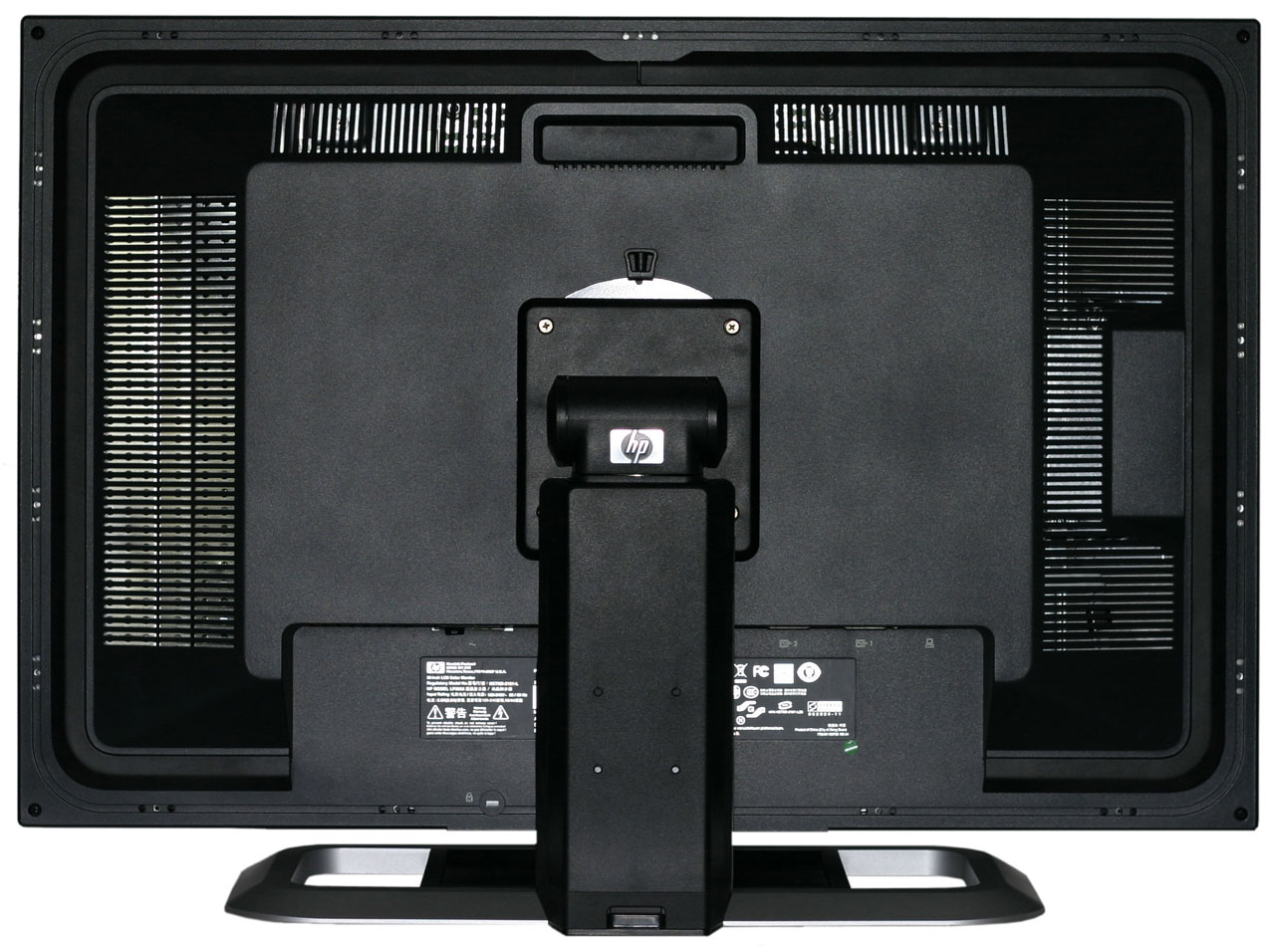
As usual, there's not much to see on the rear of the unit, other than the VESA wall mount and model information/serial number. The input and power connections face the floor, but thanks to the height adjustment and a generous amount of tilt they are reasonably easy to access even after the display has been set up. The base stand feels quite sturdy, which you would expect of something designed to hold a 20+ pound panel. The panel locks into place when you slide it onto the base stand, and in order to remove the panel you have to push the release lever to the left or right. You can also tighten a hex nut to prevent the lever from being moved, effectively locking the panel into place.
Here's another shot of the rear of the unit without the base stand installed. At the top of the display, there's also a pseudo-handle that can be useful when moving the panel around.
Here you can see the left side of the panel showing the tilt mechanism in full swing, ranging from a 5° forward tilt to a 30° backwards tilt. You can also see the four USB ports.
The major difference between the HP LP3065 on the other 30" LCDs on the market is, as previously mentioned, the number of input ports. For most others only include a single dual-link DVI port, HP includes three along with a mechanism to easily select between them.
In terms of controls, there are four buttons on the front of the panel: input select, decrease/increase brightness, and the power button. There is no on-screen display, which is typical of 30" LCDs. We would really like to see a 30" LCD that offered additional inputs (for example, component and VGA support up to 1920x1200 would be great), and the lack of an OSD has also puzzled us. The reason these features are provided is quite simple: there is at present no IC solution that provides for an OSD on 2560x1600 LCDs. That also explains why the single-link mode only functions that one fourth of the native resolution, because all scaling is handled by your graphics card and not by the LCD circuitry.
We have been told that an IC solution is in the works, and it is very likely that we will see future 30" LCDs that support on on-screen display and additional input options, as well as the ability to natively control image scaling. As the majority of people will prefer to run any LCD at its native resolution, such concerns are secondary. Still, it does prevent the 30" LCDs from being able to provide true multifunction support, which is a shame considering a 30" LCD could easily work as an HDTV.
We look forward to seeing future 30" LCDs (and perhaps even larger models) that are capable of supporting additional inputs. Considering the price and the dual-link requirement, we still feel that 24" LCDs are a better choice for most high-end users, and the 19"-22" offerings are great for the midrange and mainstream markets. Even entry level systems generally use 19" LCDs these days, with prices that are only moderately more expensive than the old 17" CRTs. If you are in the market for 30" LCD, however, the HP LP3065 is definitely at the top of the features charts right now.
The overall appearance and design of the LP3065 is similar to what we find with most other 30" LCDs - Apple's Cinema Display being the exception. You get a very large LCD panel with a base stand that supports swivel, tilt, and height adjustment. Rotate/auto rotate are not supported, which is typical of larger LCDs.
 |
 |
| Click to enlarge | |
The case exterior is an industrial black plastic, which ostensibly helps make the display more useful in multi-display environments. Besides, but is generally a neutral coloring for computer parts, and we think the display looks at least as good as any of the other LCDs we've used, from a purely aesthetic viewpoint. The side bezels are reasonably narrow, so if you're interested in setting up a massive multi-display work area (and you have the funds to support it) all you really need is a computer system capable of driving two dual-link outputs.
 |
 |
| Click to enlarge | |
As usual, there's not much to see on the rear of the unit, other than the VESA wall mount and model information/serial number. The input and power connections face the floor, but thanks to the height adjustment and a generous amount of tilt they are reasonably easy to access even after the display has been set up. The base stand feels quite sturdy, which you would expect of something designed to hold a 20+ pound panel. The panel locks into place when you slide it onto the base stand, and in order to remove the panel you have to push the release lever to the left or right. You can also tighten a hex nut to prevent the lever from being moved, effectively locking the panel into place.
 |
| Click to enlarge |
Here's another shot of the rear of the unit without the base stand installed. At the top of the display, there's also a pseudo-handle that can be useful when moving the panel around.
 |
 |
| Click to enlarge | |
Here you can see the left side of the panel showing the tilt mechanism in full swing, ranging from a 5° forward tilt to a 30° backwards tilt. You can also see the four USB ports.
 |
| Click to enlarge |
The major difference between the HP LP3065 on the other 30" LCDs on the market is, as previously mentioned, the number of input ports. For most others only include a single dual-link DVI port, HP includes three along with a mechanism to easily select between them.
In terms of controls, there are four buttons on the front of the panel: input select, decrease/increase brightness, and the power button. There is no on-screen display, which is typical of 30" LCDs. We would really like to see a 30" LCD that offered additional inputs (for example, component and VGA support up to 1920x1200 would be great), and the lack of an OSD has also puzzled us. The reason these features are provided is quite simple: there is at present no IC solution that provides for an OSD on 2560x1600 LCDs. That also explains why the single-link mode only functions that one fourth of the native resolution, because all scaling is handled by your graphics card and not by the LCD circuitry.
We have been told that an IC solution is in the works, and it is very likely that we will see future 30" LCDs that support on on-screen display and additional input options, as well as the ability to natively control image scaling. As the majority of people will prefer to run any LCD at its native resolution, such concerns are secondary. Still, it does prevent the 30" LCDs from being able to provide true multifunction support, which is a shame considering a 30" LCD could easily work as an HDTV.
We look forward to seeing future 30" LCDs (and perhaps even larger models) that are capable of supporting additional inputs. Considering the price and the dual-link requirement, we still feel that 24" LCDs are a better choice for most high-end users, and the 19"-22" offerings are great for the midrange and mainstream markets. Even entry level systems generally use 19" LCDs these days, with prices that are only moderately more expensive than the old 17" CRTs. If you are in the market for 30" LCD, however, the HP LP3065 is definitely at the top of the features charts right now.
Originally published at https://www.anandtech.com/show/2194 (Wayback Machine).