
Intel G965: microATX Performance Update
- Posted in
- CPUs
Power Consumption
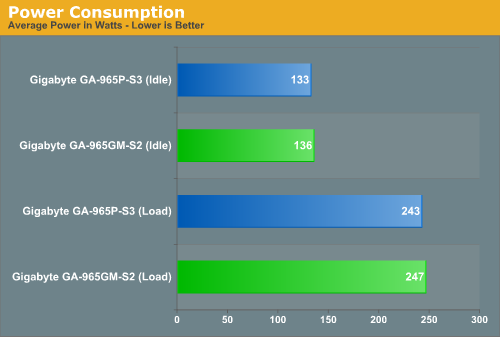
Our power consumption numbers are based on our test setup for this article and each board has C1E/EIST turned off. We will provide additional power and thermal numbers in our µATX roundup articles. The G965 consumes a little more power due to the additional circuitry onboard for the X3000 graphics core but we were surprised the difference was not greater.
Quick Take
Our initial performance results indicate a toss up as to which solution is better. That was to be expected as we have two almost identical boards from a features and BIOS perspective that only differ in their use of chipsets and layout design. Even though the chipsets are different, they are based on the same core logic so any real performance differences would be derived from BIOS tuning, options, and the quality of board components.
While the G965 boards will never overclock as well as their P965 siblings, the base performance is almost identical if you have the ability to tune the board. This is a limitation of the chipset and not the µATX board design. On the AM2 side, we have already seen excellent overclocking results from the abit and DFI µATX boards and expect even better performance with their GeForce 7050 designs next month. Also, the performance differences between AM2 solutions in the µATX and ATX designs mirror our test results on the Intel platform for the most part.
We have a few µATX boards with the G965 chipset that have very limited BIOS options, but even so our initial performance tests only indicate up to a 2% difference in most test results due to the memory timings being the prime differentiator in the scores. In fact, probably the biggest difference we have witnessed in our game tests is 5% between a top tier P965 ATX board that has been tuned and a base level G965 µATX board from Intel utilizing auto settings. Our application tests vary from 1% to 3% in scores at stock CPU settings between the two boards with DDR2-800 memory.
In the end, we feel like your choice of a µATX or ATX solution should be dictated by the requirements of the system (price, features, layout, overclocking, warranty, etc.). The use of an integrated graphics chipset will not inherently reduce performance relative to a discrete graphics chipsets, provided you use identical components. It will be the other aspects - particularly overclocking if that's a concern - that will warrant the use of a discrete graphics chipset rather than an IGP solution.
Originally published at https://www.anandtech.com/show/2192 (Wayback Machine).