
Factory Overclocked 8800 Roundup
- Posted in
- GPUs
Power, Heat and Noise
Aside from performance, the other concerns that follow along with factory overclocked hardware relate to power, heat, and noise. It is important to know if the higher clock speeds will affect any of these aspects of this already demanding technology. We know that Sparkle's Calibre P880+ OC Edition will require more power to run its thermoelectric cooler, but will we get any real benefit out of it? Is EVGA's ACS3 cooling system worth it? First let's look at power draw.
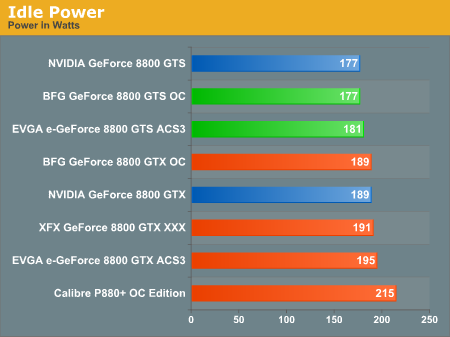
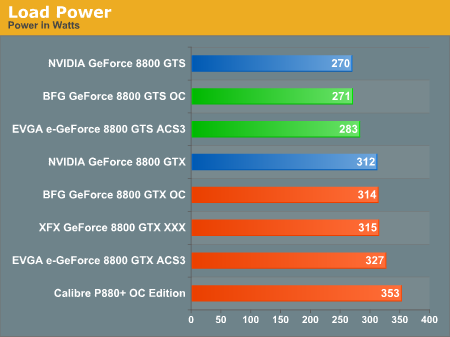
As we would expect, the GTS hardware draws less power than GTX hardware. At idle, there aren't any huge differences with the exception of the Calibre card. This part draws between 20W and 30W more than the other 8800 GTX cards, which seems to be a reasonable amount for moderate thermoelectric cooling. Under load we see similar characteristics. Higher clock speeds do seem to indicate higher power draw, but the difference is not huge.
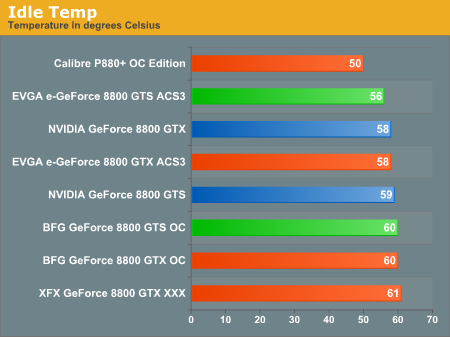
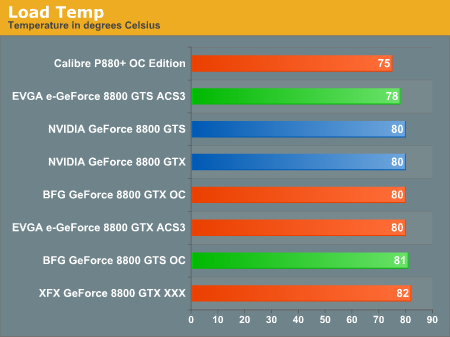
In terms of heat, the Calibre card tops the competition both at idle and under load. This is by far the coolest card of all we tested, although the lower clock speeds likely help. While EVGA's ACS3 system does provide a slight cooling advantage, it isn't huge. The external metal shroud does seem to add a slight benefit, but it seems that the system does more to improve the cool-factor of the cards' appearance rather than physical temperature. At the same time, we are glad to see manufacturers trying new things, and providing a heatspreader on the back of the card is a good move as well.
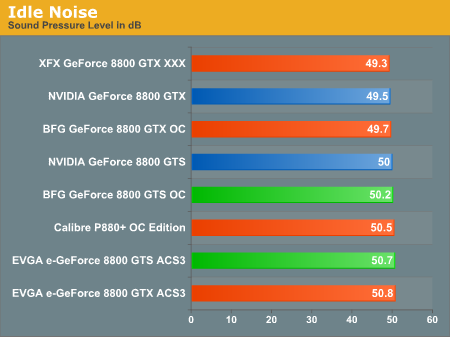
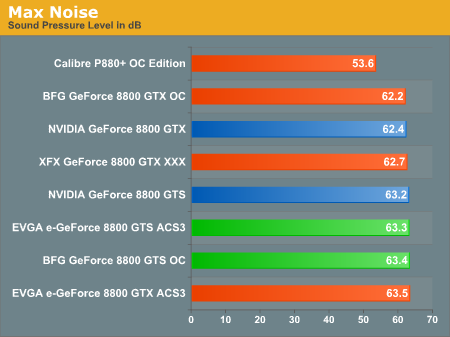
Idle noise was taken after boot, and our max noise number is determined using nTune (or a BIOS flash) to enable the fan to run at full speed at idle. In our environment, fan speed never reached 100% as the card never got hot enough to require it. However, inside a hot case or in a warmer climate, it isn't unreasonable to expect cards to spin all the way up.
At idle, the noise level of most of the cards is within 1 dB of the rest. This means that most of us would be unable to identify an audible difference in volume. Under load, we have nearly the same result, with the clear exception of the Calibre card. With a 10 dB difference, most people would perceive this as at least half the loudness of the other cards. Considering this provides more efficient cooling as well, we are duly impressed with Sparkle's hardware (especially after the poor performance of our early P880+ sample in these areas shortly after the G80 launch).
Aside from performance, the other concerns that follow along with factory overclocked hardware relate to power, heat, and noise. It is important to know if the higher clock speeds will affect any of these aspects of this already demanding technology. We know that Sparkle's Calibre P880+ OC Edition will require more power to run its thermoelectric cooler, but will we get any real benefit out of it? Is EVGA's ACS3 cooling system worth it? First let's look at power draw.
As we would expect, the GTS hardware draws less power than GTX hardware. At idle, there aren't any huge differences with the exception of the Calibre card. This part draws between 20W and 30W more than the other 8800 GTX cards, which seems to be a reasonable amount for moderate thermoelectric cooling. Under load we see similar characteristics. Higher clock speeds do seem to indicate higher power draw, but the difference is not huge.
In terms of heat, the Calibre card tops the competition both at idle and under load. This is by far the coolest card of all we tested, although the lower clock speeds likely help. While EVGA's ACS3 system does provide a slight cooling advantage, it isn't huge. The external metal shroud does seem to add a slight benefit, but it seems that the system does more to improve the cool-factor of the cards' appearance rather than physical temperature. At the same time, we are glad to see manufacturers trying new things, and providing a heatspreader on the back of the card is a good move as well.
Idle noise was taken after boot, and our max noise number is determined using nTune (or a BIOS flash) to enable the fan to run at full speed at idle. In our environment, fan speed never reached 100% as the card never got hot enough to require it. However, inside a hot case or in a warmer climate, it isn't unreasonable to expect cards to spin all the way up.
At idle, the noise level of most of the cards is within 1 dB of the rest. This means that most of us would be unable to identify an audible difference in volume. Under load, we have nearly the same result, with the clear exception of the Calibre card. With a 10 dB difference, most people would perceive this as at least half the loudness of the other cards. Considering this provides more efficient cooling as well, we are duly impressed with Sparkle's hardware (especially after the poor performance of our early P880+ sample in these areas shortly after the G80 launch).
Originally published at https://www.anandtech.com/show/2189 (Wayback Machine).