
Thermalright Ultra 120 Extreme: Is More Better?
- Posted in
- Cases/Cooling/PSUs
Overclocking
In the review of the Thermalright Ultra 120, which matched the 3.90GHz highest overclock of the best tested coolers, we concluded that the maximum stable overclock of this X6800 processor on air was likely 3.90GHz. This looked reasonable considering the dual-fan Scythe Infinity, the Tuniq Tower 120, and the Thermalright Ultra 120 all topped out at 3.90GHz. Other heatpipe towers all topped out below this threshold, with the better coolers very close to the 3.90GHz plateau.
We were wrong. Better air cooling was possible and we are seeing what that cooling can do for overclocking in the performance of the Ultra 120 Extreme. It is all about cooling, and as cooling solutions do a better job of keeping the CPU at a lower temperature, then it is reasonable to expect the overclocking capabilities of the CPU will increase.
In each test of a cooler we measure the highest stable overclock of a standard X6800 processor under the following conditions:
CPU Multiplier: 14x (Stock 11x)
CPU voltage: 1.5875V
FSB Voltage: 1.30V
Memory Voltage: 1.90V
nForce SPP Voltage: 1.35V
nForce MCP Voltage: 1.7V
HT nForce SPP <-> MCP: Auto
Memory is set to Auto timings on the 680i and memory speed is linked to the FSB for the overclocking tests. This removes memory as any kind of impediment to the maximum stable overclock. Linked settings on the 680i are a 1066FSB to a DDR2 memory speed of DDR2-800. As FSB is raised the linked memory speed increases in proportion. The same processor is used in all cooling tests to ensure comparable results.
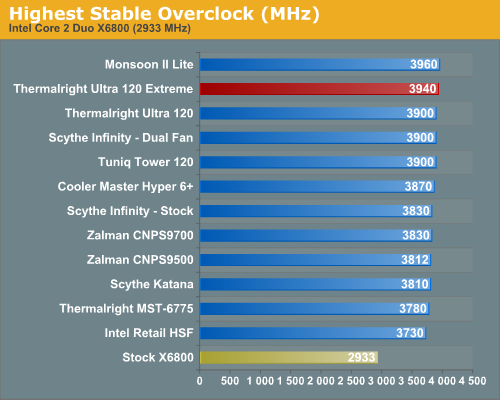
The Thermalright Ultra 120 Extreme with the Scythe S-Flex fan set a new overclocking record by maintaining a stable 3.94GHz. This is the highest stable overclock we have reached with air cooling with this CPU. We could boot at speeds as high as 4.0GHz, but gaming performance was not stable at speeds higher than 3.94GHz. Increasing the CPU voltage also did not increase stability above 3.94GHz, as 1.60V was the maximum voltage usable without generating random reboots of the system.
The best coolers prior to the Ultra 120 Extreme have topped out at 3.90GHz. The 3.94GHz with the Ultra Extreme was something of a surprise, but it proves again that if you move enough air and use enough heatpipes in a good design you can further improve air cooling. Eventually the limit will be reached with air cooling, since it is not an active cooling solution. Air cooling cannot cool lower than the ambient temperature of the room, and it will therefore be outperformed by some active cooling solution like TEC or phase-change cooling. Water cooling is also limited by ambient temperature, but liquid is a better medium for absorbing and releasing the heat produced in CPU cooling. This is also part of the principal used in the design of heatpipes that are proving effective in the current crop of heatpipe towers.
At a 3.94GHz maximum overclock the Thermalright Ultra 120 Extreme is the best air cooler we have tested at AnandTech. It is clear Thermalright knew what they were doing in modifying the Ultra 120 design with additional heatpipes.
In the review of the Thermalright Ultra 120, which matched the 3.90GHz highest overclock of the best tested coolers, we concluded that the maximum stable overclock of this X6800 processor on air was likely 3.90GHz. This looked reasonable considering the dual-fan Scythe Infinity, the Tuniq Tower 120, and the Thermalright Ultra 120 all topped out at 3.90GHz. Other heatpipe towers all topped out below this threshold, with the better coolers very close to the 3.90GHz plateau.
We were wrong. Better air cooling was possible and we are seeing what that cooling can do for overclocking in the performance of the Ultra 120 Extreme. It is all about cooling, and as cooling solutions do a better job of keeping the CPU at a lower temperature, then it is reasonable to expect the overclocking capabilities of the CPU will increase.
In each test of a cooler we measure the highest stable overclock of a standard X6800 processor under the following conditions:
CPU Multiplier: 14x (Stock 11x)
CPU voltage: 1.5875V
FSB Voltage: 1.30V
Memory Voltage: 1.90V
nForce SPP Voltage: 1.35V
nForce MCP Voltage: 1.7V
HT nForce SPP <-> MCP: Auto
Memory is set to Auto timings on the 680i and memory speed is linked to the FSB for the overclocking tests. This removes memory as any kind of impediment to the maximum stable overclock. Linked settings on the 680i are a 1066FSB to a DDR2 memory speed of DDR2-800. As FSB is raised the linked memory speed increases in proportion. The same processor is used in all cooling tests to ensure comparable results.
The Thermalright Ultra 120 Extreme with the Scythe S-Flex fan set a new overclocking record by maintaining a stable 3.94GHz. This is the highest stable overclock we have reached with air cooling with this CPU. We could boot at speeds as high as 4.0GHz, but gaming performance was not stable at speeds higher than 3.94GHz. Increasing the CPU voltage also did not increase stability above 3.94GHz, as 1.60V was the maximum voltage usable without generating random reboots of the system.
The best coolers prior to the Ultra 120 Extreme have topped out at 3.90GHz. The 3.94GHz with the Ultra Extreme was something of a surprise, but it proves again that if you move enough air and use enough heatpipes in a good design you can further improve air cooling. Eventually the limit will be reached with air cooling, since it is not an active cooling solution. Air cooling cannot cool lower than the ambient temperature of the room, and it will therefore be outperformed by some active cooling solution like TEC or phase-change cooling. Water cooling is also limited by ambient temperature, but liquid is a better medium for absorbing and releasing the heat produced in CPU cooling. This is also part of the principal used in the design of heatpipes that are proving effective in the current crop of heatpipe towers.
At a 3.94GHz maximum overclock the Thermalright Ultra 120 Extreme is the best air cooler we have tested at AnandTech. It is clear Thermalright knew what they were doing in modifying the Ultra 120 design with additional heatpipes.
Originally published at https://www.anandtech.com/show/2187 (Wayback Machine).