
AMD 690G: Performance Review
- Posted in
- CPUs
Audio Encoding Performance
While the media encoding prowess of the Intel platform seemed to be lacking at times, we expect it to fair a little better on the audio side. Our audio test suite normally consists of Exact Audio Copy v095.b4 and LAME 3.98a3. We did run these tests with basically the same results but for our purposes today we will utilize iTunes 7.1 as it is one of the most utilized audio applications available due to the immense popularity of the iPod.
Our first task was to figure out what test CD to utilize. We needed one that contained a significant number of tracks and had over 600MB of data in order to properly stress our platforms. After rummaging around the lab and discounting the Burl Ives Greatest Christmas Hits album, we happened upon a CD that would work for our purposes as it was not working for anyone else, INXS Greatest Hits. This one time '80s glory masterpiece contains 16 tracks totaling 606MB of songs that was instantly whisked into our anxiously awaiting optical drive.
Our first test consists of utilizing iTunes to rip our INXS CD to WAV format on our hard drive. Even though CPU speed and optical drive selection have a great impact on these test results we are using the same optical drive between platforms for each test.
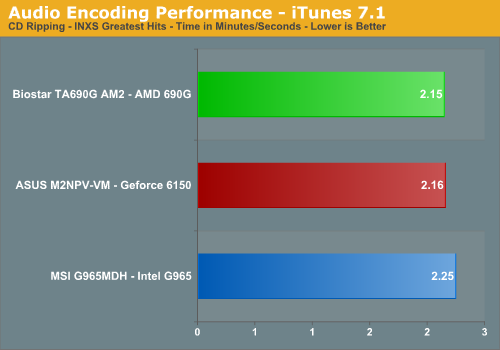
Our two AM2 platforms score slightly ahead of our Intel setup but the margin is minimal. This test was very consistent with each result never varying more than one second from the base score. Unlike the Nero Recode 2 DVD burning test, in this case our AMD systems did not suffer from drive issues.
Our next two tests have us utilizing iTunes to convert our WAV files into ACC or MP3 compatible formats. We utilize the 320kbps setting for both tests with the MP3 test also utilizing the variable bit rate option.
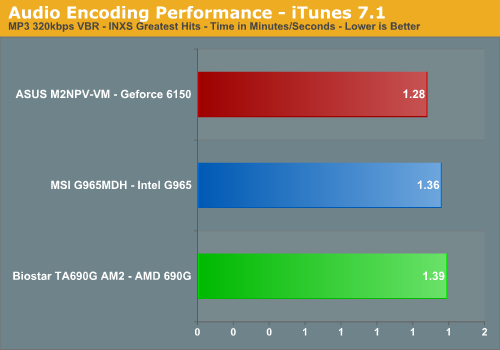
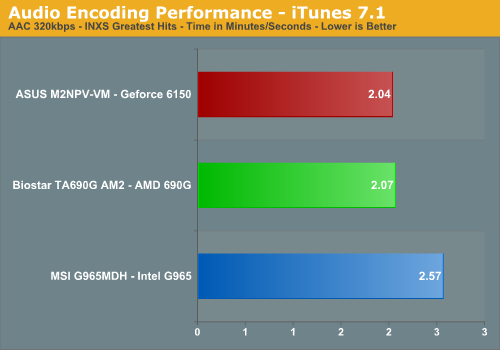
We usually see iTunes favoring the AM2 platforms in most test results. The results are no different here with both AM2 systems completing the ACC conversion about 50 seconds before the Intel system. In our MP3 conversion, the Intel system places second but the general differences are minimal. We attribute the 6150 performance to better storage controller and CPU throughput although standard memory bandwidth is lower than the other two boards.
Our final test has us creating a legal use copy CD from the base WAV files we collected when ripping the INXS Greatest Hits CD. Not that the world needs anymore of these CDs but it makes for a good closing test. We promise all CDs are destroyed after testing (much to the pleasure of our ears and those at the RIAA).
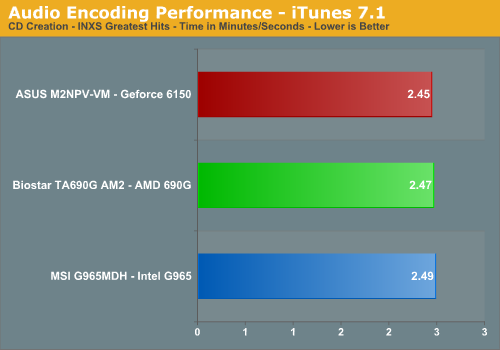
Once again our test results are extremely close with the optical drive playing a leading role in ensuring our results are fairly close. The minor differences are all attributable to the better disk performance of the NIVIDA 6150/430 combination in this case. We noticed each time that the disk access stopped about two to three seconds quicker with the 6150 platform. This is opposite of our Video Encoding results where each of our AM2 platforms could not keep the optical drive fed properly over the course of a burn session.
While the media encoding prowess of the Intel platform seemed to be lacking at times, we expect it to fair a little better on the audio side. Our audio test suite normally consists of Exact Audio Copy v095.b4 and LAME 3.98a3. We did run these tests with basically the same results but for our purposes today we will utilize iTunes 7.1 as it is one of the most utilized audio applications available due to the immense popularity of the iPod.
Our first task was to figure out what test CD to utilize. We needed one that contained a significant number of tracks and had over 600MB of data in order to properly stress our platforms. After rummaging around the lab and discounting the Burl Ives Greatest Christmas Hits album, we happened upon a CD that would work for our purposes as it was not working for anyone else, INXS Greatest Hits. This one time '80s glory masterpiece contains 16 tracks totaling 606MB of songs that was instantly whisked into our anxiously awaiting optical drive.
Our first test consists of utilizing iTunes to rip our INXS CD to WAV format on our hard drive. Even though CPU speed and optical drive selection have a great impact on these test results we are using the same optical drive between platforms for each test.
Our two AM2 platforms score slightly ahead of our Intel setup but the margin is minimal. This test was very consistent with each result never varying more than one second from the base score. Unlike the Nero Recode 2 DVD burning test, in this case our AMD systems did not suffer from drive issues.
Our next two tests have us utilizing iTunes to convert our WAV files into ACC or MP3 compatible formats. We utilize the 320kbps setting for both tests with the MP3 test also utilizing the variable bit rate option.
We usually see iTunes favoring the AM2 platforms in most test results. The results are no different here with both AM2 systems completing the ACC conversion about 50 seconds before the Intel system. In our MP3 conversion, the Intel system places second but the general differences are minimal. We attribute the 6150 performance to better storage controller and CPU throughput although standard memory bandwidth is lower than the other two boards.
Our final test has us creating a legal use copy CD from the base WAV files we collected when ripping the INXS Greatest Hits CD. Not that the world needs anymore of these CDs but it makes for a good closing test. We promise all CDs are destroyed after testing (much to the pleasure of our ears and those at the RIAA).
Once again our test results are extremely close with the optical drive playing a leading role in ensuring our results are fairly close. The minor differences are all attributable to the better disk performance of the NIVIDA 6150/430 combination in this case. We noticed each time that the disk access stopped about two to three seconds quicker with the 6150 platform. This is opposite of our Video Encoding results where each of our AM2 platforms could not keep the optical drive fed properly over the course of a burn session.
Originally published at https://www.anandtech.com/show/2186 (Wayback Machine).