
Western Digital WD740ADFD: Bottled Lightning
- Posted in
- Storage
iPeak Video/Audio Tests
The iPeak based Video/Audio benchmarks are designed around simulating media encoding and HTPC activities. These are basic benchmarks at this time as this section will be expanded once we start testing under Vista. Our change to a dual core processor will assist us in maintaining a balance between the CPU and Storage systems during the trace file creation and benchmarking processes. These benchmarks are CPU intensive in nature but also require a balanced storage system with the ability to handle read and write requests simultaneously in a very efficient manner.
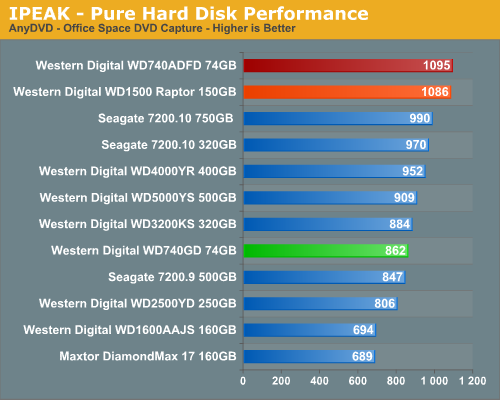
The AnyDVD benchmark is heavily weighted to write requests with the results showing a common pattern with the two 16MB cache Raptors finishing first and second and the WD740ADFD once again showing its strength in the write intensive benchmarks. However, we found the WD740GD was constantly pausing during writes due to the smaller cache size, and we witnessed buffer overruns on the large file sizes included in this test. Even with the pauses, its superior transfer rates still kept the drive ahead of the other 8MB cache drives in this benchmark.
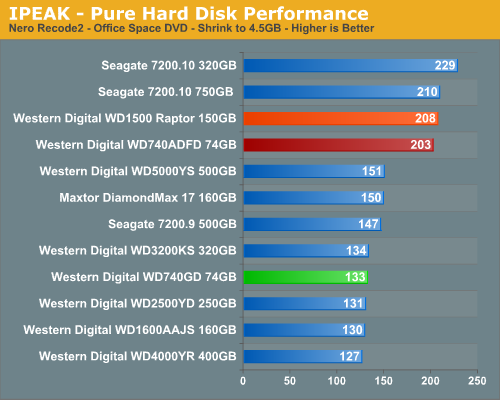
The Nero Recode 2 benchmark is weighted to streaming read requests but is balanced by continuous write operations near the end of the test. This benchmark is one of the most demanding ones in our test suite with the disk being active the entire trace file with several 100% utilization peaks. The two 16MB cache Raptors finish near the top with the WD740GD 8MB cache drive placing near the bottom. Upon reviewing the trace file results it was obvious that the WD740GD was hampered by its smaller cache and lower sustained transfer rates as it had a significant number of buffer overruns during testing.
iPeak Game Installation Tests
Our iPeak based Game Installation benchmarks simply show the ability of the hard drive to write data as quickly as possible to the disc based upon the installation software instructions. As detailed in our iPeak setup description we installed the games from our source drive in order to eliminate the optical drive bottleneck. In separate application timing we witnessed basically the same percentage spread when installing the games via our DVD drive so these results are representative of actual installation performance.
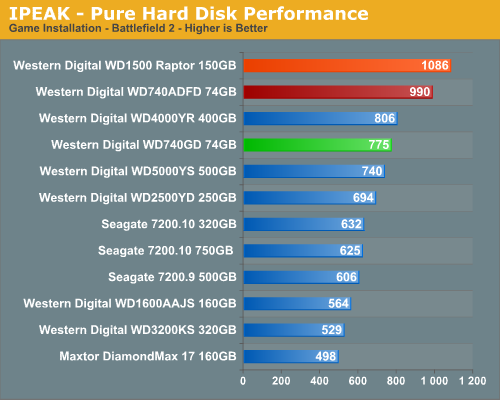
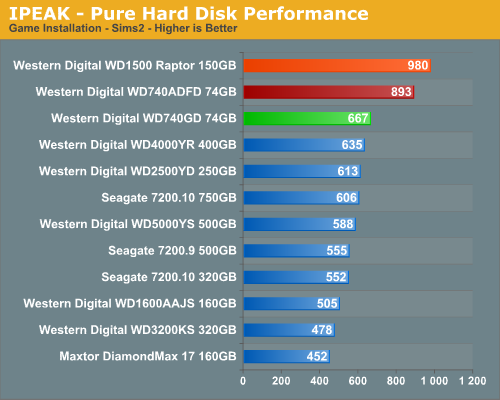
The Raptors once again finish at or near the top in our gaming tests although we expected the WD740ADFD to finish closer to the WD1500ADFD due to the amount of write operations involved in the game installations. A review of the trace files did not indicate any real standout issues with the 74GB drive, although we noticed several minor dips when the drive was reading information off the source drive. This did not occur with the 150GB Raptor.
We need to remember these tests reflect pure hard drive performance and will be mitigated by the overall system platform as we will see in our application tests. These tests are basically designed around continual read/write requests that favor large cache sizes, properly tuned firmware, and high sustained transfer rates.
iPeak Game Play Tests
The iPeak based Game Play tests are centered on the benefits of having a hard disk that can load non-linear or sequential data files quickly without interrupting the flow of the game.
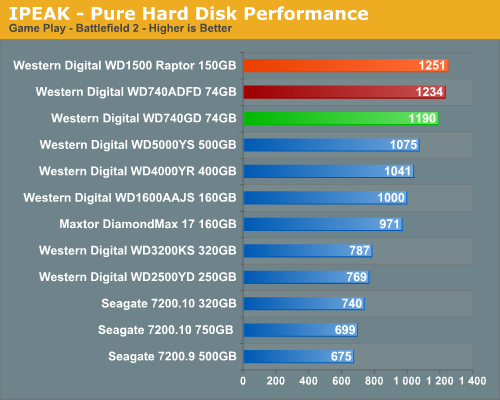
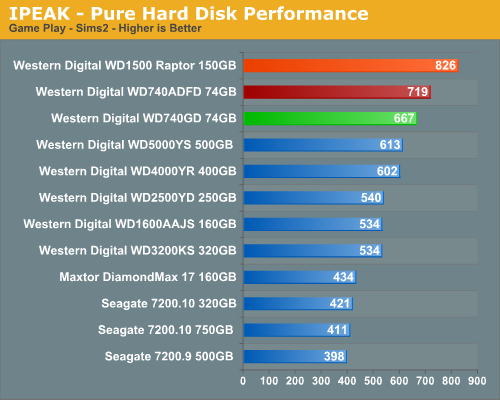
When it comes to gaming the Raptors rule. All three Raptors place in the top three spots with the two 16MB cache versions finishing one and two once again. Although we are looking at pure performance results, in subjective testing the Raptor family of drives could always be identified when loading or playing a game. Although the capacities of the drives are small, if you want the best overall gaming performance in a drive with a SATA interface then your only choice are the Raptors.
The iPeak based Video/Audio benchmarks are designed around simulating media encoding and HTPC activities. These are basic benchmarks at this time as this section will be expanded once we start testing under Vista. Our change to a dual core processor will assist us in maintaining a balance between the CPU and Storage systems during the trace file creation and benchmarking processes. These benchmarks are CPU intensive in nature but also require a balanced storage system with the ability to handle read and write requests simultaneously in a very efficient manner.
The AnyDVD benchmark is heavily weighted to write requests with the results showing a common pattern with the two 16MB cache Raptors finishing first and second and the WD740ADFD once again showing its strength in the write intensive benchmarks. However, we found the WD740GD was constantly pausing during writes due to the smaller cache size, and we witnessed buffer overruns on the large file sizes included in this test. Even with the pauses, its superior transfer rates still kept the drive ahead of the other 8MB cache drives in this benchmark.
The Nero Recode 2 benchmark is weighted to streaming read requests but is balanced by continuous write operations near the end of the test. This benchmark is one of the most demanding ones in our test suite with the disk being active the entire trace file with several 100% utilization peaks. The two 16MB cache Raptors finish near the top with the WD740GD 8MB cache drive placing near the bottom. Upon reviewing the trace file results it was obvious that the WD740GD was hampered by its smaller cache and lower sustained transfer rates as it had a significant number of buffer overruns during testing.
iPeak Game Installation Tests
Our iPeak based Game Installation benchmarks simply show the ability of the hard drive to write data as quickly as possible to the disc based upon the installation software instructions. As detailed in our iPeak setup description we installed the games from our source drive in order to eliminate the optical drive bottleneck. In separate application timing we witnessed basically the same percentage spread when installing the games via our DVD drive so these results are representative of actual installation performance.
The Raptors once again finish at or near the top in our gaming tests although we expected the WD740ADFD to finish closer to the WD1500ADFD due to the amount of write operations involved in the game installations. A review of the trace files did not indicate any real standout issues with the 74GB drive, although we noticed several minor dips when the drive was reading information off the source drive. This did not occur with the 150GB Raptor.
We need to remember these tests reflect pure hard drive performance and will be mitigated by the overall system platform as we will see in our application tests. These tests are basically designed around continual read/write requests that favor large cache sizes, properly tuned firmware, and high sustained transfer rates.
iPeak Game Play Tests
The iPeak based Game Play tests are centered on the benefits of having a hard disk that can load non-linear or sequential data files quickly without interrupting the flow of the game.
When it comes to gaming the Raptors rule. All three Raptors place in the top three spots with the two 16MB cache versions finishing one and two once again. Although we are looking at pure performance results, in subjective testing the Raptor family of drives could always be identified when loading or playing a game. Although the capacities of the drives are small, if you want the best overall gaming performance in a drive with a SATA interface then your only choice are the Raptors.
Originally published at https://www.anandtech.com/show/2167 (Wayback Machine).