
Intel Demonstrates new 45nm Transistors and Conroe's Successor
- Posted in
- CPUs
Yields and Manufacturing
Intel is sharing its usual vague data on yields at 45nm, but at least this time we get pretty good reference points to previous manufacturing processes. The graph below shows defect density as a function of time; you should keep in mind that processors generally don't start shipping until the very bottom of these curves in order to make the economics work for the CPU maker.
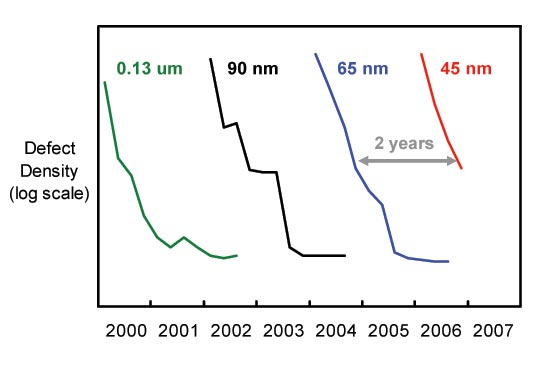
As you can see, 45nm is on a curve very similar to that of Intel's 65nm process, which means that things are on track for a smooth introduction later this year barring any unforeseen issues.
Intel attributed the rough patches in the 90nm trend to difficulty associated with building the first strained silicon transistors and using low-k interconnect dielectrics. By comparison, 65nm and 45nm appear to be much smoother sailing.
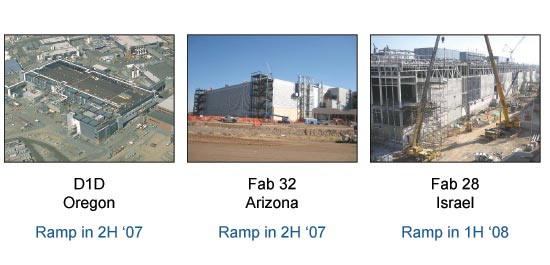
By the end of this year the first 45nm chips will be built at two 300mm Intel fabs: D1D in Oregon and Fab 32 in Arizona. Starting in the first half of 2008, Fab 28 in Israel will begin producing 45nm parts and should reach full capacity by the end of the year.
Final Words
It's very rare to get this much information out of Intel this far in advance of an actual product launch, but we're not complaining. By the middle of this year, AMD will launch its next-generation microarchitecture that will hopefully be a far better competitor to Intel's Core 2 processors. But before the year is out, Intel will respond yet again with its Penryn family of processors. We're unsure exactly what segments will be targeted first with Penryn, but by sometime in 2008 you should be able to get Penryn based notebooks, desktops and servers.
The inevitable comparison to AMD's progress on 45nm has to be made, but at this point we don't know too much. AMD revealed its 45nm SRAM test vehicle about three months after Intel did last year, with a slightly larger SRAM cell size (0.370 um^2 vs. 0.346 um^2 for Intel). The main focus for AMD at this point is the transition to 65nm; we're finally starting to see Brisbane cores available for purchase, but the highest clock speed offerings are still built on 90nm.
For Intel, we see continued strengthening and a roadmap that has a lot of promise. Penryn should be out sometime in the second half of this year, followed by a brand new architecture under the codename Nehalem. Nehalem will also be the first time we get to see an architecture change post-Core 2 under Intel's new tick-tock model of introducing new architectures every two years. It's quite possible that in the next two years Intel will have made the CPU industry far more exciting than it has been in the previous five (Core 2 launch withstanding).
Originally published at https://www.anandtech.com/show/2161 (Wayback Machine).