
Value Cooling: Two Towers for under $30
- Posted in
- Cases/Cooling/PSUs
Overclocking
When cooling solutions do a better job of keeping the CPU at a lower temperature, it is reasonable to expect the overclocking capabilities of the CPU will increase. In each test of a cooler we measure the highest stable overclock of our standard X6800 processor under the following conditions:
Memory is set to Auto timings on the 680i and memory speed is linked to the FSB for the overclocking tests. This removes memory as any kind of impediment to the maximum stable overclock. Linked settings on the 680i are a 1066FSB to a DDR2 memory speed of DDR2-800. As FSB is raised the linked memory speed increases in proportion. The same processor is used in all cooling tests to ensure comparable results.
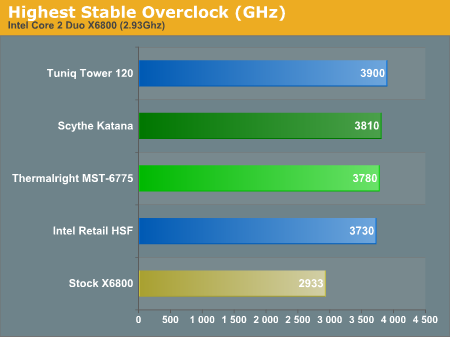
Both the Thermalright MST-9775 and the Scythe Katana enable higher overclocks than the stock Intel cooler. Neither of the coolers under test, however, comes close to the overclocking performance of the Tuniq Tower 120. Where the stock cooler reached 3.73GHz with this CPU, the Thermalright extends this to 3.78GHz, the Scythe Katana allows a stable 3.81GHz, and the same processor reached a stable 3.90GHz with the Tuniq Tower.
When cooling solutions do a better job of keeping the CPU at a lower temperature, it is reasonable to expect the overclocking capabilities of the CPU will increase. In each test of a cooler we measure the highest stable overclock of our standard X6800 processor under the following conditions:
CPU Multiplier: 14x (Stock 11x)
CPU voltage: 1.5875V
FSB Voltage: 1.30V
Memory Voltage: 2.20V
nForce SPP Voltage: 1.5V
nForce MCP Voltage: 1.7V
HT nForce SPP <-> MCP: Auto
Memory is set to Auto timings on the 680i and memory speed is linked to the FSB for the overclocking tests. This removes memory as any kind of impediment to the maximum stable overclock. Linked settings on the 680i are a 1066FSB to a DDR2 memory speed of DDR2-800. As FSB is raised the linked memory speed increases in proportion. The same processor is used in all cooling tests to ensure comparable results.
Both the Thermalright MST-9775 and the Scythe Katana enable higher overclocks than the stock Intel cooler. Neither of the coolers under test, however, comes close to the overclocking performance of the Tuniq Tower 120. Where the stock cooler reached 3.73GHz with this CPU, the Thermalright extends this to 3.78GHz, the Scythe Katana allows a stable 3.81GHz, and the same processor reached a stable 3.90GHz with the Tuniq Tower.
Originally published at https://www.anandtech.com/show/2158 (Wayback Machine).