
CES 2007 - Part II: IPTV on Xbox 360, iPhone and DTX
- Posted in
- Trade Shows
AMD’s DTX Form Factor
As we talk about convergence and the future of the two combined industries, it's far too easy just to focus on the CE side of things - after all, gadgets tend to look cooler than the parts that make them up. That being said, today's story isn't all about cell phones and streaming video.
An unexpected announcement at CES was AMD’s commitment to develop a new open standard for small form factor computers: DTX. One of the major reasons for AMD's acquisition of ATI was to get into the consumer electronics business, which ATI happened to be reasonably successful in thanks to its DTV chips and console GPU designs. The intent to develop a new small form factor specification fits very well with AMD's desire to break into the CE market, as CE devices don't tend to be in large ATX cases.
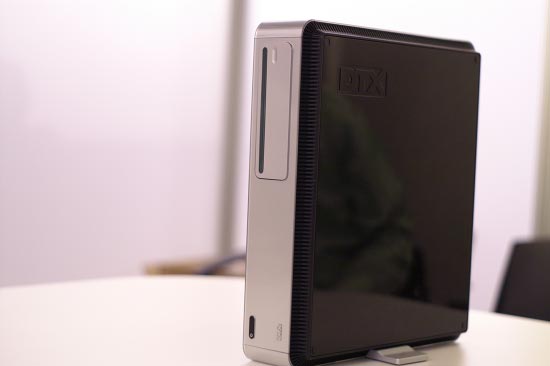
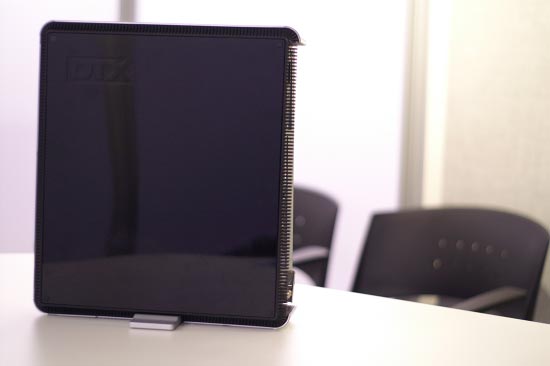
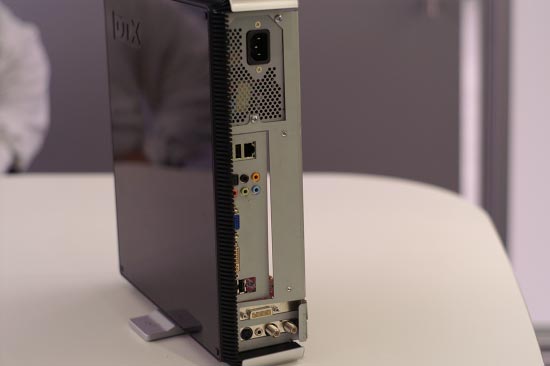
AMD's DTX demonstration chassis
If this sort of announcement sounds familiar at all, it’s because Intel tried to do the very same thing with BTX not too long ago. For years it seemed as though a small form factor standard for PCs was inevitable; we were seeing many proprietary form factors enter the marketplace to fill a very large void left by ATX. Companies like Shuttle profited tremendously from the lack of a small form factor standard as they were able to deliver cases and motherboards that were significantly smaller than anything you could get with ATX. But even during the earliest days of proprietary SFF systems, it was clear that a standard was needed.
The entire PC industry as we now know it was built upon standards, so consumers would have choice in their components, not to mention a guaranteed upgrade path. If you bought a proprietary SFF system, you were married to the motherboard you bought with the system; if you wanted an upgrade, you needed to buy a new SFF. It’s a great business proposition for the manufacturers, but not so great for the consumers.
Intel introduced the BTX specification and its three variants (standard, micro-BTX and pico-BTX) back in 2003, but since then there has been limited acceptance of the standard. Motherboard and chassis manufacturers were extremely slow to adopt the BTX spec, eventually pulling virtually all support for the standard. AMD on the other hand was fairly adamant about why it never really embraced BTX; AMD insisted that BTX was created first to cope with the rising power demands of Intel’s Pentium 4 line of processors, and only address the need for small form factor PCs as a secondary goal. While we’ve seen one AMD BTX board on display, the vast majority of BTX motherboards were Intel-only.
Interest in BTX has faded considerably over the past four years, particularly in the channel market. Even Intel's own motherboard lineup will phase out BTX support starting in Q2 of this year. Instead of throwing its weight behind a failed standard, AMD set out to create a new small form factor specification with the help of its partners.
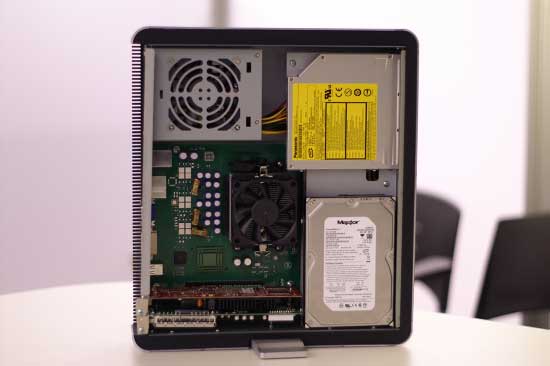
A DTX mockup
AMD doesn’t intend DTX to replace ATX, but rather supplement it for manufacturers and consumers interested in a smaller form factor. DTX will use the same standoff hole pattern as ATX, so DTX motherboards will work in ATX cases. Going one step further, mini-ITX motherboards will work in DTX cases, which will help leverage one of the more popular form factors in the SFF marketplace. There's also a mini-DTX specification that AMD is working towards developing for even smaller form factor applications.
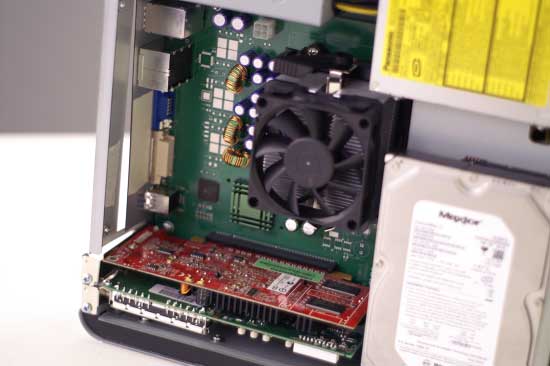
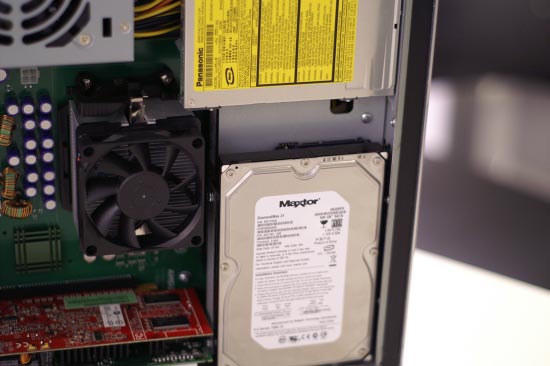
Note the use of half-height expansion cards, and fairly low profile CPU heatsink
AMD plans on having the initial draft of its DTX specification ready sometime this quarter, although we didn’t get any solid details at the show itself. AMD did mention that the DTX specification would be designed for CPUs with a TDP less than or equal to 65W, which happens to be the TDP for all of AMD's newly announced 65nm CPUs.
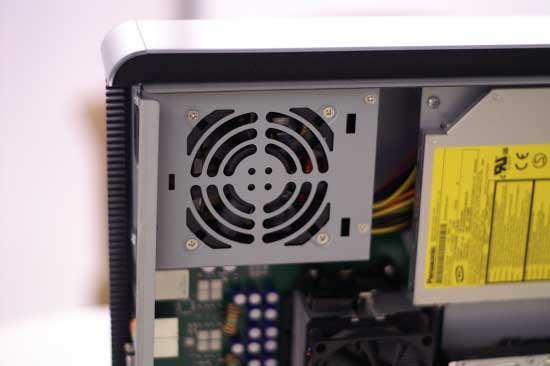
We asked AMD why it would bother with a new standard when a small form factor standard already existed with BTX, but we weren't able to get a satisfactory answer other than the usual company line of: BTX was designed to fix an Intel thermal problem, DTX is an open standard for small form factor PCs.
Despite the me-too approach that AMD appears to be taking with DTX, it's already looking to have a higher potential for success based on the simple fact that you can use DTX motherboards in ATX cases. By not having to create two different motherboards, supporting DTX from a manufacturer's standpoint is far less of a risk. The real question is whether or not AMD will be able to put enough resources behind DTX to make it a widely accepted industry standard.
Originally published at https://www.anandtech.com/show/2153 (Wayback Machine).