
CES 2007 - Part II: IPTV on Xbox 360, iPhone and DTX
- Posted in
- Trade Shows
Apple's Approach
We've seen Microsoft's approach, but what about its biggest threats? A few pieces of the Sony puzzle have been unveiled over the previous months, although honestly it doesn't seem very well assembled at this point. The PlayStation 3 does have an online service, but it isn't what Xbox Live is (not yet at least). We previewed Sony's Bravia Internet Video Link in our earlier CES coverage, but the device is fairly limited in the type of content you can stream to your TV - only allowing selected content from a handful of web portals.
Given the pressure Apple has put on Microsoft (not with marketshare, but with featureset), it isn't surprising to see competition from the industrial designers in Cupertino. The goal again is to be able to stream content from your computer, in this case a Mac, to virtually any other device in the home - starting with the TV.
Apple already has the MP3 player market with its iPod, which can play both audio and video content. And the recently introduced iPhone addresses much of the same market as the iPhone in terms of being able to take your content with you wherever you go. Apple's main limitation however is that it has no competitor to Microsoft's Media Center, television in its conventional form remains untapped for the company. Thus Apple's strategy has to change a bit and instead of attempting to produce a product that will record and archive cable TV broadcasts, Apple leveraged one of its most successful products to date: the iTunes Store.
For Apple, the iTS is the closest thing it has to an IPTV network; you can download the TV shows and movies you want and watch them on your Mac or iPod. Obviously there are limitations, as not every show you want to watch is available in the iTS and you don't get to download the shows the minute they air, but it's the only option for Apple currently. You could even view Apple's iTS as the first DRM enabled (aka legal) a la carte cable solution, that just happens to be available over the Internet. In theory if all you watched were a handful of shows, that were all available on the iTS then you wouldn't need cable, just pay for the shows you watch and you're set.
While we're not sure about the number of users that actually use the iTS as a cable TV replacement, it's clearly a big part of Apple's vision and the only way it can compete as you're not going to see an Apple IPTV solution anytime soon. The problem is that until now, there's been no good way of getting all of this content you've bought off the iTS onto your TV. Enter Apple TV.
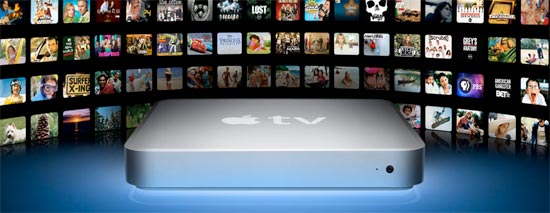
The Apple TV product is designed to bridge the last gap between your content and your TV, taking content stored on your Mac and streaming it to your TV. It's Apple's entry into the living room, as it doesn't have a gaming console or other device that naturally resides there like Microsoft at this point.
Apple TV is merely Apple's attempt at a digital media extender, similar to what we've seen from so many other companies. The difference here is that Apple not only makes the hardware, but also provides the software and service that people use to obtain the content being streamed. As such Apple TV appears to be best tailored to Mac or PC users that happen to get a lot of their audio and video content off of iTunes. The unit itself is limited in the type of content it will decode, and pirated DivX movies aren't on the short list; as such, Apple TV's success will be among a very particular group of users.
We wouldn't expect the growth rate of Apple's TV product to be incredibly fast and without support from the enthusiast community (which would undoubtedly support a product if it offered greater flexibility in what sort of content it would stream), we're not sure where the product will end up in the long term. Apple does have a long list of products that were good ideas but never grew to iPod popularity levels, and at least in its first iteration the Apple TV may be no different. Long term success aside, looking at Apple TV as a piece of the larger digital home puzzle you can see that Apple recognizes the same thing Microsoft does - it needs a box in the living room and it needs a way of getting content from your PC (or Mac in this case) to that box.
Originally published at https://www.anandtech.com/show/2153 (Wayback Machine).