
The AMD Ryzen AI 9 HX 370 Review: Unleashing Zen 5 and RDNA 3.5 Into Notebooks
Core-to-Core Latency: Zen 5 Strix Point Vs. Zen 4 Phoenix Point
As the core count of modern CPUs is growing, we are reaching a time when the time to access each core from a different core is no longer a constant. Even before the advent of heterogeneous SoC designs, processors built on large rings or meshes can have different latencies to access the nearest core compared to the furthest core. This rings true especially in multi-socket server environments.
But modern CPUs, even desktop and consumer CPUs, can have variable access latency to get to another core. For example, in the first generation Threadripper CPUs, we had four chips on the package, each with 8 threads, and each with a different core-to-core latency depending on if it was on-die or off-die. This gets more complex with products like Lakefield, which has two different communication buses depending on which core is talking to which.
If you are a regular reader of AnandTech’s CPU reviews, you will recognize our Core-to-Core latency test. It’s a great way to show exactly how groups of cores are laid out on the silicon. This is a custom in-house test, and we know there are competing tests out there, but we feel ours is the most accurate to how quick an access between two cores can happen.
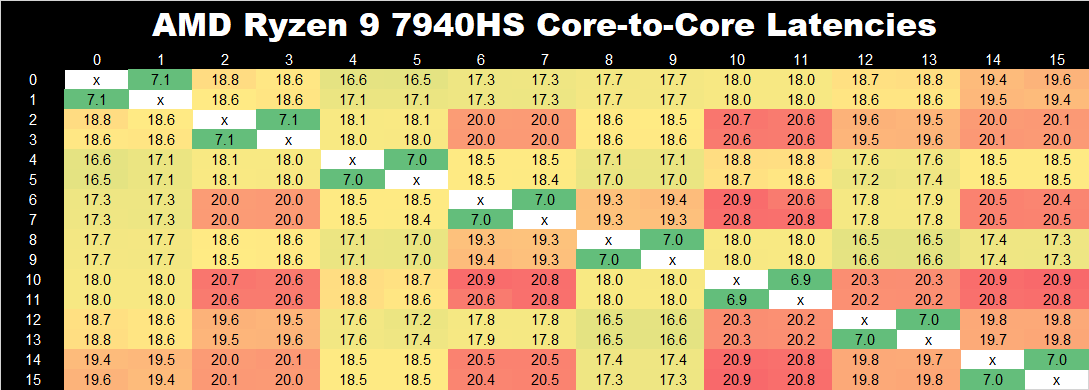
In this core-to-core latency analysis, we'll be comparing the AMD Ryzen AI 9 HX 370, which uses a combination of full-size Zen 5 cores with the more compact Zen 5c cores, directly to its predecessor, the Zen 4 Ryzen 9 7940HS.
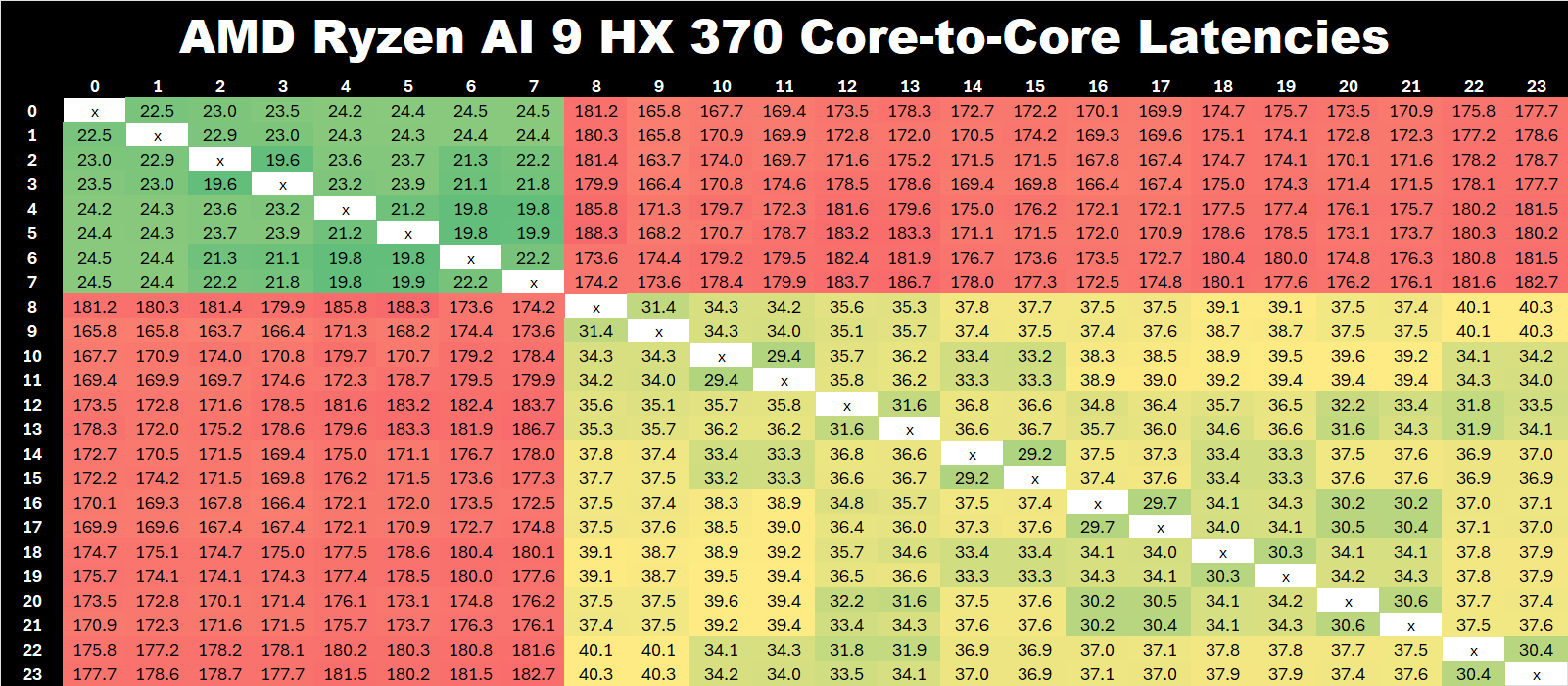
Looking at the core-to-core latencies of the AMD Ryzen AI 9 HX 370, we can see that AMD has changed the core structure from previous generations. AMD, for Strix Point, has restructured the core architecture compared to what we've seen on Zen 4 (Phoenix Point), with the full-sized Zen 5 cores and the smaller Zen 5 cores being placed on separate core complexes. This change in the fundamental architecture of previous generations does impact latency regarding the efficiency of inter-core communication.
Although on a separate CCX from the full-sized Zen 5 cores, the compact Zen 5c cores are present on the same die. Observing the inter-core latencies of the full-sized Zen 5 cores, which are shown as cores 0-7 in the above chart, range from 19.6 ns to 24.5 ns, which shows that the Zen 5 cores are communicating efficiently with each other on the core complex.
Communicating outside of the Zen 5 cluster and contacting the Zen 5c cores, the latency inherently increases to between 163.7 and 188.7 ns, which shows a significant latency penalty and much more than we anticipated. This can have a negative impact on workloads that potentially require frequent cross-cluster data exchanges. The Zen 5c cluster itself within the complex has higher latencies per each L1 access point, which shows there's an overhead within the pathway when communicating cross-cluster.
Having multiple clusters of cores on the same die does pose significant penalties across the longer pathways, especially when hopping out of the cluster to contact cores on the other. The latencies vary massively depending on the length of the pathway. Each cluster (Zen 5 + Zen 5c) operates efficiently on its own and poses an added level of complexity, but it is more of a trade-off when using multiple core clusters on a single package.
Originally published at https://www.anandtech.com/show/21485/the-amd-ryzen-ai-hx-370-review (Wayback Machine).