
Corsair Dominator DDR2-1111: Dual-Path Cooling Pushes Performance
- Posted in
- Memory
Overclocking Performance (Highest Speed)
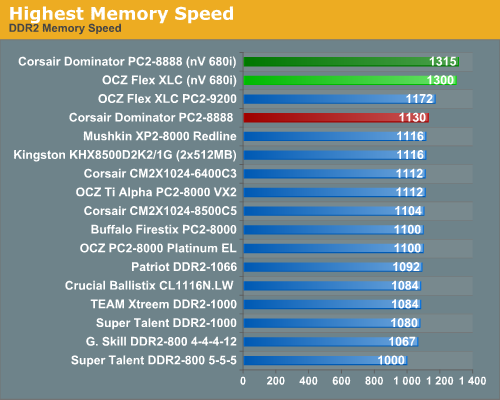
The Corsair Dominator PC2-8888 is rated at DDR2-1111 4-4-4-12, and we managed to reach that performance level on the ASUS P5W-DH Deluxe. As we've said before, the ratios on the ASUS 975X board are very demanding, and the earlier Dominator 1142 did not do nearly as well on this board. Top speed for the Corsair Dominator PC2-8888 was DDR2-1130, which is not much of an overclock going from 4-4-4 timings to 5-5-5 timings on the 975X. In fact OCZ Flex XLC managed to reach 1172 on this same board, but it is the only memory we have tested that performed better than the Dominator 1111 on this board.
With Dominator doing so well at 4-4-4 timings, it is probably best to only go to FSB speeds that Dominator can handle at 4-4-4 timings. Sticking to 4-4-4 timings will likely give you the best performance possible with this outstanding memory.
The Corsair Dominator on the NVIDIA 680i behaved like an entirely different memory, reaching much higher performance levels and overclocks than could be achieved on the P5W-DH. On the 680i the Dominator reached a stable DDR2-1315, which is the fastest performance we have ever measured on this board. Even more significantly, Dominator PC2-8888 was able to run all our benchmarks at 4-4-4 timings at DDR2-1233. This speed at 4-4-4 timings yielded top-notch performance in all our benchmarks. There are two components to memory performance - speed and memory timings - and the Corsair Dominator 1111 appears to excel in both areas.
Only one other memory is in the same performance ball park with Dominator, and that is OCZ Flex XLC. Flex XLC comes close on the 680i, but Dominator wins in raw speed and best timings at a given speed. On the ASUS P5W-DH OCZ Flex seems to have the current compatibility edge. Dominator is fast on the 975x, but Flex edges it out for top performance on that platform. Given the 680i performance, however, we expect Corsair may well be able to push Dominator to the 975X lead as well - with something as basic as a BIOS or SPD upgrade.
The Corsair Dominator PC2-8888 is rated at DDR2-1111 4-4-4-12, and we managed to reach that performance level on the ASUS P5W-DH Deluxe. As we've said before, the ratios on the ASUS 975X board are very demanding, and the earlier Dominator 1142 did not do nearly as well on this board. Top speed for the Corsair Dominator PC2-8888 was DDR2-1130, which is not much of an overclock going from 4-4-4 timings to 5-5-5 timings on the 975X. In fact OCZ Flex XLC managed to reach 1172 on this same board, but it is the only memory we have tested that performed better than the Dominator 1111 on this board.
With Dominator doing so well at 4-4-4 timings, it is probably best to only go to FSB speeds that Dominator can handle at 4-4-4 timings. Sticking to 4-4-4 timings will likely give you the best performance possible with this outstanding memory.
The Corsair Dominator on the NVIDIA 680i behaved like an entirely different memory, reaching much higher performance levels and overclocks than could be achieved on the P5W-DH. On the 680i the Dominator reached a stable DDR2-1315, which is the fastest performance we have ever measured on this board. Even more significantly, Dominator PC2-8888 was able to run all our benchmarks at 4-4-4 timings at DDR2-1233. This speed at 4-4-4 timings yielded top-notch performance in all our benchmarks. There are two components to memory performance - speed and memory timings - and the Corsair Dominator 1111 appears to excel in both areas.
Only one other memory is in the same performance ball park with Dominator, and that is OCZ Flex XLC. Flex XLC comes close on the 680i, but Dominator wins in raw speed and best timings at a given speed. On the ASUS P5W-DH OCZ Flex seems to have the current compatibility edge. Dominator is fast on the 975x, but Flex edges it out for top performance on that platform. Given the 680i performance, however, we expect Corsair may well be able to push Dominator to the 975X lead as well - with something as basic as a BIOS or SPD upgrade.
Originally published at https://www.anandtech.com/show/2146 (Wayback Machine).