
Notebook Trio: ASUS A8JS and G2P and ABS Mayhem Z5
- Posted in
- Laptops
Battery Life
Having easily swept the gaming benchmarks, the ABS Mayhem Z5 now faces its most difficult task: battery life. First, let's take a look at the MobileMark 2005 results. Note that in this case, the power saving features were left enabled and we will not be retesting as few people are willing to sacrifice battery life for a bit more performance on the road.
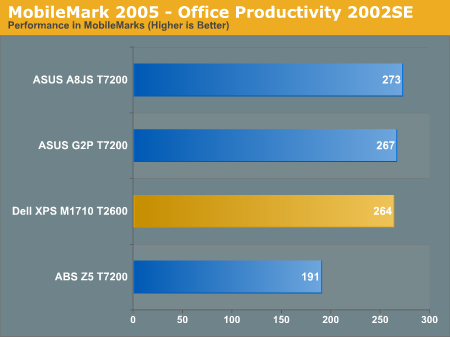
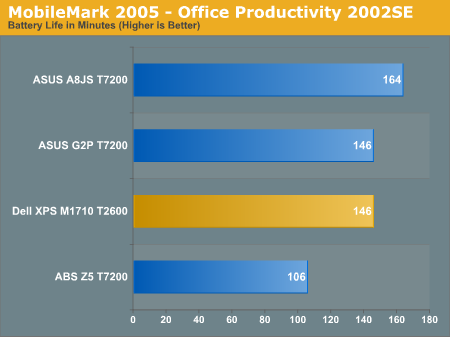
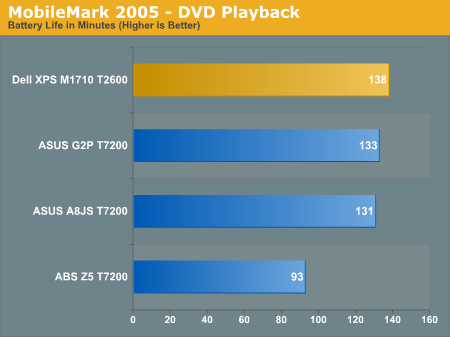
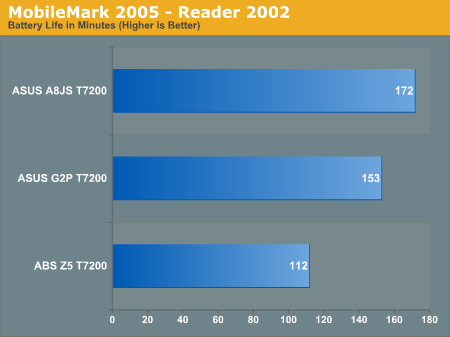
As expected, the ABS laptop - with its smaller battery compared to the G2P - provides rather abysmal battery life. Even if you turn down every performance setting possible, you're not likely to break two hours of battery life. For whatever reason, the default power profile on the ABS laptop results in much lower performance than that of the ASUS laptops. Not only does it provide less battery life, but the performance in the MobileMark 2002 productivity test is 40% lower than the other Core 2 Duo T7200 equipped laptops. It's interesting that even the XPS M1710 with a Core Duo processor is able to post significantly better results, so perhaps ABS and their partners can do some additional performance tuning to help improve performance without sacrificing battery life.
Moving beyond the ABS results, the ASUS G2P and A8JS provide similar performance, but the A8JS clearly provides better battery life. The larger and brighter display definitely takes a toll here, though the ATI X1700 does appear to do quite a bit better when it comes to DVD playback. We have noticed in the past that NVIDIA chipsets appear to consume more power during DVD decoding than roughly equivalent ATI chipsets, so if you are purely interested in a laptop that will be used for watching movies on the road, picking up something with a Radeon Mobility X1300-X1700 chipset is probably the best way to go. Unfortunately, good performance results in DVD playback do not translate to better 3D performance, and at present the fastest ATI Radeon Mobility product is a rather outdated X1800.
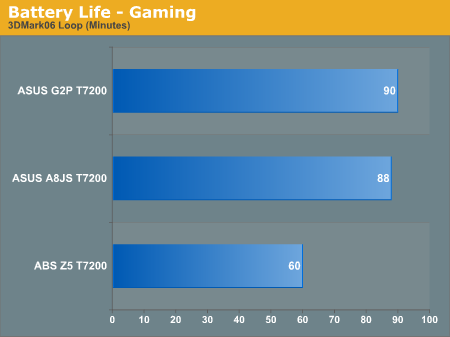
Kicking things up to the next level, we tested how long the laptops could manage to run a reasonably complex 3D gaming title in battery mode with the display set to maximum brightness. (It's really not practical to play games without cranking up the brightness levels on most laptops.) For this test, we looped the three 3DMark05 gaming benchmarks continually until the battery ran out. Informal testing with a few other actual games - Company of Heroes in particular - shows that battery life for a complex 3D game will actually be lower than what we show here, as the CPU and audio subsystems will typically be more involved. We chose to use 3DMark05 because it is easiest to set up a repeatable test that will last more than an hour. As you can see, the ABS system lasted one hour and the other two laptops lasted close to 90 minutes. Keep in mind the performance offered by the various graphics solutions, however, as lasting a bit longer on battery life may not mean much if the overall gaming experience isn't acceptable.
The worst part about the battery life results is that they basically highlight a fundamental issue with laptops: you can't get high-performance and long battery life in the same package, for the most part. That goes doubly when it comes to 3D/gaming performance, as NVIDIA and ATI have been in an arms race where power use has been a secondary or even tertiary concern next to winning the performance crown. ATI's current desktop parts consume so much power that it is basically impractical to consider putting an X1950 type GPU into a laptop (though the X1950 Pro might be able to work with some modifications). GeForce 8800 doesn't do much better these days, and it might be awhile before we see a GeForce Go product based off the G80 chipsets. For now, the fastest laptop GPUs are the GeForce Go 7900/7950 GTX products, although if you want even more performance there are also some SLI laptops available.
Having easily swept the gaming benchmarks, the ABS Mayhem Z5 now faces its most difficult task: battery life. First, let's take a look at the MobileMark 2005 results. Note that in this case, the power saving features were left enabled and we will not be retesting as few people are willing to sacrifice battery life for a bit more performance on the road.
As expected, the ABS laptop - with its smaller battery compared to the G2P - provides rather abysmal battery life. Even if you turn down every performance setting possible, you're not likely to break two hours of battery life. For whatever reason, the default power profile on the ABS laptop results in much lower performance than that of the ASUS laptops. Not only does it provide less battery life, but the performance in the MobileMark 2002 productivity test is 40% lower than the other Core 2 Duo T7200 equipped laptops. It's interesting that even the XPS M1710 with a Core Duo processor is able to post significantly better results, so perhaps ABS and their partners can do some additional performance tuning to help improve performance without sacrificing battery life.
Moving beyond the ABS results, the ASUS G2P and A8JS provide similar performance, but the A8JS clearly provides better battery life. The larger and brighter display definitely takes a toll here, though the ATI X1700 does appear to do quite a bit better when it comes to DVD playback. We have noticed in the past that NVIDIA chipsets appear to consume more power during DVD decoding than roughly equivalent ATI chipsets, so if you are purely interested in a laptop that will be used for watching movies on the road, picking up something with a Radeon Mobility X1300-X1700 chipset is probably the best way to go. Unfortunately, good performance results in DVD playback do not translate to better 3D performance, and at present the fastest ATI Radeon Mobility product is a rather outdated X1800.
Kicking things up to the next level, we tested how long the laptops could manage to run a reasonably complex 3D gaming title in battery mode with the display set to maximum brightness. (It's really not practical to play games without cranking up the brightness levels on most laptops.) For this test, we looped the three 3DMark05 gaming benchmarks continually until the battery ran out. Informal testing with a few other actual games - Company of Heroes in particular - shows that battery life for a complex 3D game will actually be lower than what we show here, as the CPU and audio subsystems will typically be more involved. We chose to use 3DMark05 because it is easiest to set up a repeatable test that will last more than an hour. As you can see, the ABS system lasted one hour and the other two laptops lasted close to 90 minutes. Keep in mind the performance offered by the various graphics solutions, however, as lasting a bit longer on battery life may not mean much if the overall gaming experience isn't acceptable.
The worst part about the battery life results is that they basically highlight a fundamental issue with laptops: you can't get high-performance and long battery life in the same package, for the most part. That goes doubly when it comes to 3D/gaming performance, as NVIDIA and ATI have been in an arms race where power use has been a secondary or even tertiary concern next to winning the performance crown. ATI's current desktop parts consume so much power that it is basically impractical to consider putting an X1950 type GPU into a laptop (though the X1950 Pro might be able to work with some modifications). GeForce 8800 doesn't do much better these days, and it might be awhile before we see a GeForce Go product based off the G80 chipsets. For now, the fastest laptop GPUs are the GeForce Go 7900/7950 GTX products, although if you want even more performance there are also some SLI laptops available.
Originally published at https://www.anandtech.com/show/2145 (Wayback Machine).