
Notebook Trio: ASUS A8JS and G2P and ABS Mayhem Z5
- Posted in
- Laptops
General Performance
For general system performance, we ran PCMark05 and SYSmark 2004. We don't expect to see much difference at all in SYSmark scores, as the memory and processor are going to be the primary factors in that benchmark. The majority of the PCMark05 scores should also be close, but the composite score obfuscates things somewhat as the graphics and hard drive performance results affect the overall standings.
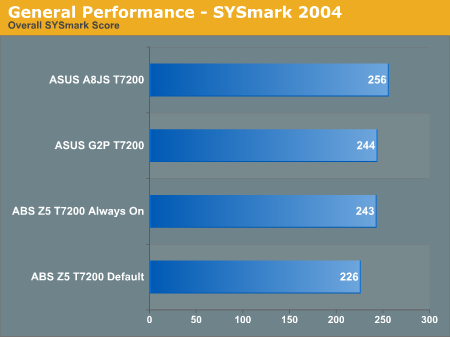
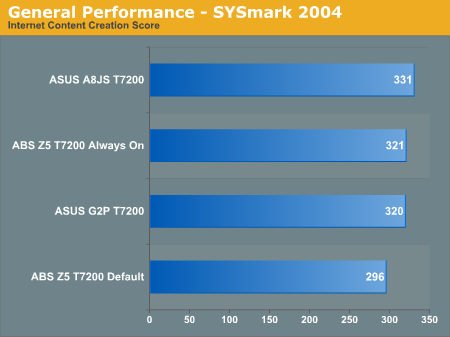
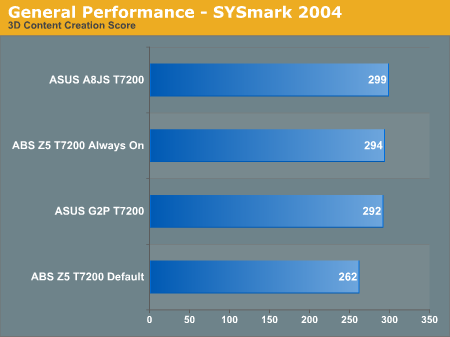
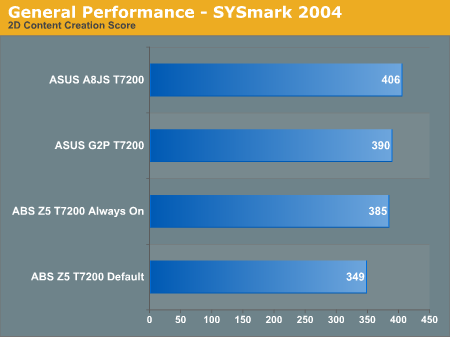
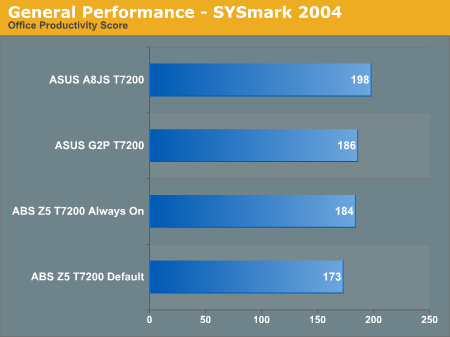
Obviously, things didn't meet up to our expectations here. There are still quite a few variables that could be affecting the results by 5% or more (different hard drives, for example), but at first glance it appears that the ASUS laptops are much better optimized than the ABS laptop. A performance difference of 10% or more is quite significant in SYSmark, especially considering we are using the same processor in all three systems. However, BIOS tuning options are virtually nonexistent on these laptops, so we are running with the manufacturer settings. Power saving features are enabled during testing, as that's the way we expect these laptops to be used.
It turns out that the default power settings in Windows still have a major impact on ABS' performance, and unfortunately we discovered after the fact that the ABS was running at lower clock speeds much of the time during these tests. After retesting, the scores are much closer in performance when we set the Windows power management to "Always On", but at default settings the power saving features can have a relatively significant impact on performance. That said, even though there's a performance deficit in some of the SYSmark test suites, the performance offered by all three laptops is more than adequate for running most applications. In that sense, the SYSmark results are becoming outdated - any reasonable computer built within the past two or three years should offer more than acceptable performance.
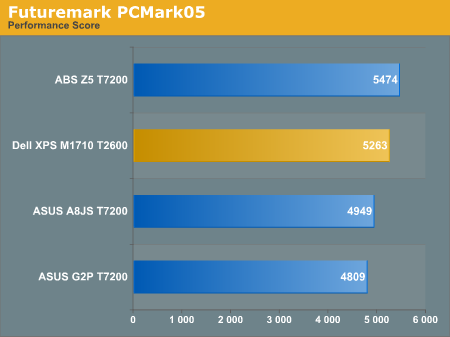
Things change a bit when looking at PCMark05, where the ABS Mayhem Z5 moves to the top of the chart. The primary reason for that is of course the graphics performance offered by the GeForce Go 7900 GTX, but we did make sure to rerun this benchmark with the Windows power saving features set to "Always On". The original scores were much lower in some areas, mimicking what we saw with SYSmark and MobileMark, but the updated scores are much closer and well within the expected range. You can see the scores from the individual categories below the main graph, and it's interesting to note that the two ASUS laptops still outperformed the ABS notebook in a few areas, likely indicating that ASUS has better BIOS optimizations. The choice of hard drive is also clearly in favor of the ASUS laptops.
For general system performance, we ran PCMark05 and SYSmark 2004. We don't expect to see much difference at all in SYSmark scores, as the memory and processor are going to be the primary factors in that benchmark. The majority of the PCMark05 scores should also be close, but the composite score obfuscates things somewhat as the graphics and hard drive performance results affect the overall standings.
Obviously, things didn't meet up to our expectations here. There are still quite a few variables that could be affecting the results by 5% or more (different hard drives, for example), but at first glance it appears that the ASUS laptops are much better optimized than the ABS laptop. A performance difference of 10% or more is quite significant in SYSmark, especially considering we are using the same processor in all three systems. However, BIOS tuning options are virtually nonexistent on these laptops, so we are running with the manufacturer settings. Power saving features are enabled during testing, as that's the way we expect these laptops to be used.
It turns out that the default power settings in Windows still have a major impact on ABS' performance, and unfortunately we discovered after the fact that the ABS was running at lower clock speeds much of the time during these tests. After retesting, the scores are much closer in performance when we set the Windows power management to "Always On", but at default settings the power saving features can have a relatively significant impact on performance. That said, even though there's a performance deficit in some of the SYSmark test suites, the performance offered by all three laptops is more than adequate for running most applications. In that sense, the SYSmark results are becoming outdated - any reasonable computer built within the past two or three years should offer more than acceptable performance.
| PCMark05 Performance Breakdown | |||
| ABS Mayhem Z5 | ASUS A8JS | ASUS G2P | |
| HDD XP Startup | 5.839 | 6.623 | 6.183 |
| Physics and 3D | 186.04 | 182.38 | 194.00 |
| 2D Transparency | 1078.48 | 733.55 | 515.72 |
| 3D Pixel Shaders | 327.74 | 132.09 | 93.84 |
| Web Page Rendering | 3.267 | 3.27 | 3.18 |
| Decryption | 54.602 | 54.524 | 54.294 |
| 2D 64 Line Redraw | 2111.47 | 1129.12 | 1326.54 |
| HDD General | 4.019 | 4.332 | 4.127 |
| Audio Compression | 2133.98 | 2219.17 | 2142.88 |
| Video Encoding | 372.19 | 363.48 | 373.53 |
| Text Editing | 137.3 | 139.57 | 138.75 |
| Image Decompression | 28.143 | 28.277 | 27.981 |
| File Compression | 4.831 | 4.819 | 4.577 |
| File Encryption | 26.513 | 26.512 | 27.54 |
| HDD Virus Scan | 32.924 | 35.32 | 43.118 |
| Memory Latency | 8.011 | 8.207 | 8.207 |
Things change a bit when looking at PCMark05, where the ABS Mayhem Z5 moves to the top of the chart. The primary reason for that is of course the graphics performance offered by the GeForce Go 7900 GTX, but we did make sure to rerun this benchmark with the Windows power saving features set to "Always On". The original scores were much lower in some areas, mimicking what we saw with SYSmark and MobileMark, but the updated scores are much closer and well within the expected range. You can see the scores from the individual categories below the main graph, and it's interesting to note that the two ASUS laptops still outperformed the ABS notebook in a few areas, likely indicating that ASUS has better BIOS optimizations. The choice of hard drive is also clearly in favor of the ASUS laptops.
Originally published at https://www.anandtech.com/show/2145 (Wayback Machine).