
Intel P965: Foxconn P9657AA- 8KS2H
- Posted in
- Motherboards
Disk Controller Performance
The AnandTech iPeak test is designed to measure "pure" hard disk controller performance, and in this case we keep the hard drive as consistent as possible while varying the hard drive controller. The idea is to measure the performance of each hard drive controller with the same hard drive.
We played back our raw files that are recorded I/O operations when running a real world benchmark - the entire Winstone 2004 suite. Intel's iPeak utility was then used to play back the trace file of all I/O operations that took place during a single run of Business Winstone 2004 and MCC Winstone 2004. To try to isolate performance differences to the controllers that we are testing we are using the Western Digital 74GB Raptor with 16MB cache for both our standard disk controller and RAID performance tests for this article. The drive is formatted before each test run and a composite average of three tests on each controller interface is tabulated in order to ensure consistency in the benchmark.
iPeak gives a mean service time in milliseconds; in other words, the average time that each drive took to fulfill each I/O operation. In order to make the data more understandable, we report the scores as an average number of I/O operations per second so that higher scores translate into better performance. This number is somewhat meaningless as far as hard disk performance is concerned, as it is just the number of I/O operations completed in a second. However, the scores are useful for comparing "pure" performance of the storage controllers in this case.
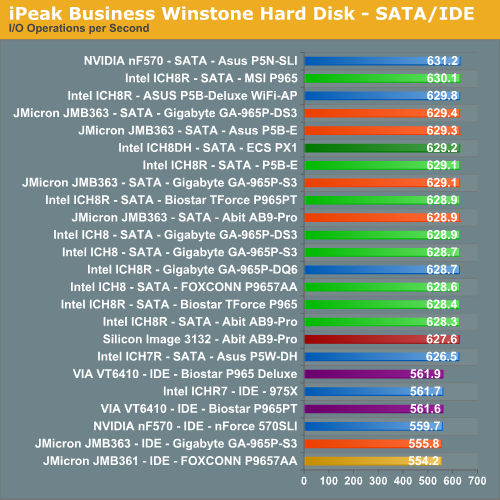
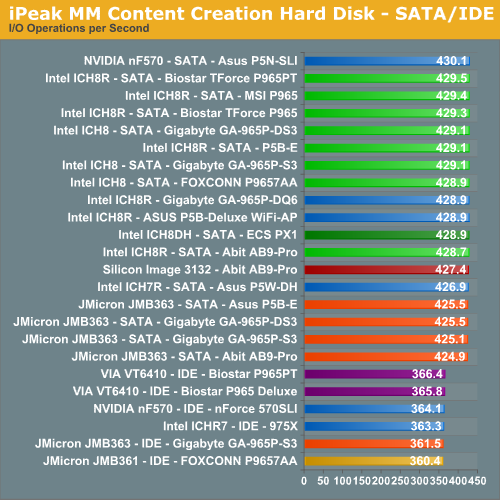
The performance patterns hold steady across both Multimedia Content I/O and Business I/O, with the NVIDIA nForce 500 based SATA controllers providing a slight improvement in I/O operations over the Intel, JMicron, and Silicon Image SATA controllers. This has been a historical trend between the two manufacturers with the NVIDIA controllers generally having a higher throughput than the Intel chipsets.
However, our recent testing of the AMD 600 chipset with the SB600 Southbridge showed the strength of this chipset by finishing ahead of the other offerings. We also noticed that the latest drivers from Intel along with optimizations on the Intel DB975XBX2 showed that the Intel chipsets are now very competitive with the new NVIDIA 680i boards.
Of note in our SATA tests is the excellent performance generated by the JMicron controller logic that scored higher than the Intel ICH7R or ICH8 based SATA controllers in the Business Winstone test. However, in the read and write heavy Content Creation tests we see the Intel SATA controllers placing ahead of the JMicron offerings. After reviewing the test script results we noticed the write operations of the JMicron JMB363 chipset was about 3% slower than the Intel ICH chipsets while being around 2% faster in read operations. We tested the e-SATA capability of the JMB361 chipset on the Foxconn board and did not encounter any issues with attaching our test drives or their performance.
The VIA VT6410 controller offered the best performance in the IDE tests with the JMicron JMB363 finishing last. During initial testing with the JMicron chipset we noticed several boards having issues with the optical drives being stuck in PIO mode resulting in terrible performance. However, this issue was solved with BIOS updates from the motherboard suppliers. We also advise that you utilize the latest JMicron JMB361 driver on the Foxconn board to avoid IDE compatibility issues with older drives.
The AnandTech iPeak test is designed to measure "pure" hard disk controller performance, and in this case we keep the hard drive as consistent as possible while varying the hard drive controller. The idea is to measure the performance of each hard drive controller with the same hard drive.
We played back our raw files that are recorded I/O operations when running a real world benchmark - the entire Winstone 2004 suite. Intel's iPeak utility was then used to play back the trace file of all I/O operations that took place during a single run of Business Winstone 2004 and MCC Winstone 2004. To try to isolate performance differences to the controllers that we are testing we are using the Western Digital 74GB Raptor with 16MB cache for both our standard disk controller and RAID performance tests for this article. The drive is formatted before each test run and a composite average of three tests on each controller interface is tabulated in order to ensure consistency in the benchmark.
iPeak gives a mean service time in milliseconds; in other words, the average time that each drive took to fulfill each I/O operation. In order to make the data more understandable, we report the scores as an average number of I/O operations per second so that higher scores translate into better performance. This number is somewhat meaningless as far as hard disk performance is concerned, as it is just the number of I/O operations completed in a second. However, the scores are useful for comparing "pure" performance of the storage controllers in this case.
The performance patterns hold steady across both Multimedia Content I/O and Business I/O, with the NVIDIA nForce 500 based SATA controllers providing a slight improvement in I/O operations over the Intel, JMicron, and Silicon Image SATA controllers. This has been a historical trend between the two manufacturers with the NVIDIA controllers generally having a higher throughput than the Intel chipsets.
However, our recent testing of the AMD 600 chipset with the SB600 Southbridge showed the strength of this chipset by finishing ahead of the other offerings. We also noticed that the latest drivers from Intel along with optimizations on the Intel DB975XBX2 showed that the Intel chipsets are now very competitive with the new NVIDIA 680i boards.
Of note in our SATA tests is the excellent performance generated by the JMicron controller logic that scored higher than the Intel ICH7R or ICH8 based SATA controllers in the Business Winstone test. However, in the read and write heavy Content Creation tests we see the Intel SATA controllers placing ahead of the JMicron offerings. After reviewing the test script results we noticed the write operations of the JMicron JMB363 chipset was about 3% slower than the Intel ICH chipsets while being around 2% faster in read operations. We tested the e-SATA capability of the JMB361 chipset on the Foxconn board and did not encounter any issues with attaching our test drives or their performance.
The VIA VT6410 controller offered the best performance in the IDE tests with the JMicron JMB363 finishing last. During initial testing with the JMicron chipset we noticed several boards having issues with the optical drives being stuck in PIO mode resulting in terrible performance. However, this issue was solved with BIOS updates from the motherboard suppliers. We also advise that you utilize the latest JMicron JMB361 driver on the Foxconn board to avoid IDE compatibility issues with older drives.
Originally published at https://www.anandtech.com/show/2144 (Wayback Machine).