
Quad Core Intel Xeon 53xx Clovertown
- Posted in
- IT Computing
Secure Socket Layers RSA Performance
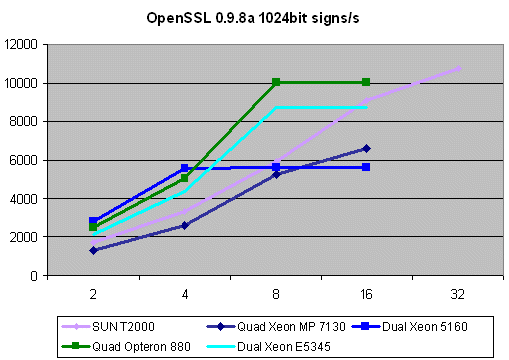
Secure web communication is possible through the utilization of the Secure Sockets Layer (SSL). Using "openssl speed rsa" we can measure the number of RSA public keys (sign) operations that a system can perform per second using OpenSSL 0.9.8a. Both verifies/s and signs/s benchmarks are rather synthetic, but give an idea of the "pure" encrypting and decrypting speed.
Note that this time we did not compile OpenSSL with specific flags for each architecture (march="xxx") but we used the same flags on each CPU. We feel that this better reflects the real world use of SSL as most people do not know the specific CPU architecture they are running on. So we compiled with the following on all x86 systems:
In the case of doing verifies, the server has to authenticate the identity of the client. This is a lot less intensive, and we show you the verifies/s numbers at 2048 bits. At 1024 bits length, both the Woodcrest and Opteron were able to verify more than 50,000 keys per core, and that is a hard limit of the OpenSSL benchmark.
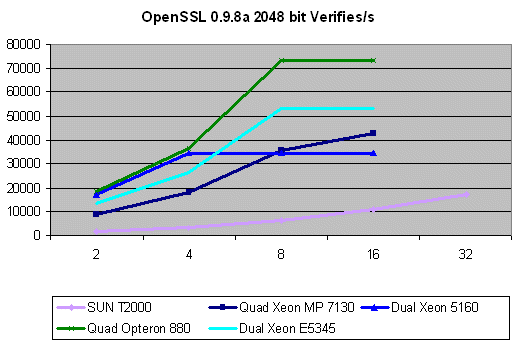
Both benchmarks behave as expected. All CPUs scale almost perfectly: this benchmark runs in the caches. The Opteron remains on top, as it offers better OpenSSL performance per clock.
Secure web communication is possible through the utilization of the Secure Sockets Layer (SSL). Using "openssl speed rsa" we can measure the number of RSA public keys (sign) operations that a system can perform per second using OpenSSL 0.9.8a. Both verifies/s and signs/s benchmarks are rather synthetic, but give an idea of the "pure" encrypting and decrypting speed.
Note that this time we did not compile OpenSSL with specific flags for each architecture (march="xxx") but we used the same flags on each CPU. We feel that this better reflects the real world use of SSL as most people do not know the specific CPU architecture they are running on. So we compiled with the following on all x86 systems:
gcc -fPIC -DOPENSSL_PIC -DZLIB -DOPENSSL_THREADS -D_REENTRANT -DDSO_DLFCN -DHAVE_DLFCN_H -m64 -DL_ENDIAN -DTERMIO -O3 -Wa,-noexecstack -g -Wall -DMD32_REG_T=int -DMD5_ASMIn the case of doing verifies, the server has to authenticate the identity of the client. This is a lot less intensive, and we show you the verifies/s numbers at 2048 bits. At 1024 bits length, both the Woodcrest and Opteron were able to verify more than 50,000 keys per core, and that is a hard limit of the OpenSSL benchmark.
Both benchmarks behave as expected. All CPUs scale almost perfectly: this benchmark runs in the caches. The Opteron remains on top, as it offers better OpenSSL performance per clock.
Originally published at https://www.anandtech.com/show/2143 (Wayback Machine).