
Digital SLR Buyer's Guide
- Posted in
- Digital Camera
Our Picks
The best value among current entry-level Digital SLR cameras is the Pentax K110D kit. At a price of about $400 after rebate you get a remarkably fast and capable 6 megapixel SLR with a metal lens-mount kit lens of better than average quality and performance. The K110D processing engine is fast and the 11-point autofocus is all but identical to the SAFOX module used in the top-line K10D. The K110D uses four AA or two CRV3 batteries and it eats batteries unless you feed it rechargeable AA or CRV3 batteries. The K110D does not provide body integral anti-shake or auto sensor cleaning. However those features are available in the same camera at $100 more - the Pentax K100D.
At the $500 to $600 price point the 6MP Pentax K100D or the 8MP Canon Rebel XT are both exceptional buys. If you already own Nikon lenses the new 6MP Nikon D40 is also a good choice, but neither the Canon nor Nikon offer auto sensor cleaning or body-integral anti-shake if those features are important to you. Both Canon and Nikon do offer specialty anti-shake lenses, but they are very expensive and anti-shake is only available on Canon and Nikon SLR cameras with special AS lenses.
In the fierce competition at 10 megapixel resolution the Sony A100 is our best buy. With the recent drop in retail prices by Sony you can actually buy a 10MP Sony A100 with the wider 18-70mm kit lens for about $720 from a large etailer like Amazon. The Sony continues the Minolta pioneering "Steady-Shot", refined by Sony, and the Alpha will work with almost any existing Maxxum lens in addition to Sony SLR lenses.
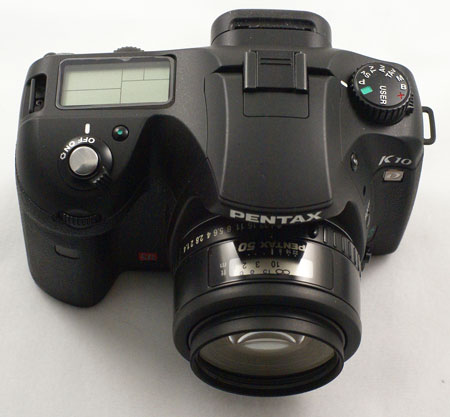
Best Value in the 10 Megapixel category is clearly the Pentax K10D. The Pentax designed anti-shake system is said to be capable of up to four stops of improved low-light performance. In addition the Pentax integrates auto sensor cleaning. It is also the only SLR in our tests with pro level sealing that makes the camera water and dust resistant. The K10D is a solid piece of engineering that redefines the norm in the $1000 digital SLR category. We suspect the Pentax will encourage other new designs that will bring Pro level construction and features to lower Digital SLR price points. The Nikon D80 is also an exceptional 10 megapixel offering that is only marred by the fact that Nikon remains the only major camera maker that refuses to incorporate any means of auto sensor cleaning. We also prefer the body-integral anti-shake built into the Pentax K10D that will work with any lens mounted to the expensive lens-based anti-shake used on specialty lenses by Nikon and Canon. Pentax has even added provisions that allow anti-shake to work with any of the 25 million older K-mount lenses that have been manufactured over the years.
The new lineup of Pentax digital cameras is very impressive, and Pentax finally seems to have it right after several generations of near misses. Pentax is also offering some of the most innovative and interesting lenses currently available in digital photography. This includes the rebirth of the extremely thin "pancake" lenses like the 40mm f2.8 and 21mm f3.2, as well as new fast primes like the 31mm f1.8, 43 f1.9 and the 77mm f1.8, and innovative zooms like the zoom fish-eye 10-17mm f3.5-4.5.
That does not minimize the fact that Canon and Nikon remain the safe choices in all categories. Pentax has a long and illustrious history in innovative camera and lens design, but they are still a small company compared to Canon, Nikon, and now Sony. Perhaps the recently announced merger of Pentax and Hoya - who is the one of the largest "glass blank" suppliers to the camera industry - will provide even more resources for Pentax to continue the kind of innovation we are seeing in their current Digital SLR offerings.
The best value among current entry-level Digital SLR cameras is the Pentax K110D kit. At a price of about $400 after rebate you get a remarkably fast and capable 6 megapixel SLR with a metal lens-mount kit lens of better than average quality and performance. The K110D processing engine is fast and the 11-point autofocus is all but identical to the SAFOX module used in the top-line K10D. The K110D uses four AA or two CRV3 batteries and it eats batteries unless you feed it rechargeable AA or CRV3 batteries. The K110D does not provide body integral anti-shake or auto sensor cleaning. However those features are available in the same camera at $100 more - the Pentax K100D.
At the $500 to $600 price point the 6MP Pentax K100D or the 8MP Canon Rebel XT are both exceptional buys. If you already own Nikon lenses the new 6MP Nikon D40 is also a good choice, but neither the Canon nor Nikon offer auto sensor cleaning or body-integral anti-shake if those features are important to you. Both Canon and Nikon do offer specialty anti-shake lenses, but they are very expensive and anti-shake is only available on Canon and Nikon SLR cameras with special AS lenses.
In the fierce competition at 10 megapixel resolution the Sony A100 is our best buy. With the recent drop in retail prices by Sony you can actually buy a 10MP Sony A100 with the wider 18-70mm kit lens for about $720 from a large etailer like Amazon. The Sony continues the Minolta pioneering "Steady-Shot", refined by Sony, and the Alpha will work with almost any existing Maxxum lens in addition to Sony SLR lenses.
Best Value in the 10 Megapixel category is clearly the Pentax K10D. The Pentax designed anti-shake system is said to be capable of up to four stops of improved low-light performance. In addition the Pentax integrates auto sensor cleaning. It is also the only SLR in our tests with pro level sealing that makes the camera water and dust resistant. The K10D is a solid piece of engineering that redefines the norm in the $1000 digital SLR category. We suspect the Pentax will encourage other new designs that will bring Pro level construction and features to lower Digital SLR price points. The Nikon D80 is also an exceptional 10 megapixel offering that is only marred by the fact that Nikon remains the only major camera maker that refuses to incorporate any means of auto sensor cleaning. We also prefer the body-integral anti-shake built into the Pentax K10D that will work with any lens mounted to the expensive lens-based anti-shake used on specialty lenses by Nikon and Canon. Pentax has even added provisions that allow anti-shake to work with any of the 25 million older K-mount lenses that have been manufactured over the years.
The new lineup of Pentax digital cameras is very impressive, and Pentax finally seems to have it right after several generations of near misses. Pentax is also offering some of the most innovative and interesting lenses currently available in digital photography. This includes the rebirth of the extremely thin "pancake" lenses like the 40mm f2.8 and 21mm f3.2, as well as new fast primes like the 31mm f1.8, 43 f1.9 and the 77mm f1.8, and innovative zooms like the zoom fish-eye 10-17mm f3.5-4.5.
That does not minimize the fact that Canon and Nikon remain the safe choices in all categories. Pentax has a long and illustrious history in innovative camera and lens design, but they are still a small company compared to Canon, Nikon, and now Sony. Perhaps the recently announced merger of Pentax and Hoya - who is the one of the largest "glass blank" suppliers to the camera industry - will provide even more resources for Pentax to continue the kind of innovation we are seeing in their current Digital SLR offerings.
Originally published at https://www.anandtech.com/show/2142 (Wayback Machine).