
ECS LIVA Z5 PLUS mini-PC Review: A Different Take on Raptor Lake
GPU Performance: Synthetic Benchmarks
GPUs in business and industrial use-cases service a variety of workloads such as driving digital signage and kiosk GUIs, as well as limited applications such as arcade gaming. The focus is more on being able to drive a large number of displays, rather than raw gaming performance. The GPU in the Intel Core i5-1335U is based on the Iris (Xe) iGPU microarchitecture. With 80 EUs, this is not the top-end in the Raptor Lake family, and the clock speed is also not as high as the one in the version with 96 EUs. As we shall see in the benchmark numbers below, there is not much of an extra power headroom due to the 20W PL1 limitation for the processor package.

The Intel Iris Xe Graphics in the ECS LIVA Z5 PLUS is an integrated GPU based on a reworked scalable architecture. In the consumer market, it is a couple of generations old, but that is not much of a concern for industrial and business systems.
GFXBench
The DirectX 12-based GFXBench tests from Kishonti are cross-platform, and available all the way down to smartphones. As such, they are not very taxing for discrete GPUs and modern integrated GPUs. We processed the offscreen versions of the 'Aztec Ruins' benchmark.
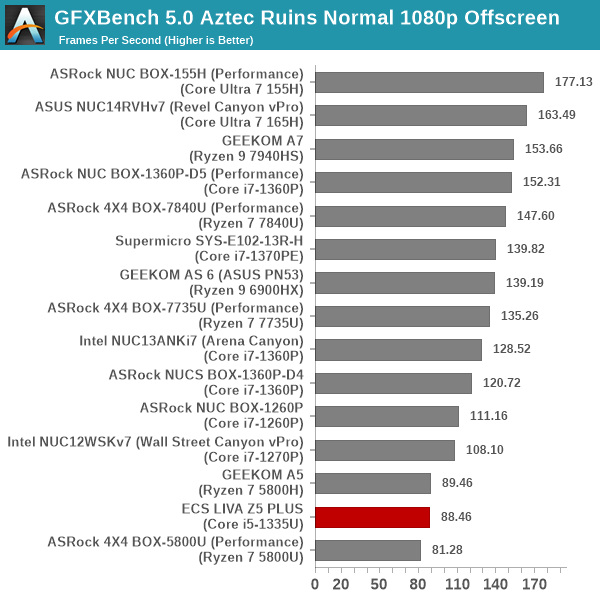
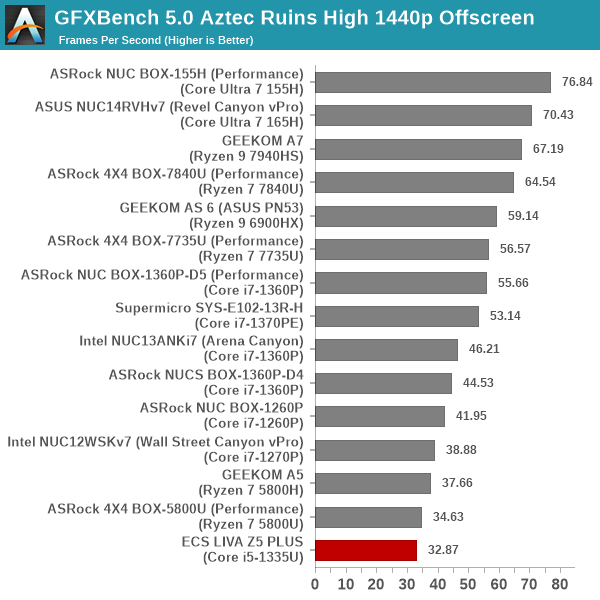
The low power budget and the EU count combine to push the system to the bottom of the pack in both workloads.
UL 3DMark
Four different workload sets were processed in 3DMark - Fire Strike, Time Spy, Night Raid, and Wild Life.
3DMark Fire Strike
The Fire Strike benchmark has three workloads. The base version is meant for high-performance gaming PCs. It uses DirectX 11 (feature level 11) to render frames at 1920 x 1080. The Extreme version targets 1440p gaming requirements, while the Ultra version targets 4K gaming system, and renders at 3840 x 2160. The graph below presents the overall score for the Fire Strike Extreme and Fire Strike Ultra benchmark across all the systems that are being compared.
| UL 3DMark - Fire Strike Workloads | |||
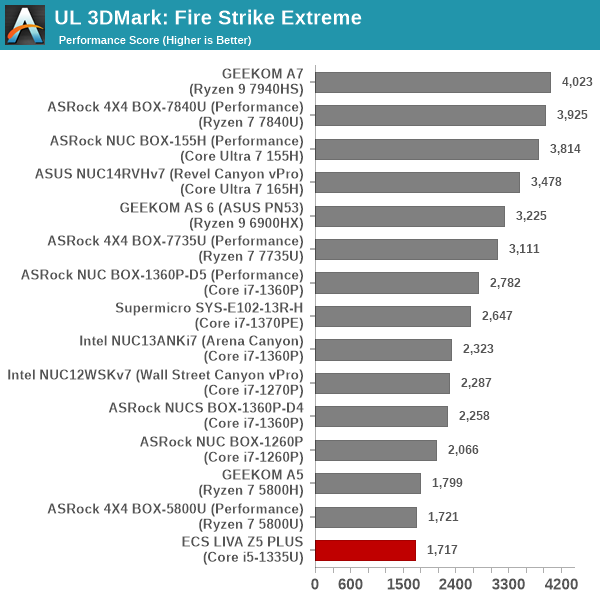
The newer iGPU architecture in Iris Xe manages to outperform the dated one in the Ryzen 5000 series at higher resolutions. However, the power budget proves to be a dampener in the default lower resolution case keeping the system at the bottom of the pack.
3DMark Time Spy
The Time Spy workload has two levels with different complexities. Both use DirectX 12 (feature level 11). However, the plain version targets high-performance gaming PCs with a 2560 x 1440 render resolution, while the Extreme version renders at 3840 x 2160 resolution. The graphs below present both numbers for all the systems that are being compared in this review.
| UL 3DMark - Time Spy Workloads | |||
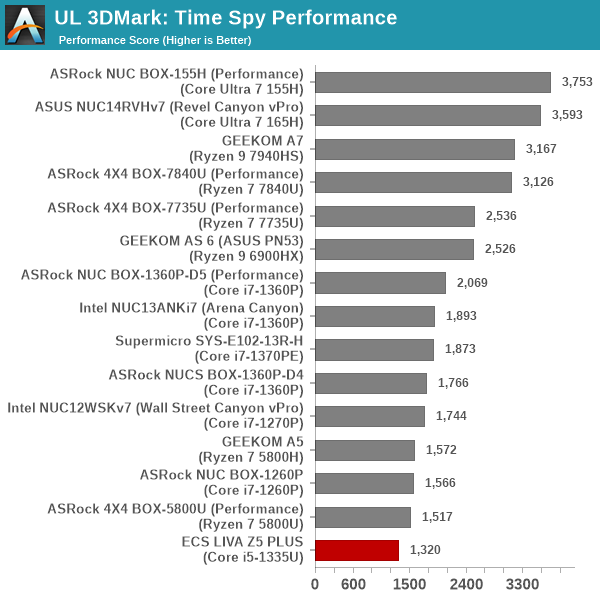
The available power budget and clock rate for the iGPU are too low to make an impact in this set of workloads, keeping the system at the bottom of the pack.
3DMark Wild Life
The Wild Life workload was initially introduced as a cross-platform GPU benchmark in 2020. It renders at a 2560 x 1440 resolution using Vulkan 1.1 APIs on Windows. It is a relatively short-running test, reflective of mobile GPU usage. In mid-2021, UL released the Wild Life Extreme workload that was a more demanding version that renders at 3840 x 2160 and runs for a much longer duration reflective of typical desktop gaming usage.
| UL 3DMark - Wild Life Workloads | |||
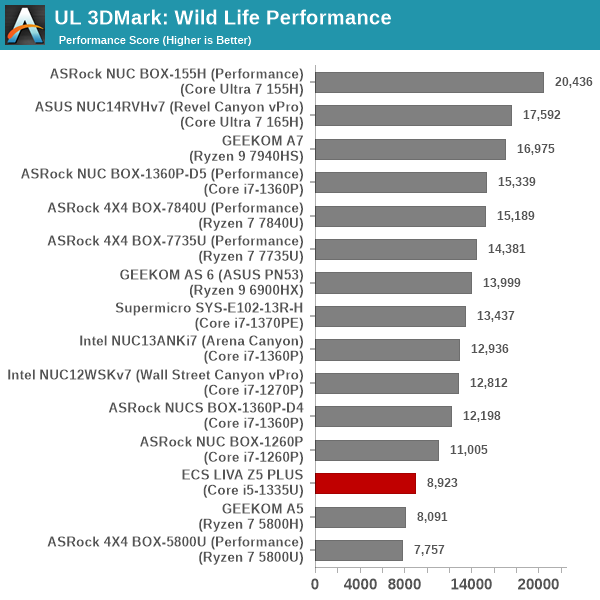
This workload behaves similar to Fire Strike, albeit at both resolutions. The newer architecture manages to make it past the Ryzen 5000 series, but the system still finds itself in the bottom half of the pack.
3DMark Night Raid
The Night Raid workload is a DirectX 12 benchmark test. It is less demanding than Time Spy, and is optimized for integrated graphics. The graph below presents the overall score in this workload for different system configurations.
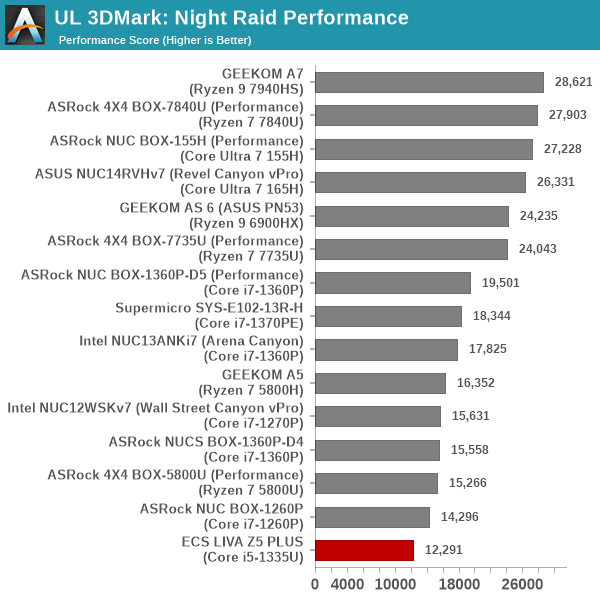
The trend observed in previous workloads is reflected here too, with the lower power budget and clock rate combining to push the LIVA Z5 PLUS to the bottom.
Originally published at https://www.anandtech.com/show/21417/ecs-liva-z5-plus-minipc-review-a-different-take-on-raptor-lake (Wayback Machine).