
ACEMAGIC F2A 125H SFF PC Review: Mid-Range Meteor Lake at 65W
GPU Performance: Synthetic Benchmarks
The integrated GPU in Meteor Lake-H is a pared down version of the one used in Intel's discrete Arc GPUs. The Meteor Lake-H architecture isolates the media engine and display pipe away from the GPU tile. The new iGPU also includes ray-tracing support.

GPU performance evaluation typically involved gaming workloads, and for select PCs, GPU compute. Prior to that, a look at the capabilities of the GPU in the Core Ultra 5 125H is warranted.

The Intel Arc Graphics in MTL-H is a completely new architecture for the mobile processor market. The iGPU in the F2A processor has one less Xe core, and is also clocked slightly lower. However, it is still good enough to regain parity with the RDNA3-based iGPU in the AMD-based systems, as shown in the benchmarks below.
GFXBench
The DirectX 12-based GFXBench tests from Kishonti are cross-platform, and available all the way down to smartphones. As such, they are not very taxing for discrete GPUs and modern integrated GPUs. We processed the offscreen versions of the 'Aztec Ruins' benchmark.
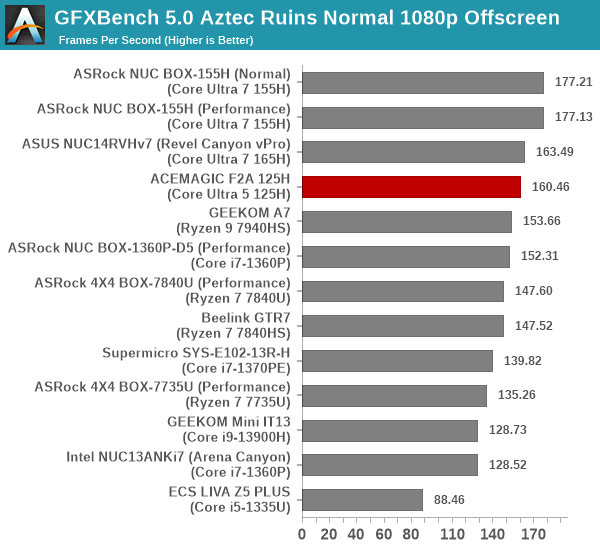
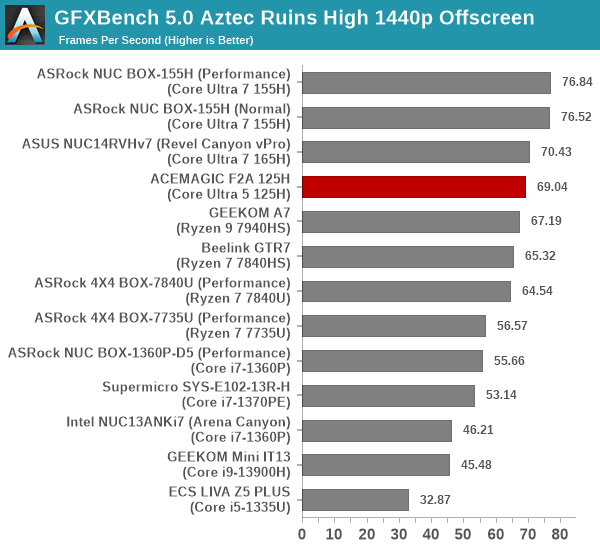
The numbers depend on the iGPU's power budget allocation, and not just on the PL1 of the package. That said, we see that the F2A 125H and the NUC14RVHv7 perform similarly, with the small delta being attributable to the lowered Xe core count and clock speed.
UL 3DMark
Four different workload sets were processed in 3DMark - Fire Strike, Time Spy, Night Raid, and Wild Life.
3DMark Fire Strike
The Fire Strike benchmark has three workloads. The base version is meant for high-performance gaming PCs. It uses DirectX 11 (feature level 11) to render frames at 1920 x 1080. The Extreme version targets 1440p gaming requirements, while the Ultra version targets 4K gaming system, and renders at 3840 x 2160. The graph below presents the overall score for the Fire Strike Extreme and Fire Strike Ultra benchmark across all the systems that are being compared.
| UL 3DMark - Fire Strike Workloads | |||
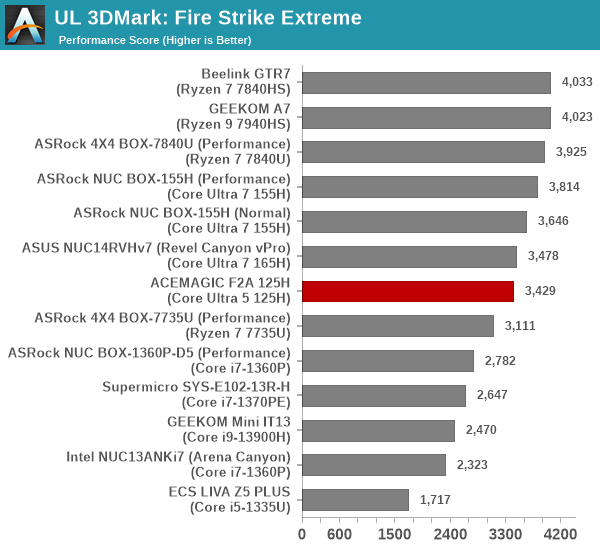
The RDNA3 iGPU in the Phoenix-based systems manages to come out on top in the two workloads, but the Meteor Lake-based systems are right behind, with the internal ordering the same as what was observed in the previous test.
3DMark Time Spy
The Time Spy workload has two levels with different complexities. Both use DirectX 12 (feature level 11). However, the plain version targets high-performance gaming PCs with a 2560 x 1440 render resolution, while the Extreme version renders at 3840 x 2160 resolution. The graphs below present both numbers for all the systems that are being compared in this review.
| UL 3DMark - Time Spy Workloads | |||
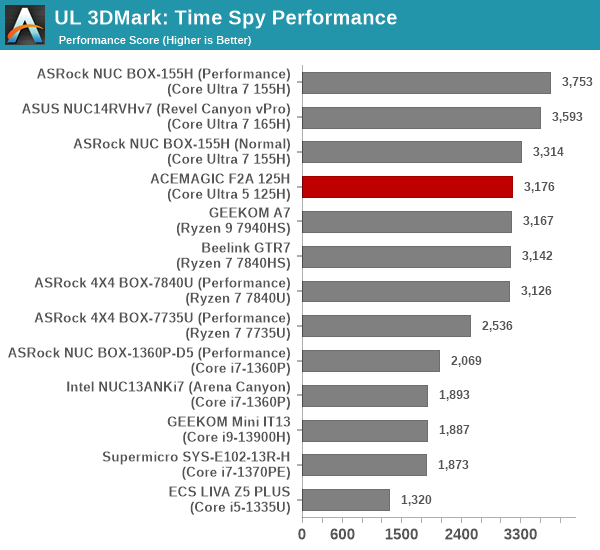
The Arc iGPU in Meteor Lake takes up the top four spots in both Time Spy configurations, as shown above. The two Phoenix-based systems take up the next two spots.
3DMark Wild Life
The Wild Life workload was initially introduced as a cross-platform GPU benchmark in 2020. It renders at a 2560 x 1440 resolution using Vulkan 1.1 APIs on Windows. It is a relatively short-running test, reflective of mobile GPU usage. In mid-2021, UL released the Wild Life Extreme workload that was a more demanding version that renders at 3840 x 2160 and runs for a much longer duration reflective of typical desktop gaming usage.
| UL 3DMark - Wild Life Workloads | |||
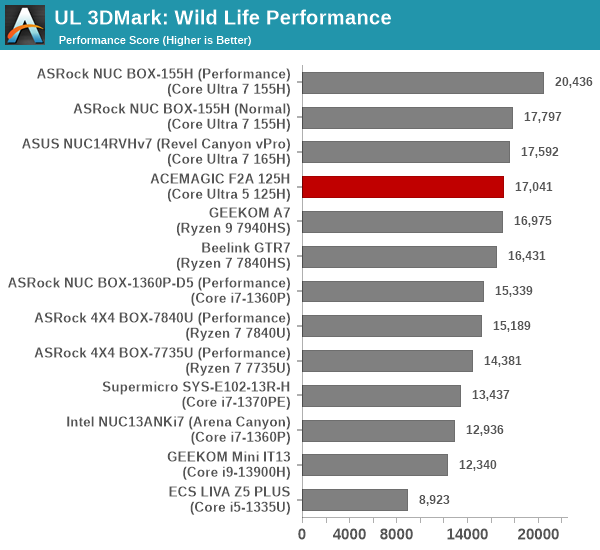
The 1440p version sees the Meteor Lake-based systems on top, but the 4K version sees a much closer fight. The Phoenix-based systems take up three of the first four spots, with the 40W NUC BOX-155H sneaking in-between (thanks to its iGPU power budget allocation). The F2A 125H remains consistently just behind the NUC14RVHv7.
3DMark Night Raid
The Night Raid workload is a DirectX 12 benchmark test. It is less demanding than Time Spy, and is optimized for integrated graphics. The graph below presents the overall score in this workload for different system configurations.
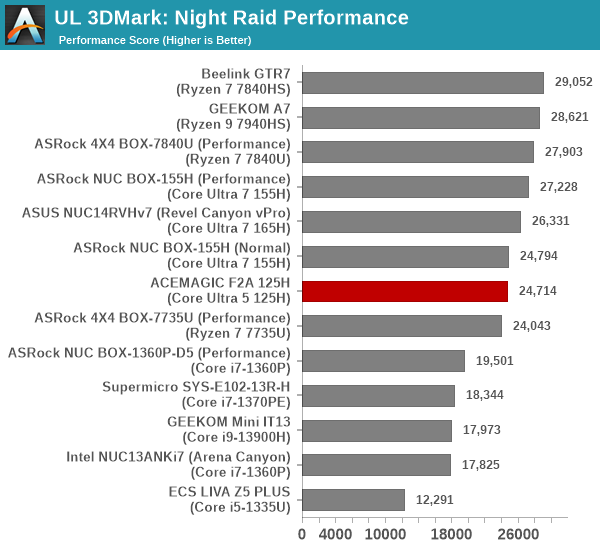
RDNA3 scores a win here, with the Phoenix-based systems taking up the top three spots and followed immediately by the four MTL-H configurations.
3DMark Port Royal
UL introduced the Port Royal ray-tracing benchmark as a DLC for 3DMark in early 2019. The scores serve as an indicator of how the system handles ray-tracing effects in real-time.
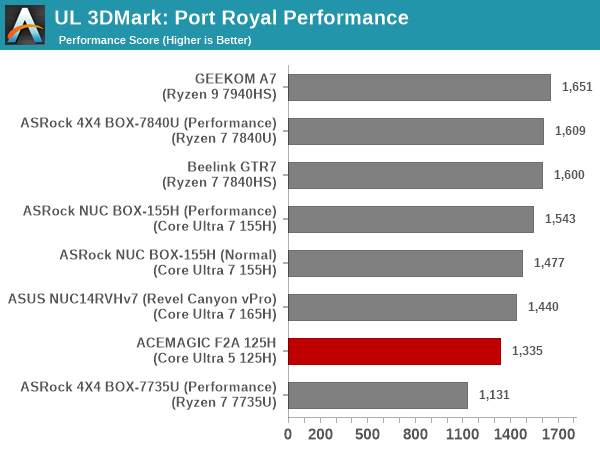
RDNA3's ray tracing performance is slightly better than that of MTL-H. The RDNA2 ray tracing in the Rembrandt SoC makes up the bottom half of the pack.
Originally published at https://www.anandtech.com/show/21416/acemagic-f2a-meteor-lakeh-sff-pc-review (Wayback Machine).