
ASUS P5N-E SLI: NVIDIA's 650i enters with a Bang
- Posted in
- Motherboards
Standard Gaming Performance
As usual, gaming performance was tested with a variety of current games. We ran benchmarks with our standard 1280x1024 resolution without antialiasing enabled (and generally without anisotropic filtering, though that varies by game). Given the number of users that run 19 inch LCDs these days, 1280x1024 represents one of the most commonly used resolutions. We could certainly increase the amount of eye candy being displayed in most of the games, but as this is a motherboard benchmark we aren't particularly interested in maxing out the graphics cards in our tests.
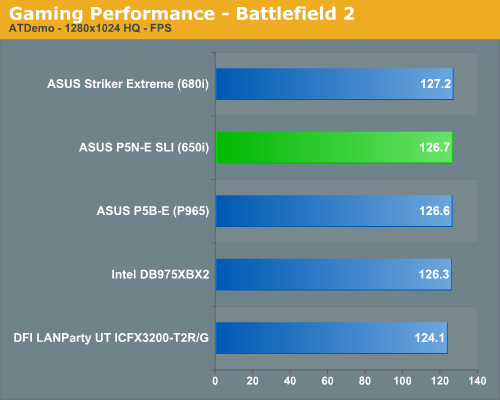
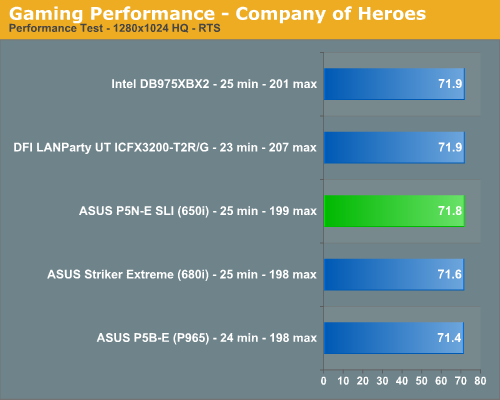
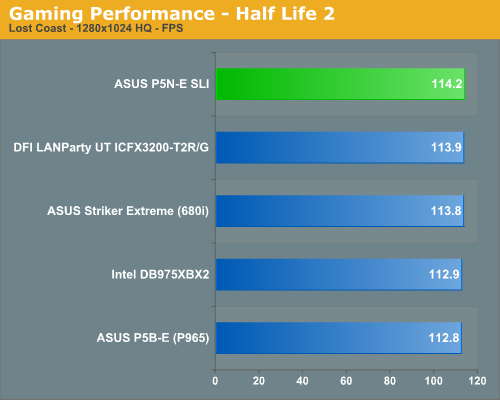
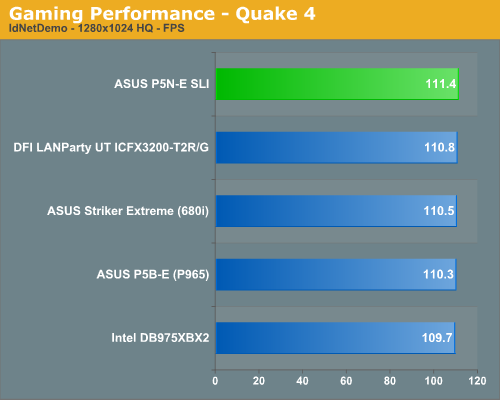
These results surprised us but after testing several other games we came to the same conclusion, the ASUS P5N-E SLI performs extremely well in our game benchmarks where graphics subsystem optimizations are very important. The board was very stable with our settings and did not have any issues during benchmarking or online game play. However, this board was ultra sensitive to memory changes when testing games. Although we could dial in higher memory speeds or lower latencies and still pass the synthetic tests, we would notice instant lockups in games with the same settings. We received a retail Intel DB975XBX2 board that performed slightly better than our press kit sample during testing and will update these scores in our next RD600 article. While the performance improved, especially in CrossFire operation, it did not improve enough to top the 650i board.
High-Resolution Gaming Performance
For high-quality gaming performance, we also tested at 1600x1200 and 1920x1200 with 4xAA /8xAF. As just about anyone familiar with current games can tell you, benchmarking with most single high-end graphics card at those stressful settings will make just about any recent game GPU limited. In fact, several of the most recently released games such as Oblivion can be GPU limited at this setting even with CrossFire or SLI setups. However, our testing will utilize the GeForce 8800 GTX and unfortunately, the two games we listed do not benefit that much from SLI. This is due to both our processor choice and the fact the current drivers still need additional SLI optimizations. In fact we did not see any real differences in performance in Q4 or Battlefield 2 with SLI enabled. Our initial testing with Oblivion did show improvements but we still believe our 8800 GTX SLI combination was CPU limited in most of our tests.
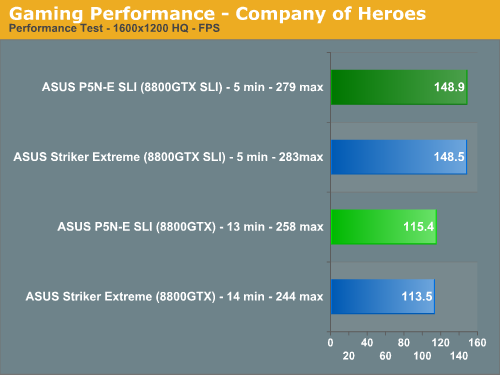
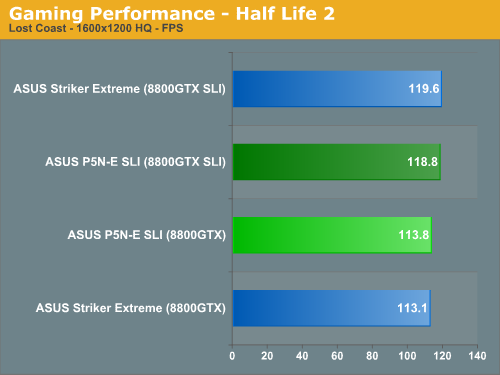
We had heard rumors that the 8800 GTX cards would thrive on the dual x16 capable 680i chipset but in looking at the results in our two test games it appears there is very little difference in the scores between the two nForce 600i boards. We did not have any issues running our 8800 GTX SLI setup on the dual x8 capable 650i board and only in the synthetic 3DMark benchmarks did we see any true separation between the two setups. Those results favored the 680i over the 650i by 8% in 3DMark06, 6% in 3DMark05, and in 3DMark 2001 the 650i actually finished about 4% ahead of the 680i. At this time, the current games we have tested will perform almost equally on either board in 8800 GTX SLI operation at 1600x1200. We also tested at 1920x1200 resolutions with the same results between the two chipsets. We still need to complete testing at 2560x1600 with the 650i chipset but considering the very small increase in performance in SLI mode with our test setup, we highly recommend the purchase of a single 8800 GTX for today's games and to forgo 8800 GTX SLI operation at this time.
As usual, gaming performance was tested with a variety of current games. We ran benchmarks with our standard 1280x1024 resolution without antialiasing enabled (and generally without anisotropic filtering, though that varies by game). Given the number of users that run 19 inch LCDs these days, 1280x1024 represents one of the most commonly used resolutions. We could certainly increase the amount of eye candy being displayed in most of the games, but as this is a motherboard benchmark we aren't particularly interested in maxing out the graphics cards in our tests.
These results surprised us but after testing several other games we came to the same conclusion, the ASUS P5N-E SLI performs extremely well in our game benchmarks where graphics subsystem optimizations are very important. The board was very stable with our settings and did not have any issues during benchmarking or online game play. However, this board was ultra sensitive to memory changes when testing games. Although we could dial in higher memory speeds or lower latencies and still pass the synthetic tests, we would notice instant lockups in games with the same settings. We received a retail Intel DB975XBX2 board that performed slightly better than our press kit sample during testing and will update these scores in our next RD600 article. While the performance improved, especially in CrossFire operation, it did not improve enough to top the 650i board.
High-Resolution Gaming Performance
For high-quality gaming performance, we also tested at 1600x1200 and 1920x1200 with 4xAA /8xAF. As just about anyone familiar with current games can tell you, benchmarking with most single high-end graphics card at those stressful settings will make just about any recent game GPU limited. In fact, several of the most recently released games such as Oblivion can be GPU limited at this setting even with CrossFire or SLI setups. However, our testing will utilize the GeForce 8800 GTX and unfortunately, the two games we listed do not benefit that much from SLI. This is due to both our processor choice and the fact the current drivers still need additional SLI optimizations. In fact we did not see any real differences in performance in Q4 or Battlefield 2 with SLI enabled. Our initial testing with Oblivion did show improvements but we still believe our 8800 GTX SLI combination was CPU limited in most of our tests.
We had heard rumors that the 8800 GTX cards would thrive on the dual x16 capable 680i chipset but in looking at the results in our two test games it appears there is very little difference in the scores between the two nForce 600i boards. We did not have any issues running our 8800 GTX SLI setup on the dual x8 capable 650i board and only in the synthetic 3DMark benchmarks did we see any true separation between the two setups. Those results favored the 680i over the 650i by 8% in 3DMark06, 6% in 3DMark05, and in 3DMark 2001 the 650i actually finished about 4% ahead of the 680i. At this time, the current games we have tested will perform almost equally on either board in 8800 GTX SLI operation at 1600x1200. We also tested at 1920x1200 resolutions with the same results between the two chipsets. We still need to complete testing at 2560x1600 with the 650i chipset but considering the very small increase in performance in SLI mode with our test setup, we highly recommend the purchase of a single 8800 GTX for today's games and to forgo 8800 GTX SLI operation at this time.
Originally published at https://www.anandtech.com/show/2140 (Wayback Machine).