
Value DDR2-800 from Super Talent: Where Can You Go?
- Posted in
- Memory
Game Performance Comparison
Real-world benchmarks - specifically gaming benchmarks - provide the most useful measure of memory performance if you keep in mind what they represent. Memory is just one small part of overall gaming performance, and the AnandTech benchmarks keep everything the same except memory speed. Even the CPU speed is kept constant (except for the Highest Speed (overclocking) test). As a result performance improvements in FPS are very small because the only factor influencing the test results is memory speed. Many factors affect system performance, and memory speed is just one of those factors.
Results for high-end memory were very close at tested speeds. Therefore, the scale range was reduced to better show the small differences in these memory benchmark results at each speed. Please keep this in mind when viewing the charts. A normal zero scale would make performance differences appear much smaller than these expanded scale charts. Values for the tested memories are included below each chart for reference.
The AnandTech memory test suite uses Far Cry, Half Life 2 and Quake 4 for memory testing because these games are sensitive to memory performance and they are generally not GPU bound.
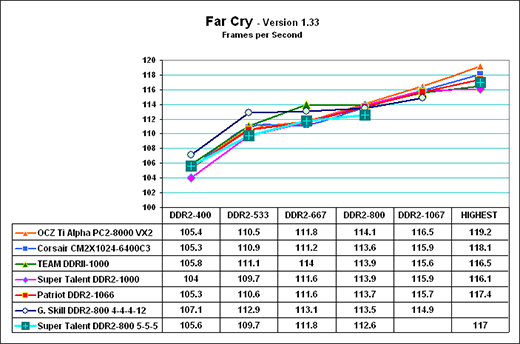
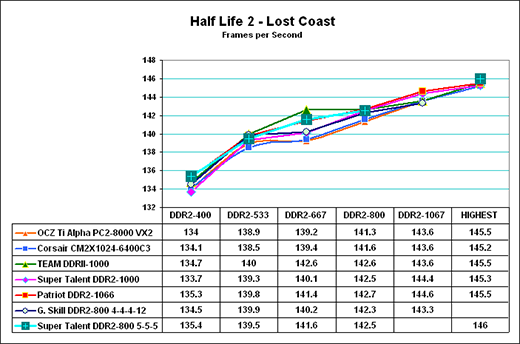
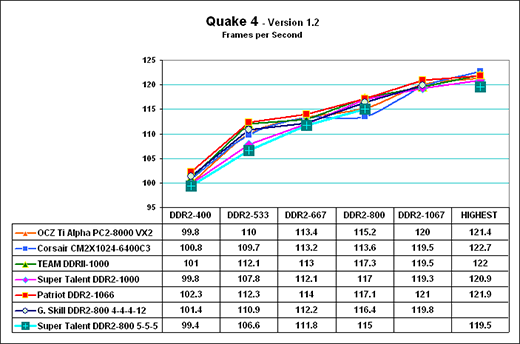
We have said before that the Core 2 Duo chips are not memory starved, and if you look closely you will see that the real world performance of this value RAM is only a bit slower in games than tested memory that costs twice as much. The Super Talent can't reach DDR2-1066, but with a modest overclock at DDR2-1000 the performance is still competitive with the top DDR2 memory we have tested at speeds to DDR2-1000 or higher.
There is no doubt the best memory gives you a few frames per second better gaming performance at all speeds, and it will also allow your system to reach higher CPU overclocks due to the added latitude of the memory. However, the real world difference between 4-4-4 timings and 3-3-3 timings at DDR2-800 is quite small.
It is interesting that memory is varying from 3-2-2-6 timings at DDR2-400 all the way to 5-5-5-15 timings at DDR2-1000. Despite the rapid drop in memory timings, all three games continue to show improvement in frame rates as memory speed increases. Put another way, performance continues to improve as memory speed increases. The Super Talent T800UX2GC5 performance was pretty much as expected. Results were virtually the same as the best DDR2 we have tested to DDR2-800, with a slight drop off due to slower timings at DDR2-800. The Super Talent could not reach DDR-1067, but it did perform well to DDR2-1000 with an 889 ratio pushed to a 300 bus setting (from the stock 266). Memory speed can definitely improve system performance, but not to the extent of an upgraded video card or a higher speed processor.
Real-world benchmarks - specifically gaming benchmarks - provide the most useful measure of memory performance if you keep in mind what they represent. Memory is just one small part of overall gaming performance, and the AnandTech benchmarks keep everything the same except memory speed. Even the CPU speed is kept constant (except for the Highest Speed (overclocking) test). As a result performance improvements in FPS are very small because the only factor influencing the test results is memory speed. Many factors affect system performance, and memory speed is just one of those factors.
Results for high-end memory were very close at tested speeds. Therefore, the scale range was reduced to better show the small differences in these memory benchmark results at each speed. Please keep this in mind when viewing the charts. A normal zero scale would make performance differences appear much smaller than these expanded scale charts. Values for the tested memories are included below each chart for reference.
The AnandTech memory test suite uses Far Cry, Half Life 2 and Quake 4 for memory testing because these games are sensitive to memory performance and they are generally not GPU bound.
We have said before that the Core 2 Duo chips are not memory starved, and if you look closely you will see that the real world performance of this value RAM is only a bit slower in games than tested memory that costs twice as much. The Super Talent can't reach DDR2-1066, but with a modest overclock at DDR2-1000 the performance is still competitive with the top DDR2 memory we have tested at speeds to DDR2-1000 or higher.
There is no doubt the best memory gives you a few frames per second better gaming performance at all speeds, and it will also allow your system to reach higher CPU overclocks due to the added latitude of the memory. However, the real world difference between 4-4-4 timings and 3-3-3 timings at DDR2-800 is quite small.
It is interesting that memory is varying from 3-2-2-6 timings at DDR2-400 all the way to 5-5-5-15 timings at DDR2-1000. Despite the rapid drop in memory timings, all three games continue to show improvement in frame rates as memory speed increases. Put another way, performance continues to improve as memory speed increases. The Super Talent T800UX2GC5 performance was pretty much as expected. Results were virtually the same as the best DDR2 we have tested to DDR2-800, with a slight drop off due to slower timings at DDR2-800. The Super Talent could not reach DDR-1067, but it did perform well to DDR2-1000 with an 889 ratio pushed to a 300 bus setting (from the stock 266). Memory speed can definitely improve system performance, but not to the extent of an upgraded video card or a higher speed processor.
Originally published at https://www.anandtech.com/show/2124 (Wayback Machine).