
The Geometric Future Eskimo Junior 36 AIO Cooler Review: Subdued Minimalism
Testing Results, Maximum Fan Speed
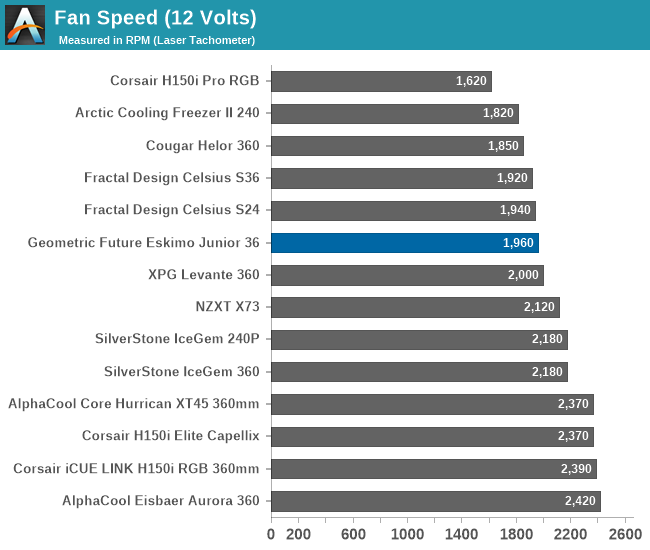
Our maximum speed testing is performed with both the fans and the pump of the kit powered via a 12V DC source. This input voltage should have the pump and fans matching the speed ratings of the manufacturer. According to the company’s specifications, the Squama fans included with the Eskimo Junior 36 should have a rotational speed of 2000 RPM. Our tachometer indicated that the fans were rotating at an average speed of 1960 RPM, very close to their rated specifications.
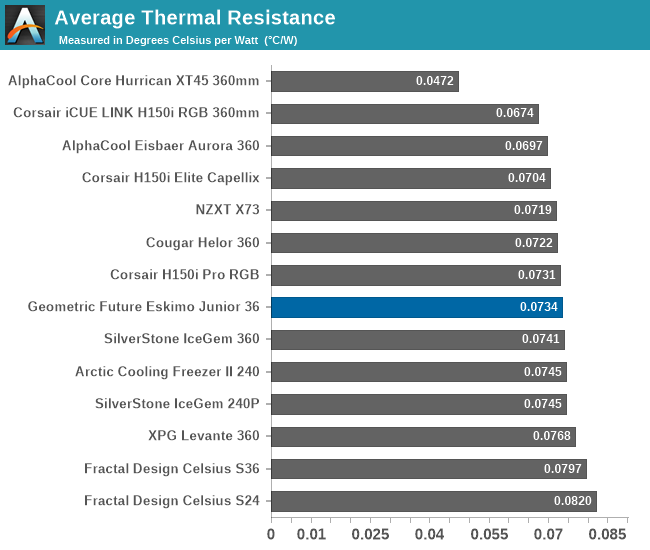
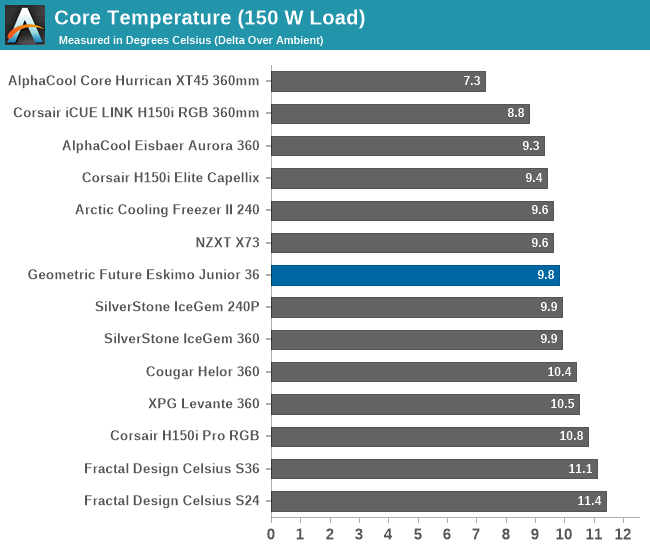
| Core Temperature, Constant Thermal Load (Max Fan Speed) |
The Geometric Future Eskimo Junior 36 demonstrates commendable performance across various loads, with an average thermal resistance of 0.0734 °C/W at its maximum fan speed of 1960 RPM. This figure, while slightly higher than many other 360 mm coolers, is noteworthy considering the relatively low maximum speed of the supplied fans. The cooler appears to be performing very well when the loads are high but loses ground when the load is very low.
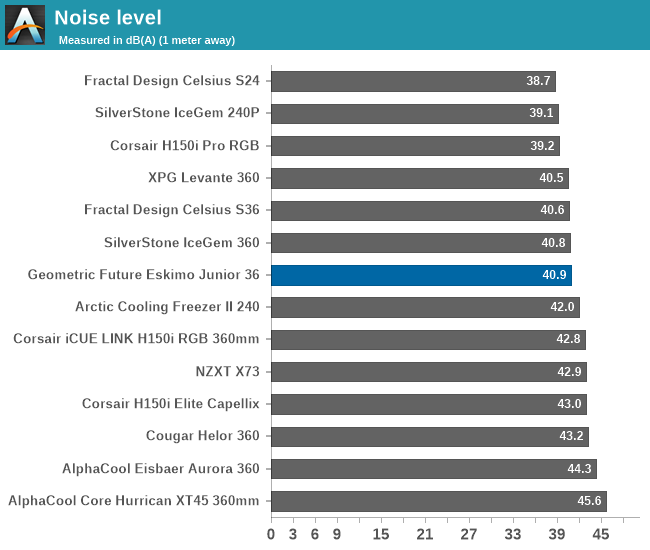
The Eskimo Junior 36 maintains a sound pressure level (SPL) of 40.9 dB(A) at full fan speed, one of the lowest figures amongst the 360 mm AIO coolers in our database. That is not a quiet figure of course – the cooler will be clearly audible even from a distance – but we consider it tolerable for typical gaming/workstation use. 360 mm coolers typically do not run their fans at maximum speed as they can easily cope with the thermal load of CPUs without having to. It is noteworthy to mention that the pump, rated at 30 dB(A) by the manufacturer, is practically inaudible, meaning that nearly all of the noise is aerodynamic noise generated by the three cooling fans.
Testing Results, Low Fan Speed
Using a PWM voltage regulator, we reduced the speed of the fans manually down to half their rated speed. At this setting, the 120 mm Squama fans of the Eskimo Junior 36 rotate at 1000 RPM.
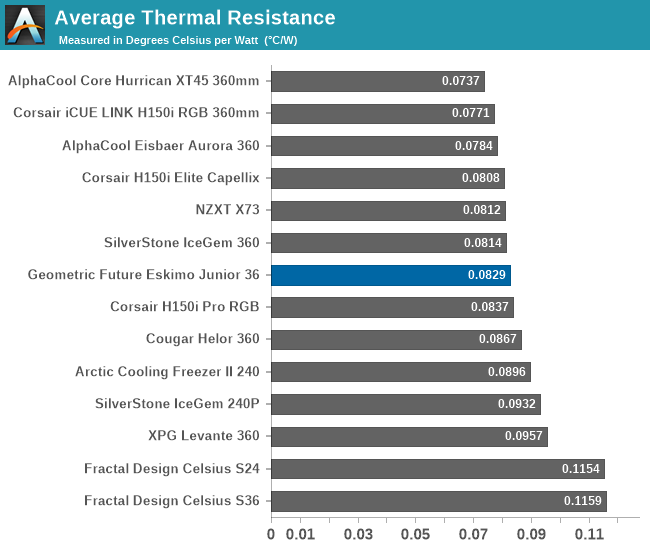
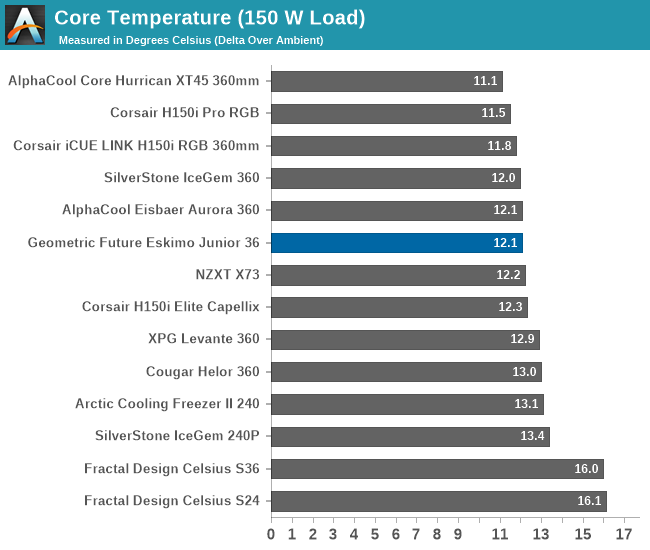
| Core Temperature, Constant Thermal Load (Low Fan Speed) |
The Geometric Future Eskimo Junior 36, when operating at half speed (1000 RPM for the fans), demonstrates fair cooling efficiency with an average thermal resistance of 0.0829 °C/W. Once again, its thermal performance is significantly improved at higher loads, with the cooler falling behind when the loads are low to very low.
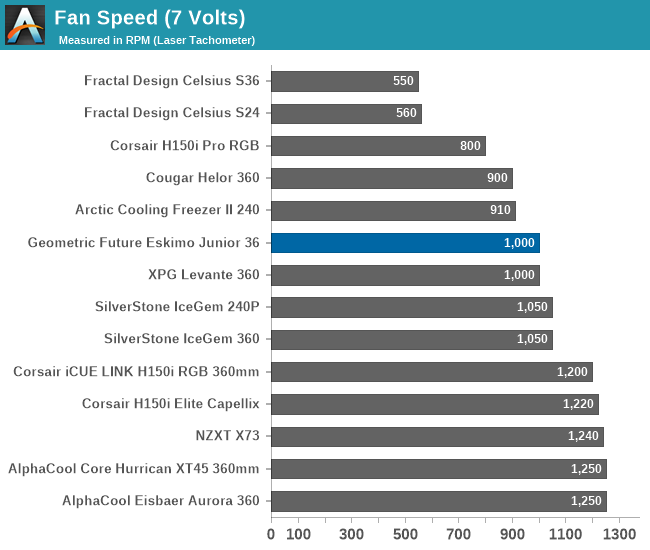
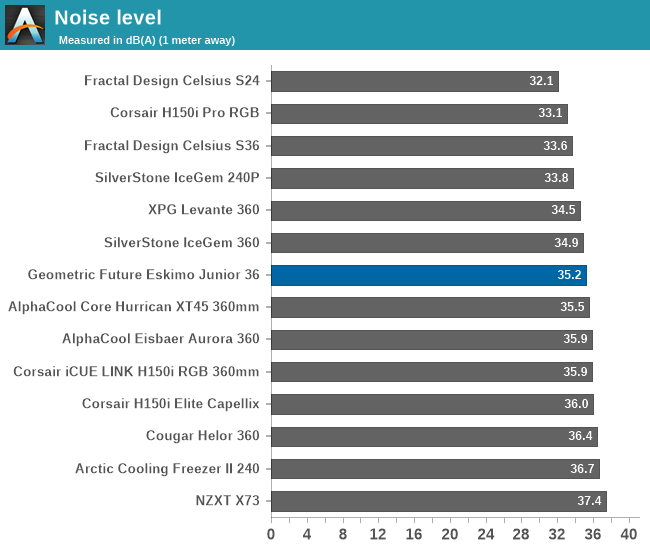
The acoustic performance of the Geometric Future Eskimo Junior 36 cooler is quite good when its fans are operating at half speed. At 1000 RPM the cooler maintains a relatively low noise level of 35.2 dB(A), making it a quieter cooling solution compared to many other models that are running their fans at higher speeds.
Thermal Resistance VS Sound Pressure Level
During our thermal resistance vs. sound pressure level test, we maintain a steady 100W thermal load and assess the overall performance of the coolers by taking multiple temperature and sound pressure level readings within the operating range of the stock cooling fans. The result is a graph that depicts the absolute thermal resistance of the cooler in comparison to the noise generated. For both the sound pressure level and absolute thermal resistance readings, lower figures are better.

The Geometric Future Eskimo Junior 36, while falling slightly behind some similar designs in its category, maintains a competitive stance in the market. It offers good thermal performance that is remarkably linear and shows minimal impact from airflow changes. This performance profile indicates that the Eskimo Junior 36 is a solid choice for those prioritizing scenarios where lower fan speeds are desirable. On the other hand, its thermal performance does not improve significantly at higher airflows, limiting its maximum potential.
Originally published at https://www.anandtech.com/show/21211/the-geometric-future-eskimo-junior-36-aio-cooler-review (Wayback Machine).