
ASRock Industrial 4X4 BOX-7840U mini-PC Review: AMD Phoenix in an UCFF Avatar
Power Consumption and Thermal Characteristics
The power consumption at the wall was measured with a 4K display being driven through the HDMI port of the system. In the graph below, we compare the idle and load power of the ASRock 4X4 BOX-7840U with other systems evaluated before. For load power consumption, we ran the AIDA64 System Stability Test with various stress components, as well as our custom stress test with Prime95 / Furmark, and noted the peak as well as idling power consumption at the wall.
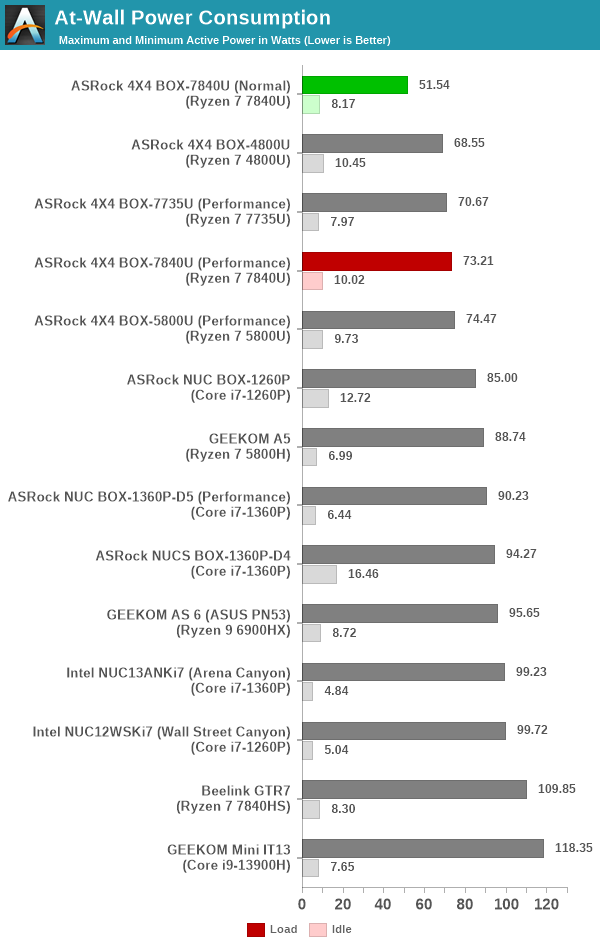
The numbers are consistent with the TDP and suggested PL1 / PL2 values for the processors in the systems, and do not come as any surprise. Idle power consumption of Intel-based systems is very impressive, with the Arena Canyon NUC able to hit a sub-5W number. The 4X4 BOX-7840U in its 28W mode idles at 8.17W. While a part of this number could be attributed to the Gen 4 x4 NVMe SSD in the system, we believe ASRock Industrial can tweak BIOS settings further to optimize this number.
Stress Testing
Our thermal stress routine is a combination of Prime95, Furmark, and Finalwire's AIDA64 System Stability Test. The following 9-step sequence is followed, starting with the system at idle:
- Start with the Prime95 stress test configured for maximum power consumption
- After 30 minutes, add Furmark GPU stress workload
- After 30 minutes, terminate the Prime95 workload
- After 30 minutes, terminate the Furmark workload and let the system idle
- After 30 minutes of idling, start the AIDA64 System Stress Test (SST) with CPU, caches, and RAM activated
- After 30 minutes, terminate the previous AIDA64 SST and start a new one with the GPU, CPU, caches, and RAM activated
- After 30 minutes, terminate the previous AIDA64 SST and start a new one with only the GPU activated
- After 30 minutes, terminate the previous AIDA64 SST and start a new one with the CPU, GPU, caches, RAM, and SSD activated
- After 30 minutes, terminate the AIDA64 SST and let the system idle for 30 minutes
Traditionally, this test used to record the clock frequencies - however, with the increasing number of cores in modern processors and fine-grained clock control, frequency information makes the graphs cluttered and doesn't contribute much to understanding the thermal performance of the system. The focus is now on the power consumption and temperature profiles to determine if throttling is in play.


There were some unforeseen issues with tracking STAPM numbers and other power-related quantities in the system. Therefore, only the at-wall numbers are presented. They track our observations in the 4X4 BOX-7735U review, which helped in inferring the package power limits in both modes.


The thermal solution is able to easily handle the 28W configuration, but we suspect it is not enough to handle the 40W version even with the fan running at full tilt. The comparison of the temperature numbers show the die temperature reaching 95C+ in the performance mode, while it is well below 85C even under extreme stress in the normal mode. This was unlike our experience with ASRock Industrial's Rembrandt-R system, where both modes came out with flying colors in the stress test. Additionally, the lack of support for an effective thermal solution for the NVMe SSD may limit storage performance. We see temperatures in excess of 75C (and possibly kept in check by the SSD controller's throttling) for the drive.
Originally published at https://www.anandtech.com/show/21199/asrock-industrial-4x4-box7840u-minipc-review-phoenix-in-an-ucff-avatar (Wayback Machine).