
Silicon Power MS70 SSD-in-a-Stick Review: Thumb Drive Meets Massive Capacity
The performance of different high-performance UFDs in various real-world access traces as well as synthetic workloads was brought out in the preceding sections. We also looked at the performance consistency for these cases. Power users may also be interested in performance consistency under worst-case conditions, as well as drive power consumption. The latter is also important when used with battery powered devices such as notebooks and smartphones. Pricing is also an important aspect. We analyze each of these in detail below.
Worst-Case Performance Consistency
Flash-based storage devices tend to slow down in unpredictable ways when subject to a large number of small-sized random writes. Many benchmarks use that scheme to pre-condition devices prior to the actual testing in order to get a worst-case representative number. Fortunately, such workloads are uncommon for direct-attached storage devices, where workloads are largely sequential in nature. Use of SLC caching as well as firmware caps to prevent overheating may cause drop in write speeds when a flash-based DAS device is subject to sustained sequential writes.
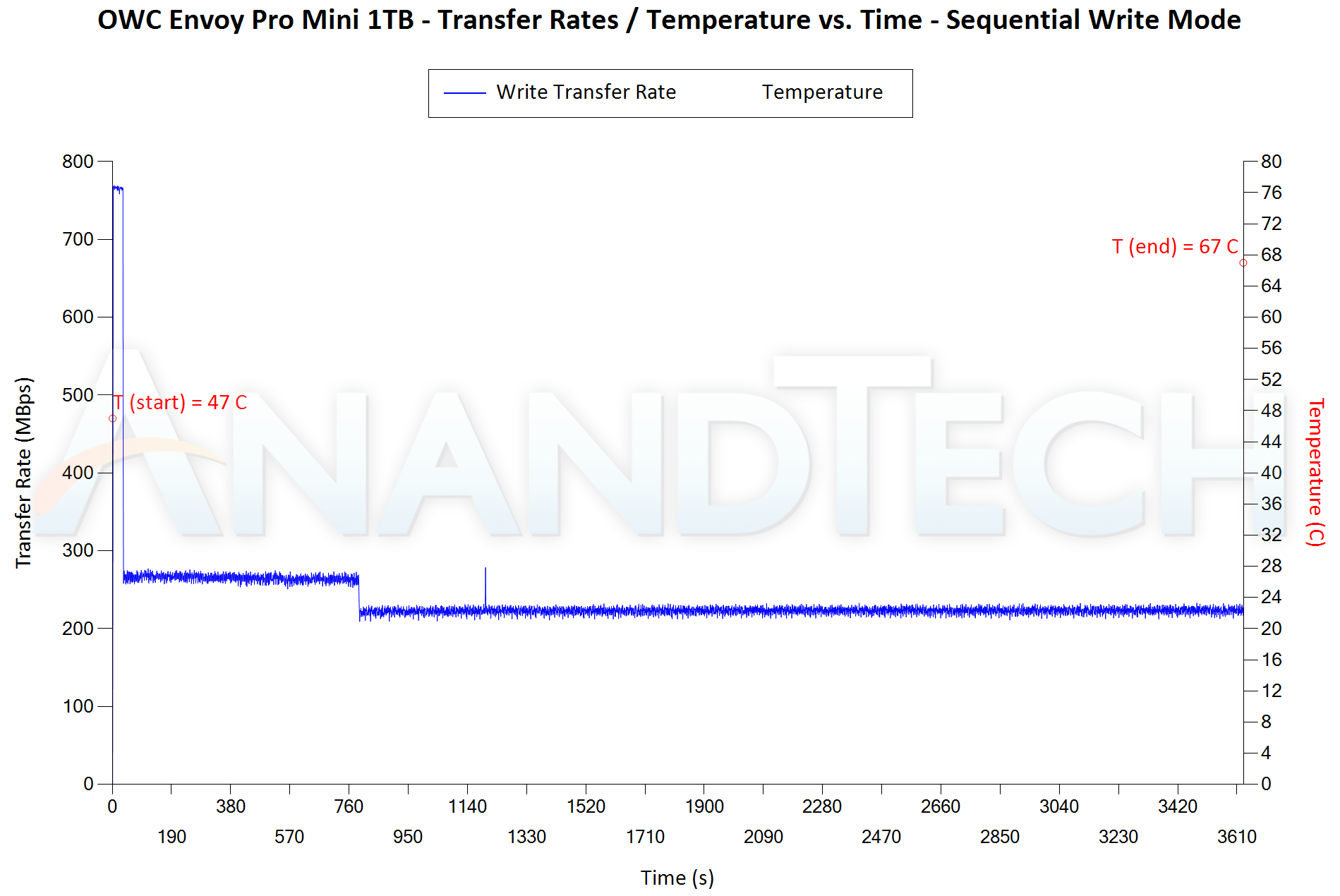
Our Sequential Writes Performance Consistency Test configures the device as a raw physical disk (after deleting configured volumes). A fio workload is set up to write sequential data to the raw drive with a block size of 128K and iodepth of 32 to cover 90% of the drive capacity. The internal temperature is recorded at either end of the workload, while the instantaneous write data rate and cumulative total write data amount are recorded at 1-second intervals.
| Sequential Writes to 90% Capacity - Performance Consistency | |
| TOP: | BOTTOM: |
 |
|
 |
|
The apparent SLC cliff for the Silicon Power MS70 is only around 4GB after which write speeds drop down from 950 MBps to 450 MBps. This sustains for another 50GB before dropping down to 300 MBps for the next 50GB. Beyond that, speeds stabilize around 200 MBps for the remaining span. This SLC caching behavior is very different from the observations we had in the course of the disk-to-disk write transfer workloads where high write speeds were sustained for as long as 50s (pointing to a SLC cache of around 45GB). It is likely that the new Phison firmware does not respond well to high I/O depths compared to the version in the OWC Envoy Pro Mini. A deeper analysis would be nice to do here, but it suffices to say that the performance is good enough for the product's price point.
Power Consumption
Bus-powered devices can configure themselves to operate within the power delivery constraints of the host port. While Thunderbolt ports are guaranteed to supply up to 15W for client devices, USB 2.0 ports are guaranteed to deliver only 2.5W (500mA @ 5V). In this context, it is interesting to have a fine-grained look at the power consumption profile of the various external drives. Using the ChargerLAB KM003C, the bus power consumption of the drives was tracked while processing the CrystalDiskMark workloads (separated by 5s intervals). The graphs below plot the instantaneous bus power consumption against time, while singling out the maximum and minimum power consumption numbers.
| CrystalDiskMark Workloads - Power Consumption | |
| TOP: | BOTTOM: |
 |
|
 |
|
The MS70 has a peak power consumption of 2.97W, though it sips less than 2W during most of the workload processing. Except for the peak numbers, the power consumption profile of the OWC Envoy Pro Mini and the Silicon Power MS70 look remarkably similar, down to the time taken for entry into a deep-sleep state.
Final Words
The Silicon Power MS70 was introduced into the market just last month, and is yet to become widely available. Currently, the drive is available for purchase only in Silicon Power's own storefront. The SKUs are priced at $20 for the 250GB version ($38 outside the year-end promotion period), and $30 for the 500GB one ($46 outside the promotion period), The 1TB and 2TB versions are priced at $63 and $101 respectively. These are very aggressive price points, even better than the 7.5¢ / GB of the Transcend ESD310C we were recommending last month.

Based on the evaluation of different UFDs (thumb drives) based on controllers from both Silicon Motion and Phison, it is clear that the former excels at application workloads, while delivering passable numbers for file transfers. Phison drives are optimized for file transfer workloads, but the delta for regular application access traces is a bit higher than Silicon Motion's delta for the other use case. Silicon Power has attempted to address this by incorporating a large amount of SK hynix 3D TLC NAND flash. That helps the MS70 in providing better overall performance compared to the Silicon Motion units employing the relatively old BiCS 5 NAND from Kioxia.

7TB+ writes, and 4TB+ reads at the end of our testing routine
At around $100 for a 2TB thumb drive, it is easy to look past the minor performance flaws of the MS70. The absolute performance numbers were not great, but the unit was remarkably consistent in delivering them across repeated stress testing. In terms of value proposition, the product comes out on top by a huge margin.
Originally published at https://www.anandtech.com/show/21195/silicon-power-ms70-ssdinastick-review-thumb-drive-meets-massive-capacity (Wayback Machine).