
Intel's Core 2 Extreme QX6700: The Multi-core Era Begins
- Posted in
- CPUs
Analyzing Efficiency Trends
The graph below summarizes the data pretty well; what you're looking at is a graph of normalized performance per watt in six applications as a function of the number of cores in a Core micro-architecture CPU:
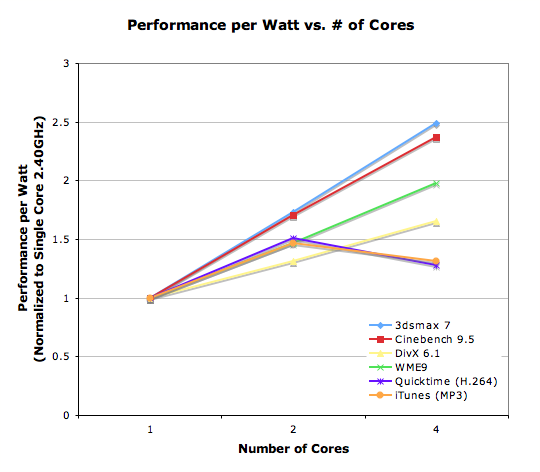
The graph illustrates exactly what we've confirmed here today: having more cores does increase efficiency if the software is designed to take advantage of those additional cores.
We have not yet hit the point of diminishing returns with adding more cores, but the two downward trending curves show the current problem with scaling from two to four cores. Very few desktop applications can take good advantage of a dual core CPU and even fewer are geared for quad core chips, and in those applications these quad core processors are actually a step back in terms of efficiency; it's not a fault of the processor, but rather of the software.
Through the benchmarks on the previous page we also highlighted another important point to take away: even in the areas where performance and efficiency were both improved, they came at a very expensive cost: twice the transistor count of Core 2 Duo. As much as Intel may call the next decade the era of multi-core and thread level parallelism, we simply can't lose focus on improving instruction level parallelism and core level efficiency.
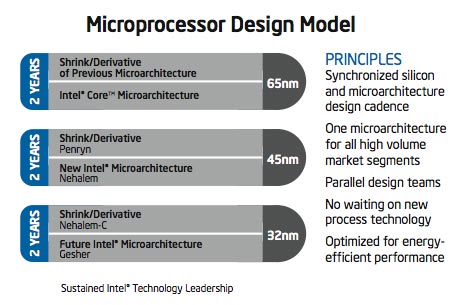
Thankfully Intel has recently announced that it will be updating its micro-architecture every two years in an attempt to avoid problems like what happened with NetBurst and the Pentium 4. If it weren't for this change in microprocessor design model, the quest for more cores would end up no differently than the gigahertz race.
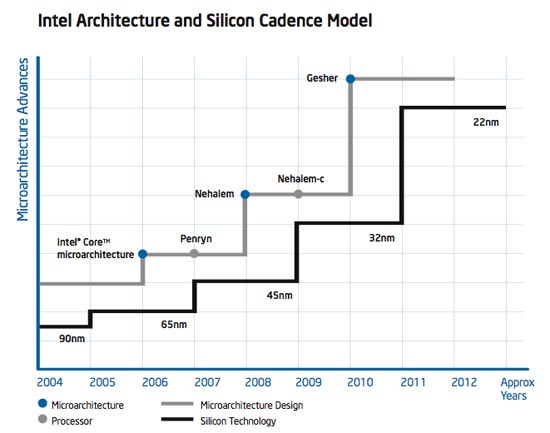
If all goes according to plan, it looks like we will get one of those improvements to ILP and core efficiency by the end of 2007/beginning of 2008 with Nehalem in order to avoid hitting another efficiency brick wall.
Originally published at https://www.anandtech.com/show/2112 (Wayback Machine).