
GEEKOM Mini IT13 Review: Core i9-13900H in a 4x4 Package
Miscellaneous Aspects and Concluding Remarks
Networking and storage are aspects that may be of vital importance in specific PC use-cases. The GEEKOM Mini IT13 comes with an Intel AX211 Wi-Fi 6E / Bluetooth 5.2 controller and an Intel I225-V 2.5G BASE-T solution. The system also includes USB4 with PCIe tunneling support - so it is easy to add external Thunderbolt-based solutions for additional high-speed networking capabilities.
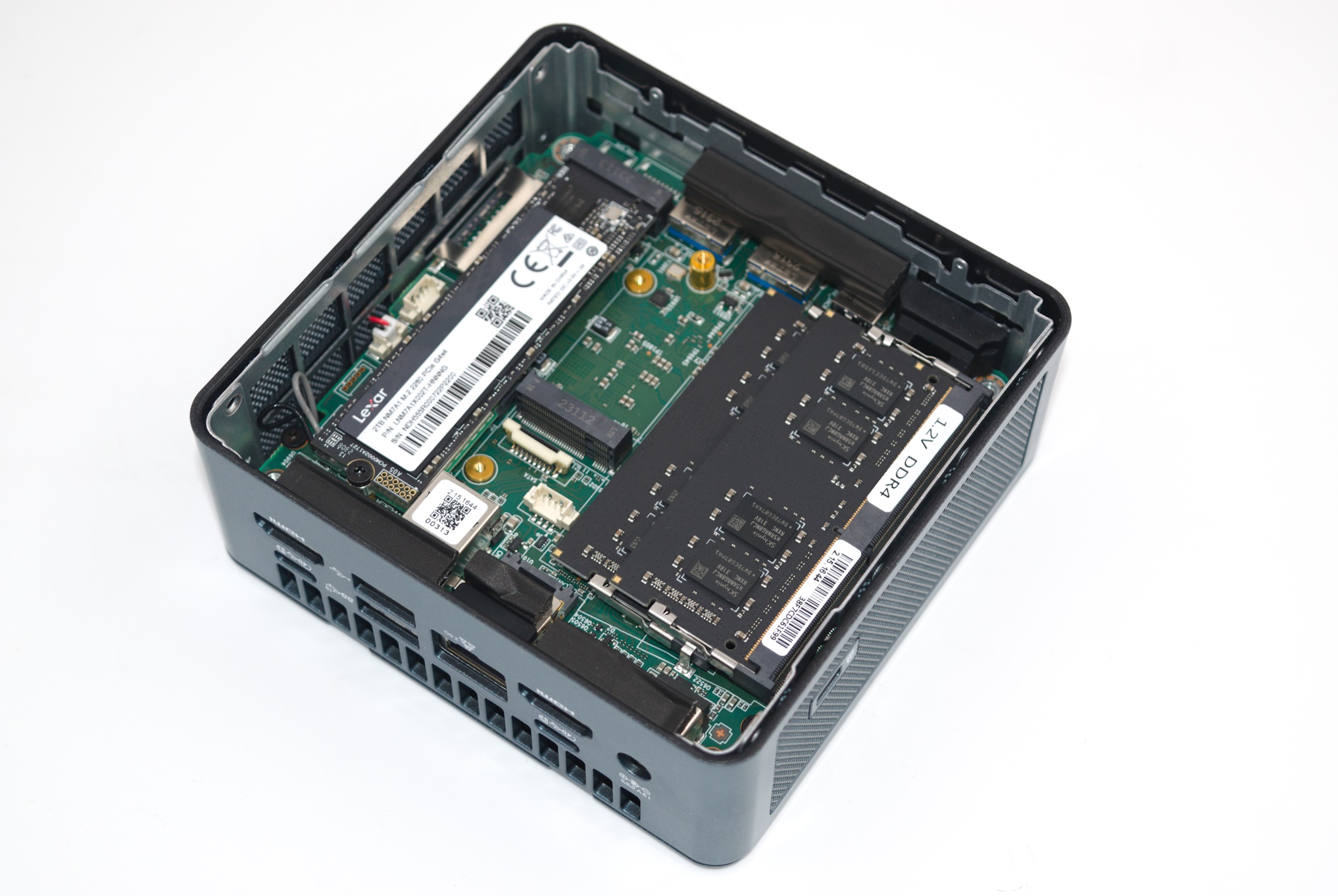
On the storage side, the GEEKOM Mini IT13 came pre-configured with a Lexar SSD NM7A1 2TB M.2 2280 PCIe 4.0 x4 NVMe SSD. It uses a Maxio MAP1602 DRAM-less 4-channel controller. The SSD is a double-sided one, likely using Micron's 176L 3D TLC (based on the flash package markings). The SSD includes a dedicated thermal solution with a thermal pad affixed to the metal frame. Based on the construction, we should likely not be seeing any thermal throttling during usage. The system can also accommodate a 2.5" 7mm drive and a M.2 2242 SATA SSD. From a benchmarking perspective, we provide results from the WPCstorage test of SPECworkstation 3.1. This benchmark replays access traces from various programs used in different verticals and compares the score against the one obtained with a 2017 SanDisk 512GB SATA SSD in the SPECworkstation 3.1 reference system.
| SPECworkstation 3.1.0 - WPCstorage SPEC Ratio Scores | |||
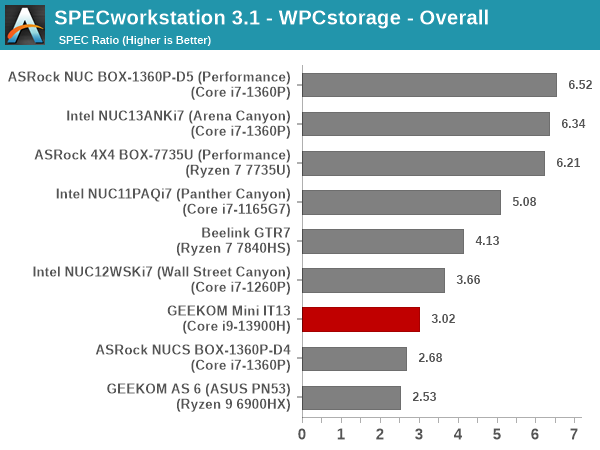
The graphs above present results for different verticals, as grouped by SPECworkstation 3.1. The storage workload consists of 60 subtests. Access traces from CFD solvers and programs such as Catia, Creo, and Soidworks come under 'Product Development'. Storage access traces from the NAMD and LAMMPS molecular dynamics simulator are under the 'Life Sciences' category. 'General Operations' includes access traces from 7-Zip and Mozilla programs. The 'Energy' category replays traces from the energy-02 SPECviewperf workload. The 'Media and Entertainment' vertical includes Handbrake, Maya, and 3dsmax. The overall rating puts the Lexar NM7A1 in the lower half of the pack - having gotten surpassed by systems equipped with SSDs using their own DRAM for the flash translation layer (FTL).
Closing Thoughts
The GEEKOM Mini IT13 provided us with the opportunity to evaluate one of the first Core i9-based UCFF systems in the market. It is loaded with premium features including two full-featured USB4 ports. Having put many Raptor Lake-P systems through our rigorous evaluation, a Raptor Lake-H one provided a slightly different perspective. The Core i9-based system excels in specific tasks such as web browsing that can make good use of the boost clocks and rely on single-threaded performance. However, for the vast majority of office workloads and the like, the addition of two performance cores within a thermally constrained system provides no tangible benefit.
GEEKOM's systems have traditionally adopted a conservative approach to configuring package power limits for their systems. We saw that the GEEKOM AS 6's Ryzen 9 6900HX was configured with a 35W package power limit. The Mini IT13 is also configured similarly, despite its slightly smaller footprint. Based on our benchmarking results, it appears that the Core i9-13900H needs a 45W PL1 configuration to bring out its capabilities. While both Intel and ASRock Industrial's Raptor Lake-P UCFF systems have the SoC configured for 40W PL1, the conservative 35W setting by GEEKOM reflects negatively on the performance. The silver lining is that the fan noise is not overwhelming. GEEKOM also has an even more conservative 'Quiet' mode in the BIOS that reduces the PL1 to 28W.
There is no doubt that the GEEKOM Mini IT13 is equipped with the optimal set of I/O interfaces. Packing six high performance and four efficiency cores into a 4x4 package makes for an interesting product. However, prospective purchasers need to tune their performance expectations keeping the power budget in mind.
The GEEKOM Mini IT13's pricing makes it a winner from a value proposition perspective. The system is currently available for US $889 (2TB SSD / 32GB RAM / Windows 11 Pro) (USD 849 with $40 off coupon code D9ZAYQNX) / US $789 (2TB SSD / 32GB RAM / Windows 11 Pro, GEEKOM web store) (USD 749 with $40 off coupon code anandtech40). Compared to the barebones ASRock Industrial NUC BOX-1360P/D5 at $670 and the Intel NUC13ANHi7 at $699, the addition of the SSD, RAM, and OS license for less than $100 (while also adding two high-performance cores) represents significant value for the end user.
In terms of scope for improvement, we would have liked to see the system come with DDR5 SODIMM support instead of DDR4. Additional focus on the PL1 settings could have resulted in a system that could deliver on both performance and value proposition. As it stands currently, the GEEKOM Mini IT13 is a compelling system that combines an optimal feature set with a rather unique processor for a UCFF desktop. As long as the end user is aware of the tradeoffs involved (lower sustained package power), the investment is bound to be a satisfactory one.
Originally published at https://www.anandtech.com/show/21075/geekom-mini-it13-review-core-i913900h-in-a-4x4-package (Wayback Machine).