
ATI Radeon X1950 Pro: CrossFire Done Right
- Posted in
- GPUs
Power
The current generation of ATI GPUs have been very power hungry. With much higher transistor counts and larger die sizes than competing NVIDIA products, ATI has lagged behind NVIDIA for quite some time in the area of performance per watt. The trade off has been that ATI's parts are more feature complete than NVIDIA's. The price for full time 32bit processing in pixel shaders, angle independent anisotropic filtering, antialiasing of floating point textures, and fine grained branching must be paid somehow. A more power hungry, hotter running chip is certainly a fine trade off to get the performance ATI is capable of delivering.
But with the RV570 that powers the X1950 Pro, we expect to see a little better power consumption. Additional transistors are used for the integrated CrossFire compositing engine, but with fewer pixel shaders and a smaller fab process the X1950 Pro comes in much smaller. R580 weighs in at 384 Million transistors with a 352mm2 die size, while the RV570 GPU is 330 Million transistors and 230mm2. What does all of this translate to in terms of power? Let's take a look.
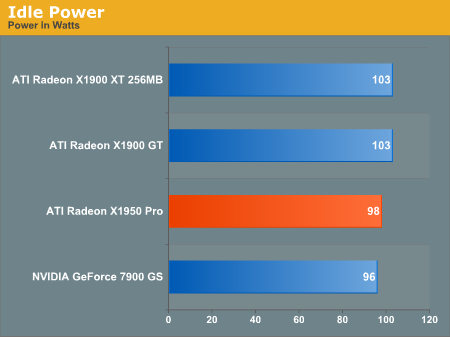
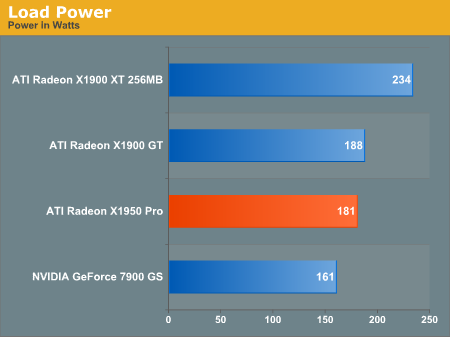
While the X1950 Pro does show a drop in power from the X1900 GT, the decrease isn't huge. Part of this is due to the fact that the X1950 Pro uses faster memory than the X1900 GT (1380MHz as opposed to 1200MHz). Taking the fact that the X1950 Pro is also higher performance than the X1900 GT, we can certainly be happy with what ATI has delivered. Compared to the 7900 GS, the X1950 Pro is higher performance, but also higher power. We'll have to wait until we see an 80nm high end part to see if there will be a decrease in power where it is needed most.
The fan used isn't really louder than the X1900 GT, but the aural quality isn't as desirable in our opinion. The new fan on the X1950 Pro is a little higher pitched and whiny. We would also love to see the 4-pin fan control employed on the rest of the X1950 series here as well, but the control is more important on a larger fan anyway.
Originally published at https://www.anandtech.com/show/2104 (Wayback Machine).