
ATI Radeon X1950 Pro: CrossFire Done Right
- Posted in
- GPUs
Quake 4 Performance
There has always been a lot of debate in the community surrounding pure
timedemo benchmarking. We have opted to stick with the timedemo test rather
than the nettimedemo option for benchmarking Quake 4. To be clear, this means
our test results focus mostly on the capability of each graphics card to
render frames generated by Quake 4. The frame rates we see here don't directly
translate into what one would experience during game play.
Additionally, Quake 4 limits frame rate to 60 fps during gameplay whether or
not VSync is enabled. Performance characteristics of a timedemo do not reflect
actual gameplay. So why do we do them? Because the questions we are trying to
answer have only to do with the graphics subsystem. We want to know what
graphics card is better at rendering Quake 4 frames. Any graphics card that
does better at rendering Quake 4 frames will handle Quake 4 better than
another card. While that doesn't mean the end user will necessarily see higher
performance throughout the game, it does mean that the potential for seeing
more performance is there. For instance, if the user upgrades CPUs while
keeping the same graphics card, having higher potential GPU performance is
going to be important.
What this means to the end user is that in-game performance will almost always
be lower than timedemo performance. It also means that graphics cards that do
slightly better than other graphics cards will not always show a tangible
performance increase on an end user's system. As long as we keep these things
in mind, we can make informed conclusions based on the data we collect.
Our benchmark consists of the first few minutes of the first level. This
includes both inside and outdoor sections, with the initial few fire fights.
We tested the game with Ultra Quality settings (uncompressed normal maps), and
we enabled all the advanced graphics options except for VSync. Id does a
pretty good job of keeping framerate very consistent, and so in-game
framerates of 25 are acceptable. While we don't have the ability to make a
direct mapping to what that means in the timedemo test, our experience
indicates that a timedemo fps of about 35 translates into an enjoyable
experience on our system. This will certainly vary on other systems, so take
it with a grain of salt. The important thing to remember is that this is more
of a test of relative performance of graphics cards when it comes to rendering
Quake 4 frames -- it doesn't directly translate to Quake 4 experience.
Before we get to performance analysis here, we must note that ATI has confirmed our numbers and indicated that Quake 4 performance with X1950 Pro CrossFire suffers from a driver issue that will be resolved in an upcoming version of Catalyst drivers.
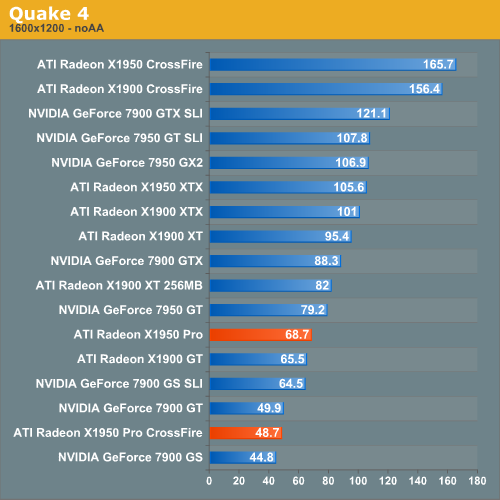
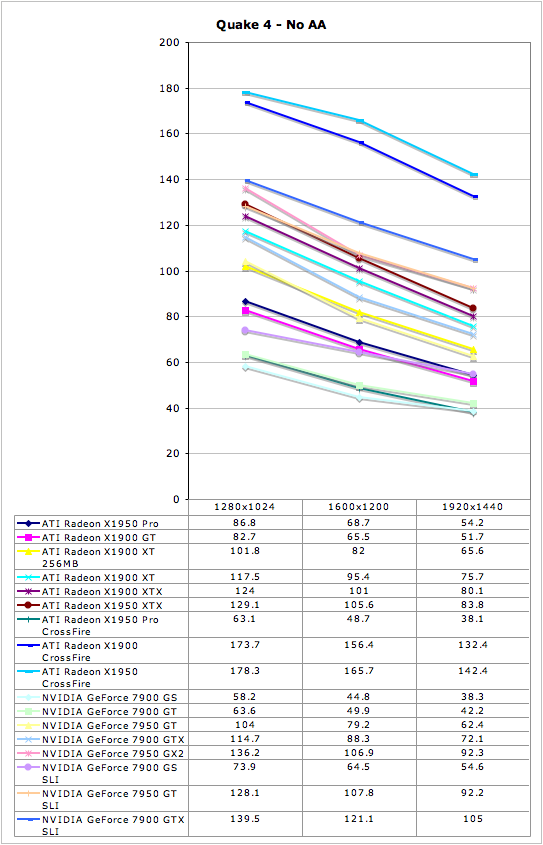
A single 7900 GS loses quite handily to the X1950 Pro under Quake 4 without AA enabled. We won't be able to talk about X1950 Pro CrossFire performance until ATI fixes the current driver issue. For now, we do see proper scaling under Quake 4 with High Quality mode enabled rather than Ultra Quality.
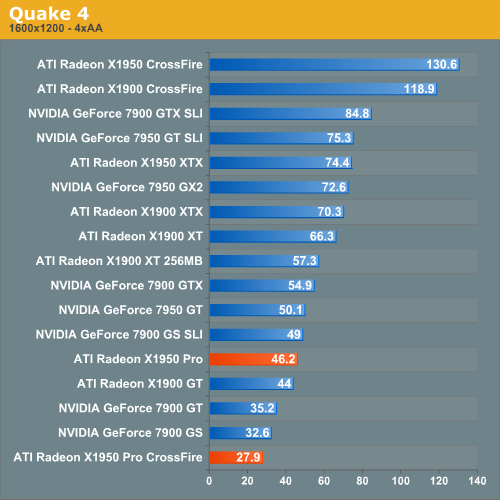
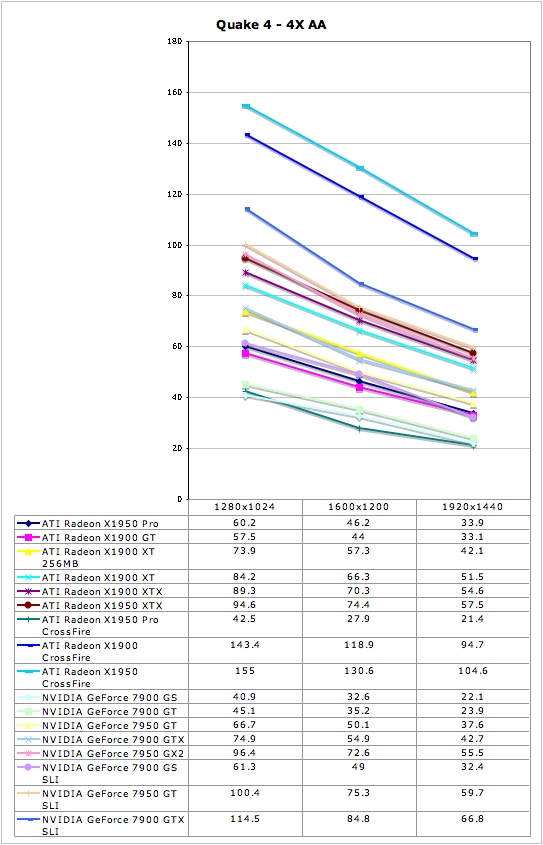
Performance characteristics with 4xAA enabled are similar to those without AA.
The 7900 GS does close the gap a little with the X1950 Pro, but it isn't
nearly enough to put them in the same category.
Originally published at https://www.anandtech.com/show/2104 (Wayback Machine).