
Super Talent & TEAM Join the Fast DDR2 Club
- Posted in
- Memory
Performance Comparison
While Sandra and Super Pi provide useful information on how memory performs, the real test is real-world benchmarks - specifically gaming benchmarks. We use Far Cry, Half-Life 2 and Quake 4 for memory testing because they are sensitive to memory changes, making them useful for examining memory performance.
Since the results were so close at all tested speeds, the scale range was reduced to better show the small differences in these memories. Please keep this in mind when viewing the charts, since a normal zero scale would make performance differences appear much smaller than these expanded scale charts. Values for each memory at each speed are included below each chart for reference.
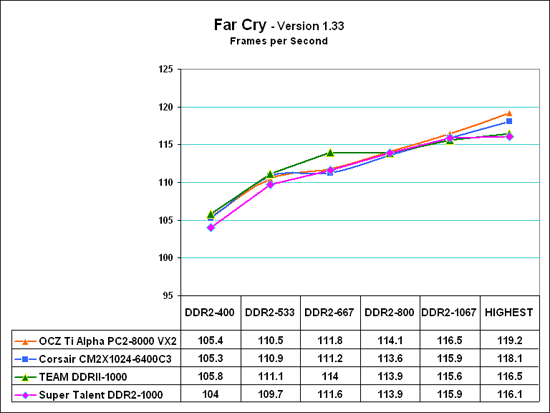
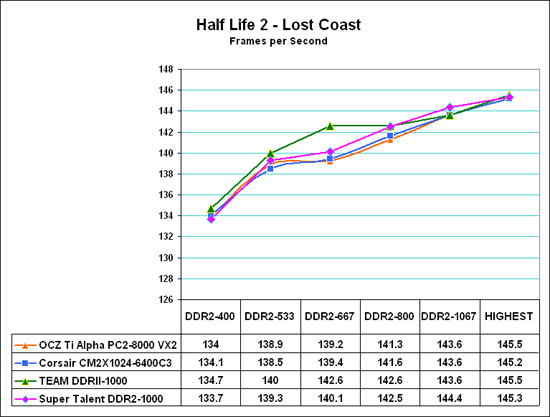
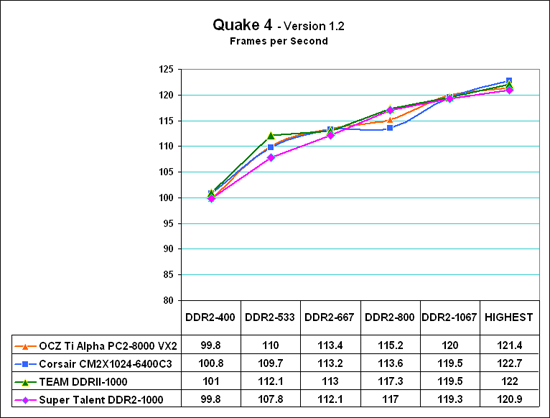
All three games continue to show improvement in frame rates as memory speed increases, even though timings are looser the faster we go. Put another way, performance continues to improve as memory speed increases - to DDR2-1067 and a bit beyond. The TEAM is still capable of operating at 4-3-4 timings at DDR2-1067, and the Super Talent is only a bit slower at 4-3-5 timings. At the bottom of the scaling chart Super Talent requires a 3 RAS-to-CAS setting, while the other 3 memories are stable at a 2 setting. This is reflected in the general drop-off at the bottom and top for Super Talent, while the TEAM memory mirrors the results of the OCS and Corsair. The performance differences are admittedly very small - but still measurable. Memory speed can definitely improve system performance, but not to the extent of an upgraded video card or a higher speed processor.
While Sandra and Super Pi provide useful information on how memory performs, the real test is real-world benchmarks - specifically gaming benchmarks. We use Far Cry, Half-Life 2 and Quake 4 for memory testing because they are sensitive to memory changes, making them useful for examining memory performance.
Since the results were so close at all tested speeds, the scale range was reduced to better show the small differences in these memories. Please keep this in mind when viewing the charts, since a normal zero scale would make performance differences appear much smaller than these expanded scale charts. Values for each memory at each speed are included below each chart for reference.
All three games continue to show improvement in frame rates as memory speed increases, even though timings are looser the faster we go. Put another way, performance continues to improve as memory speed increases - to DDR2-1067 and a bit beyond. The TEAM is still capable of operating at 4-3-4 timings at DDR2-1067, and the Super Talent is only a bit slower at 4-3-5 timings. At the bottom of the scaling chart Super Talent requires a 3 RAS-to-CAS setting, while the other 3 memories are stable at a 2 setting. This is reflected in the general drop-off at the bottom and top for Super Talent, while the TEAM memory mirrors the results of the OCS and Corsair. The performance differences are admittedly very small - but still measurable. Memory speed can definitely improve system performance, but not to the extent of an upgraded video card or a higher speed processor.
Originally published at https://www.anandtech.com/show/2099 (Wayback Machine).