
Super Talent & TEAM Join the Fast DDR2 Club
- Posted in
- Memory
Stock Memory Performance
Most Intel processor motherboards provide a wide range of memory ratios that match available DDR2 memory. End-users can select the memory ratio that matches their DDR2 memory speed. For those reasons, we first test all of the stock ratios at the fastest stable timings we can achieve at the given ratio. With ratios, CPU speed remains the same at 2.93GHz in our memory test bed, and memory speed is varied by selecting different ratios.
There are some downsides to this approach. With the memory controller in the chipset, instead of part of the processor as in AM2 systems, there is a small performance penalty for speeds other than a 1:1 ratio (DDR2-533 in this case). However the penalty is in reality very small and memory scales nicely through the various speed options. DDR2 memory is then pushed from the highest stock ratio that could be achieved in testing - in this case 1067 - to the highest FSB speed at the stock multiplier.
Super Talent DDR2-1000
The Super Talent reached a stable speed of 1080, which is below the fastest DDR2 speed we have tested, but still well above the rated specs of DDR2-1000. While the system could boot at speeds as high as DDR2-1100, the Super Talent could not complete our benchmark tests at higher than DDR2-1080.
While the Super Talent reached similar speeds achieved with other top DDR2 memory, a closer look at the performance chart shows the Super Talent generally required a little more voltage and/or a little slower timings for stability at the top and bottom of our memory ratios tests. Where other top DDR2 runs fine at 3-2-2 timings at DDR2-400 and DDR2-533, the Super Talent required 3-2-3 timings. In fact, the memory seemed to be completely averse to running at a 2 setting for RAS-to-CAS at any speed, requiring 3 for that timing. Super Talent also requires a bit more voltage - .05V to .10V more at most speeds - to perform with complete stability. This may mean something as simple as the SPD needs a bit more refinement, or it could reflect different binning procedures compared to Corsair and OCZ.
In the middle range, the important DDR2-800 and DDR2-667, the Super Talent DDR2-100 performed virtually the same as the best we have tested. The message here is that if DDR2-800 is the fastest you will run, the Super Talent performs as well as anything you can buy.
TEAM DDR2-1000
The TEAM performance numbers are so close to our past Corsair and OCZ test results that we can only conclude that the memory chips have to be Micron, which is certainly a good thing. While the TEAM DDR2-1100 topped out at DDR2-1084, the memory matched the best timings we have seen at all the standard test ratios - including DDR2-1067. Required voltages were also similar at each ratio. Together this means that over almost all of the useful range of memory performance the TEAM DDR2-1000 is equivalent to the best DDR2 we have tested at AnandTech.
The TEAM will not reach well over 1100, as the best Corsair and OCZ do, but it performs exactly the same to DDR2-1067 and a bit beyond. If you plan to run the memory in that range then you will be just as happy with TEAM as any DDR2 you can buy and you might save a few dollars on your purchase. However, if your goal is the highest memory speed you can achieve, then you will need to go with the OCZ Alpha VX2 or the Corsair 6400C3.
Most Intel processor motherboards provide a wide range of memory ratios that match available DDR2 memory. End-users can select the memory ratio that matches their DDR2 memory speed. For those reasons, we first test all of the stock ratios at the fastest stable timings we can achieve at the given ratio. With ratios, CPU speed remains the same at 2.93GHz in our memory test bed, and memory speed is varied by selecting different ratios.
There are some downsides to this approach. With the memory controller in the chipset, instead of part of the processor as in AM2 systems, there is a small performance penalty for speeds other than a 1:1 ratio (DDR2-533 in this case). However the penalty is in reality very small and memory scales nicely through the various speed options. DDR2 memory is then pushed from the highest stock ratio that could be achieved in testing - in this case 1067 - to the highest FSB speed at the stock multiplier.
Super Talent DDR2-1000
 |
| Click to enlarge |
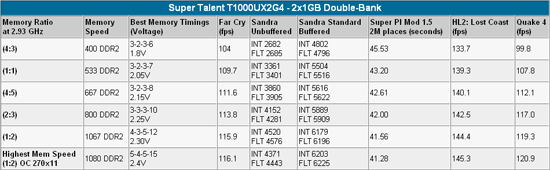
The Super Talent reached a stable speed of 1080, which is below the fastest DDR2 speed we have tested, but still well above the rated specs of DDR2-1000. While the system could boot at speeds as high as DDR2-1100, the Super Talent could not complete our benchmark tests at higher than DDR2-1080.
While the Super Talent reached similar speeds achieved with other top DDR2 memory, a closer look at the performance chart shows the Super Talent generally required a little more voltage and/or a little slower timings for stability at the top and bottom of our memory ratios tests. Where other top DDR2 runs fine at 3-2-2 timings at DDR2-400 and DDR2-533, the Super Talent required 3-2-3 timings. In fact, the memory seemed to be completely averse to running at a 2 setting for RAS-to-CAS at any speed, requiring 3 for that timing. Super Talent also requires a bit more voltage - .05V to .10V more at most speeds - to perform with complete stability. This may mean something as simple as the SPD needs a bit more refinement, or it could reflect different binning procedures compared to Corsair and OCZ.
In the middle range, the important DDR2-800 and DDR2-667, the Super Talent DDR2-100 performed virtually the same as the best we have tested. The message here is that if DDR2-800 is the fastest you will run, the Super Talent performs as well as anything you can buy.
TEAM DDR2-1000
 |
| Click to enlarge |
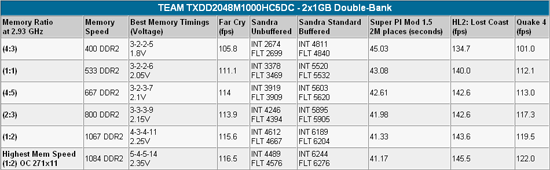
The TEAM performance numbers are so close to our past Corsair and OCZ test results that we can only conclude that the memory chips have to be Micron, which is certainly a good thing. While the TEAM DDR2-1100 topped out at DDR2-1084, the memory matched the best timings we have seen at all the standard test ratios - including DDR2-1067. Required voltages were also similar at each ratio. Together this means that over almost all of the useful range of memory performance the TEAM DDR2-1000 is equivalent to the best DDR2 we have tested at AnandTech.
The TEAM will not reach well over 1100, as the best Corsair and OCZ do, but it performs exactly the same to DDR2-1067 and a bit beyond. If you plan to run the memory in that range then you will be just as happy with TEAM as any DDR2 you can buy and you might save a few dollars on your purchase. However, if your goal is the highest memory speed you can achieve, then you will need to go with the OCZ Alpha VX2 or the Corsair 6400C3.
Originally published at https://www.anandtech.com/show/2099 (Wayback Machine).