
Dell XPS 410: Core 2 Duo for the Masses
- Posted in
- Systems
Noise and Power
Another aspect of system performance that we like to test is the noise and power requirements. Dell is marketing the XPS 410 as a multimedia computer, and in that case lowered noise levels are even more important. We tested noise and power at three settings: idle, 100% CPU, and maximum CPU + GPU. 100% CPU load is achieved by running two instances of Folding@Home (FAH). For the maximum stress test, we leave FAH running and launch the Splinter Cell: Chaos Theory benchmark at 1600x1200 4xAA/8xAF. Performing video encoding or other CPU intensive tasks while playing a game will achieve a similar CPU load.
Some of our readers have questioned in the past why we even perform such heavy stress test scenarios. After all, there are a lot of people that will never run two CPU intensive tasks along with a game to fully stress their computer, right? The problem is, we don't know what the future holds. Right now, most games and applications will not achieve the same load levels that we are using. In another year, however, newer products and games may actually reach the point where "typical use" scenarios put a similar stress on a system. We consider the maximum load test a worst-case scenario, but provided the systems can run fully stable throughout our testing then we can say with some confidence that they will be okay with future applications and games.
For the ABS system, noise results basically showed no difference between any of the clock speeds, as all of the fans run at a constant RPM. However, the water cooling fan does come with the ability to control fan speed, so we set that to minimum for idle testing and then a middle and maximum speed to show the difference in noise levels.
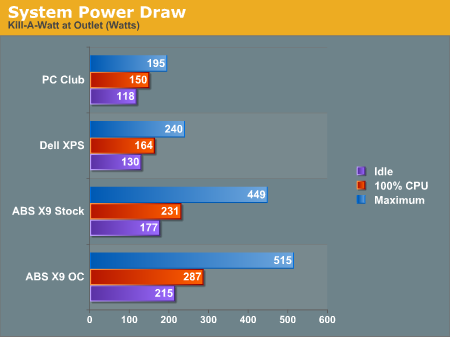
Starting with power requirements, it should come as little surprise that faster CPUs and GPUs require more power. In comparison to the ABS Ultimate X9, the power requirements of the Dell and PC Club computers are extremely low, with the Dell using slightly more power. Using two faster graphics cards, a faster CPU, not to mention the water cooling configuration and hard drives clearly requires a lot more power than a typical midrange computer.
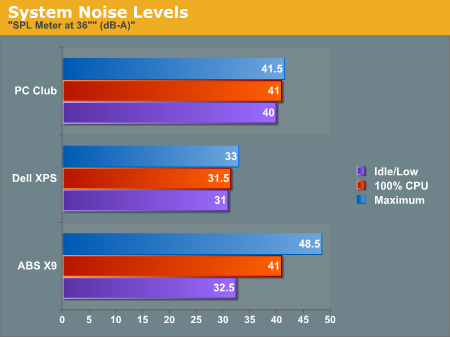
Looking at noise levels, all the tested computers have a relatively consistent noise output. The ABS Ultimate X9 is louder than the others at maximum fan speed and very quiet at minimum fan speed, but again we note that the X9 was not entirely stable during testing in the original configuration, and for high stress situations you will definitely want to increase the fan RPMs.
The Dell XPS 410 does very well in the noise and power benchmarks. If you had any concerns about the 375W power supply, the highest power draw we were able to achieve was 240W, which should leave you plenty of leeway. The noise levels are clearly better than the competition, and only under maximum load were we able to generate slightly more noise than at idle. Of course, if one of the optical drives spins up to maximum speed, the noise readings jump up to about 46 dB, but we're talking about constant system noise and not optical drive noise. Dell's use of a BTX form factor chassis and motherboard certainly appears to have helped them keep noise levels low; now users just need to remember to clean the dust off the fan intakes every now and then.
Another aspect of system performance that we like to test is the noise and power requirements. Dell is marketing the XPS 410 as a multimedia computer, and in that case lowered noise levels are even more important. We tested noise and power at three settings: idle, 100% CPU, and maximum CPU + GPU. 100% CPU load is achieved by running two instances of Folding@Home (FAH). For the maximum stress test, we leave FAH running and launch the Splinter Cell: Chaos Theory benchmark at 1600x1200 4xAA/8xAF. Performing video encoding or other CPU intensive tasks while playing a game will achieve a similar CPU load.
Some of our readers have questioned in the past why we even perform such heavy stress test scenarios. After all, there are a lot of people that will never run two CPU intensive tasks along with a game to fully stress their computer, right? The problem is, we don't know what the future holds. Right now, most games and applications will not achieve the same load levels that we are using. In another year, however, newer products and games may actually reach the point where "typical use" scenarios put a similar stress on a system. We consider the maximum load test a worst-case scenario, but provided the systems can run fully stable throughout our testing then we can say with some confidence that they will be okay with future applications and games.
For the ABS system, noise results basically showed no difference between any of the clock speeds, as all of the fans run at a constant RPM. However, the water cooling fan does come with the ability to control fan speed, so we set that to minimum for idle testing and then a middle and maximum speed to show the difference in noise levels.
Starting with power requirements, it should come as little surprise that faster CPUs and GPUs require more power. In comparison to the ABS Ultimate X9, the power requirements of the Dell and PC Club computers are extremely low, with the Dell using slightly more power. Using two faster graphics cards, a faster CPU, not to mention the water cooling configuration and hard drives clearly requires a lot more power than a typical midrange computer.
Looking at noise levels, all the tested computers have a relatively consistent noise output. The ABS Ultimate X9 is louder than the others at maximum fan speed and very quiet at minimum fan speed, but again we note that the X9 was not entirely stable during testing in the original configuration, and for high stress situations you will definitely want to increase the fan RPMs.
The Dell XPS 410 does very well in the noise and power benchmarks. If you had any concerns about the 375W power supply, the highest power draw we were able to achieve was 240W, which should leave you plenty of leeway. The noise levels are clearly better than the competition, and only under maximum load were we able to generate slightly more noise than at idle. Of course, if one of the optical drives spins up to maximum speed, the noise readings jump up to about 46 dB, but we're talking about constant system noise and not optical drive noise. Dell's use of a BTX form factor chassis and motherboard certainly appears to have helped them keep noise levels low; now users just need to remember to clean the dust off the fan intakes every now and then.
Originally published at https://www.anandtech.com/show/2081 (Wayback Machine).