
Apple's Mac Pro - Upgrading CPUs, Memory & Running XP
- Posted in
- Mac
Encoding Performance using DivX 6.1, WME9, Quicktime (H.264) & iTunes
Multimedia encoding is typically a very good CPU benchmark, with performance that scales very nearly linearly with faster CPU clock speeds. Video testing was conducted using three popular codecs and applications: Xmpeg 5.03 with DivX 6.1, Windows Media Encoder with WMV9, and QuickTime 7.1 with H.264. The complexity of the encoding process increases as we move from DivX to WMV9, and H.264 encoding is in a league of its own in terms of the amount of CPU time required. Audio encoding performance was also tested using iTunes; MP3 encoding is less time-consuming and video encoding, but it continues to stress CPU performance.
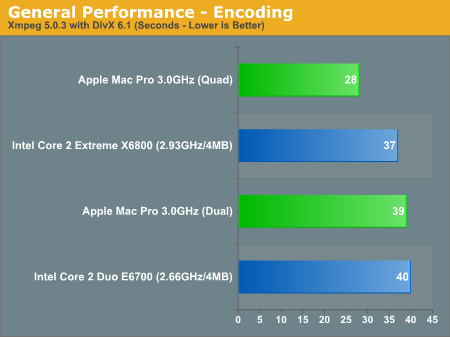
With only two cores enabled the Mac Pro at 3.0GHz is about 5% slower than the Core 2 Extreme X6800, once again thanks to its high latency FB-DIMMs that erase any benefits the faster FSB and clock speeds would have provided. With all four cores enabled however, the Mac Pro manages to perform our encoding test in a mere 28 seconds - an improvement of almost 30%.
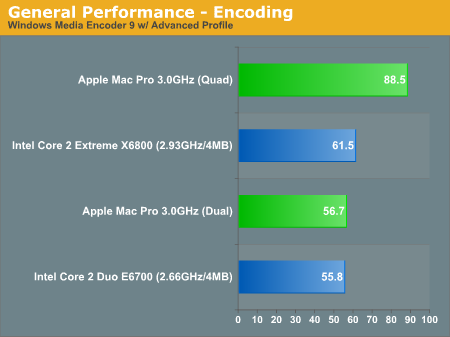
The same situation exists under WME9, where the Mac Pro with only two cores enabled ends up being a bit slower than a two core Core 2 Extreme platform thanks to its memory subsystem. But with all four cores enabled, WME9 performance skyrockets. For the PC users reading - this is the sort of performance you can expect to see from Kentsfield in the coming months, all in a single socket.
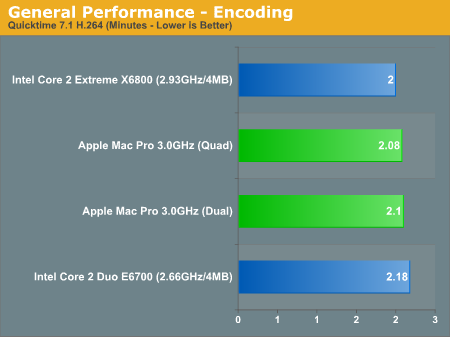
Our Quicktime test gets virtually no boost from having four cores, and thus both Mac Pro configurations end up a bit slower than the Core 2 Extreme for the same reasons as before.
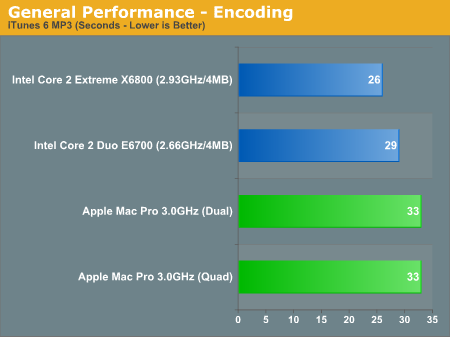
The iTunes tests show no advantage offered by the four core Mac Pro, so the FB-DIMM penalty makes both Mac Pro configurations slower than even our Core 2 Duo E6700 test platform.
Originally published at https://www.anandtech.com/show/2079 (Wayback Machine).