
Fall '06 NVIDIA GPU Refresh - Part I: GeForce 7900 GS
- Posted in
- GPUs
XFX 480M Extreme vs. Stock Performance
We are quite interested in understanding the scalability of this new 7 vertex pipe, 5 quad configuration. In order to demonstrate the performance increase we can expect from overclocked 7900 GS parts, we've run percent increase numbers from stock performance to the performance we measured with the XFX 480M Extreme version.
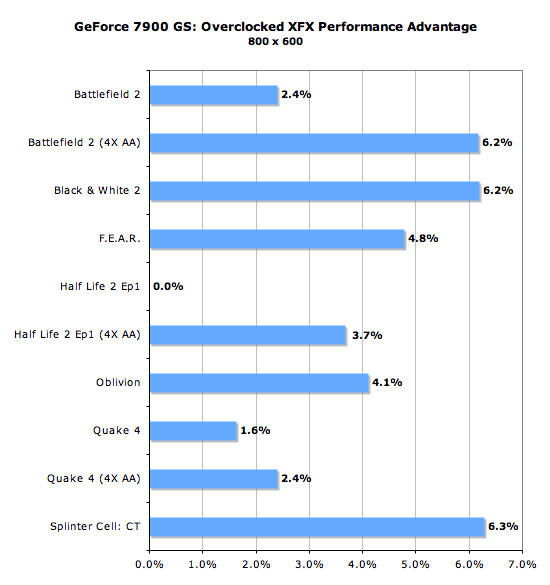
800 x 600 1024 x 768 1280x1024 1600x1200 1920x1440
Interestingly, it seems like the largest performance difference between our stock and overclocked 7900 GS cards occurs at 1024x768. With a 6.7% core clock boost and a 6% memory clock increase, the XFX 480M Extreme is able to consistently perform over 6% faster than its stock brethren. The increased clocks allow for an increase in performance of up to 12% if a game makes full use of both memory bandwidth and pure processing power. Note, that the maximum theoretical performance increase shouldn't simply be memory clock percent increase added to core clock percent increase: it's a much more complex relationship that we can't explain without intimate knowledge of how NVIDIA handles latency hiding, data moving, and scheduling.
With Oblivion, we hit over a 11% increase. This indicates that the latest Elder Scrolls game is very tough on all aspects of a graphics card. The fact that the game reflects a very higher performance increase can also be explained by the higher than normal variance of our FRAPS test with Oblivion.
Originally published at https://www.anandtech.com/show/2075 (Wayback Machine).