
Silence is Golden: Silent GPU Roundup
- Posted in
- GPUs
The Elder Scrolls IV: Oblivion
Oblivion is the most graphically intensive game we have for testing the cards in this review. It's also one of the more troublesome games to benchmark because it doesn't have any built-in demo recording/playback features and there is a large variance in performance between the different areas (outside and inside, forests and gates, etc.) of this vast game. In order to resolve this to a degree, we have two separate benchmarks we use for Oblivion: one takes place outside walking towards an Oblivion gate, and the second is in one of the towns (Bruma) walking past several characters in a snowy daylight environment.
Because Oblivion has so much eye candy, having the graphics settings on higher quality (with settings like "distant lands" turned on, and item/actor distances set for longer distances, etc.) can result in a massive performance hit in even high-end graphics cards. Since we are dealing with mid-range and low-end cards in this review, we had to turn many of the quality settings down quite a bit in order to get playable results (and even then some of the cards fall short in the Gate benchmark). Here are the graphical settings we used for Oblivion.
The first benchmark through the town is less demanding on graphics hardware than the second one with an Oblivion gate. With the "distant lands" setting to off as well as the "view distance" set to 50%, the world seems strangely limited, especially for those who have experienced the game with extended view distances. The game is still technically playable at these settings however.
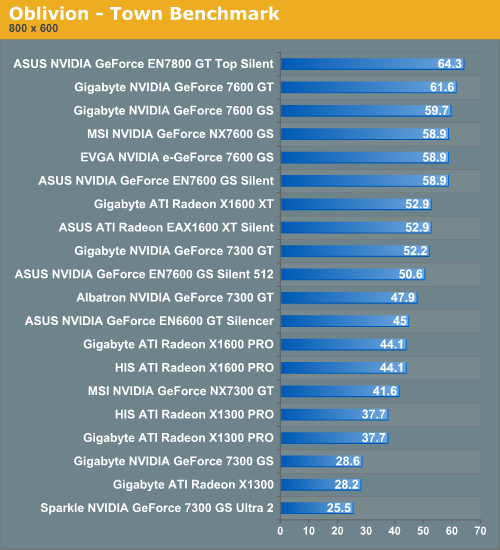
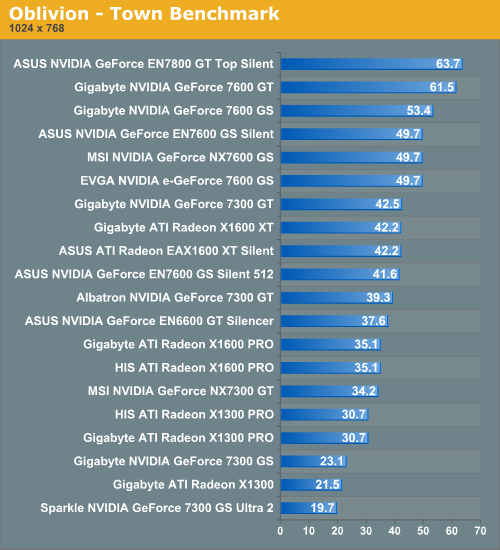
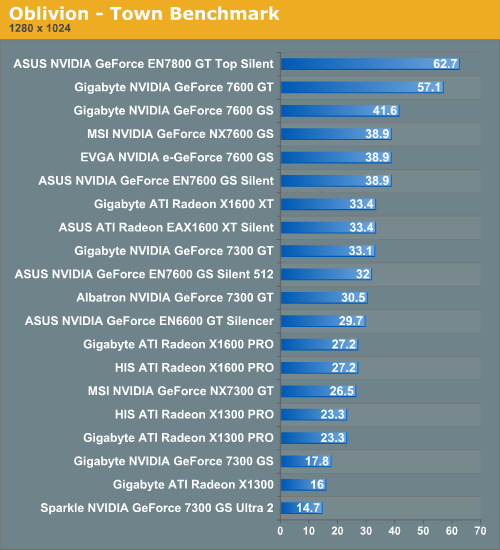
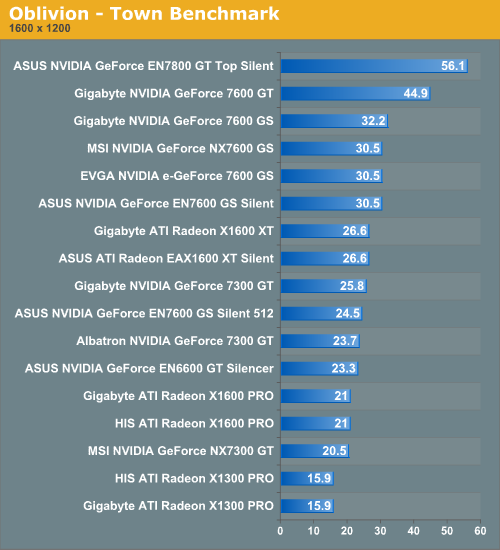
The framerates above show that these cards run this benchmark fairly well, with many cards handling 1600x1200 aside from the obvious issues with 128 MB cards (the Sparkle 7300 GS Ultra 2, Gigabyte 7300 GS, and Gigabyte X1300) and all the ATI cards except the X1600 XT. Not much is going on in this benchmark, however, aside from a few townsfolk walking around and snow falling between the buildings.
For those that have played the game, an Oblivion gate is an impressive visual spectacle to behold, very reminiscent of the "Eye" effect for Sauron in Peter Jackson's epic Lord of the Rings movies. The fact that the second benchmark takes place at night with monsters hurling fireballs at the player makes the effect even more striking, but it also tends to slow the framerate down to a crawl at even the lowest resolutions.
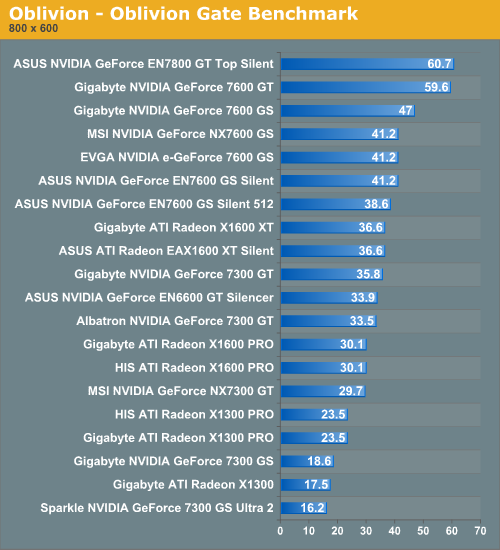
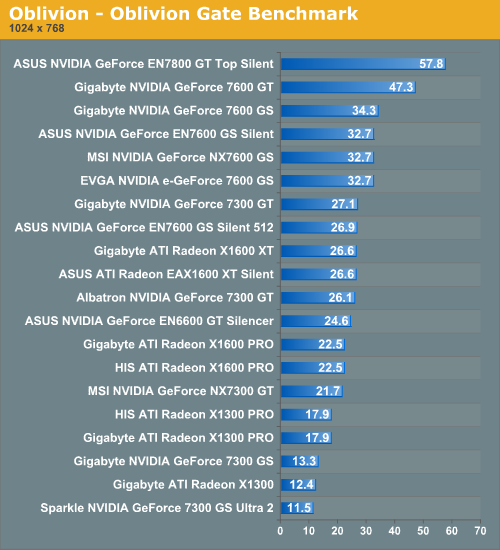
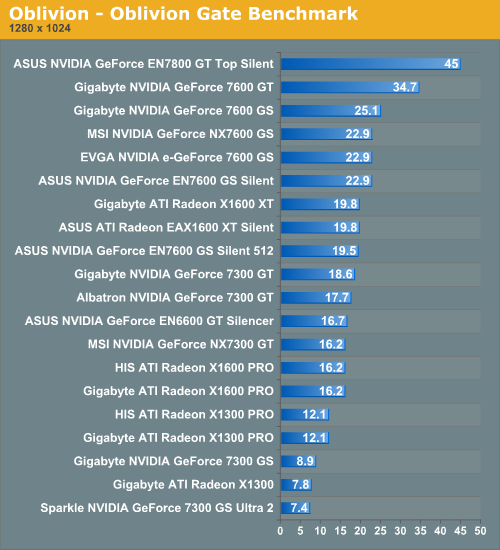
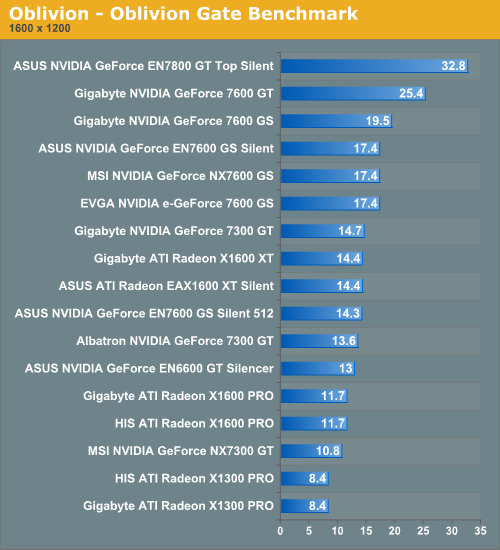
This is one of the only benchmarks we have that could bring the ASUS EN7800 GT Top Silent down to its knees at the highest resolution. Even at the lower resolution of 1024x768 most of these cards see barely playable average framerates. Because this can be a relatively fast-paced game at times, you really don't want to have to deal with framerate issues while battling some of the creatures and characters in this game. Most of the cards run smoothly at 800x600 with this benchmark, but the game isn't very enjoyable at such a low resolution.
This is all with drastically reduced image quality settings already - none of these cards can handle cranking up the eye candy in Oblivion. Unfortunately, this is one of the games that we would recommend not playing with any of these cards, with the exception of the ASUS EN7800 GT Top Silent and perhaps the Gigabyte 7600 GT. We feel a higher-end card is really needed to properly appreciate this game, though opinions vary. It is possible to play the game and even enjoy it with the settings turned way down and at the lowest resolutions, but a great deal of graphical elements are lost, and this is one of those games that relies heavily on graphics to be fully enjoyed.
Oblivion is the most graphically intensive game we have for testing the cards in this review. It's also one of the more troublesome games to benchmark because it doesn't have any built-in demo recording/playback features and there is a large variance in performance between the different areas (outside and inside, forests and gates, etc.) of this vast game. In order to resolve this to a degree, we have two separate benchmarks we use for Oblivion: one takes place outside walking towards an Oblivion gate, and the second is in one of the towns (Bruma) walking past several characters in a snowy daylight environment.
Because Oblivion has so much eye candy, having the graphics settings on higher quality (with settings like "distant lands" turned on, and item/actor distances set for longer distances, etc.) can result in a massive performance hit in even high-end graphics cards. Since we are dealing with mid-range and low-end cards in this review, we had to turn many of the quality settings down quite a bit in order to get playable results (and even then some of the cards fall short in the Gate benchmark). Here are the graphical settings we used for Oblivion.
| Oblivion Performance Settings | |
| Texture Size | Medium |
| Tree Fade | 20% |
| Actor Fade | 20% |
| Item Fade | 20% |
| Object Fade | 20% |
| Grass Distance | 0% |
| View Distance | 50% |
| Distant Land | Off |
| Distant Buildings | On |
| Distant Trees | On |
| Interior Shadows | 0% |
| Exterior Shadows | 0% |
| Self Shadows | Off |
| Shadows on Grass | Off |
| Tree Canopy Shadows | Off |
| Shadow Filtering | Off |
| Specular Distance | 20% |
| HDR Lighting | On |
| Bloom Lighting | Off |
| Water Detail | Normal |
| Water Reflections | On |
| Water Ripples | On |
| Window Reflections | On |
| Blood Decals | Off |
| Anti-aliasing | Off |
The first benchmark through the town is less demanding on graphics hardware than the second one with an Oblivion gate. With the "distant lands" setting to off as well as the "view distance" set to 50%, the world seems strangely limited, especially for those who have experienced the game with extended view distances. The game is still technically playable at these settings however.
The framerates above show that these cards run this benchmark fairly well, with many cards handling 1600x1200 aside from the obvious issues with 128 MB cards (the Sparkle 7300 GS Ultra 2, Gigabyte 7300 GS, and Gigabyte X1300) and all the ATI cards except the X1600 XT. Not much is going on in this benchmark, however, aside from a few townsfolk walking around and snow falling between the buildings.
For those that have played the game, an Oblivion gate is an impressive visual spectacle to behold, very reminiscent of the "Eye" effect for Sauron in Peter Jackson's epic Lord of the Rings movies. The fact that the second benchmark takes place at night with monsters hurling fireballs at the player makes the effect even more striking, but it also tends to slow the framerate down to a crawl at even the lowest resolutions.
This is one of the only benchmarks we have that could bring the ASUS EN7800 GT Top Silent down to its knees at the highest resolution. Even at the lower resolution of 1024x768 most of these cards see barely playable average framerates. Because this can be a relatively fast-paced game at times, you really don't want to have to deal with framerate issues while battling some of the creatures and characters in this game. Most of the cards run smoothly at 800x600 with this benchmark, but the game isn't very enjoyable at such a low resolution.
This is all with drastically reduced image quality settings already - none of these cards can handle cranking up the eye candy in Oblivion. Unfortunately, this is one of the games that we would recommend not playing with any of these cards, with the exception of the ASUS EN7800 GT Top Silent and perhaps the Gigabyte 7600 GT. We feel a higher-end card is really needed to properly appreciate this game, though opinions vary. It is possible to play the game and even enjoy it with the settings turned way down and at the lowest resolutions, but a great deal of graphical elements are lost, and this is one of those games that relies heavily on graphics to be fully enjoyed.
Originally published at https://www.anandtech.com/show/2073 (Wayback Machine).