
ABS Ultimate X9: Core 2 Extreme Hits a Speed Bump
- Posted in
- Systems
Standard Application Benchmarks
We'll begin with a look at typical application performance. Results from PCMark05, 3DMark06, and Cinebench 9.5 were collected. As mentioned already, the higher clock speed of the ABS system should result in higher performance, particularly in situations where we are CPU limited. Those of you wondering how a 3.5 GHz Core 2 processor performs need look no further.
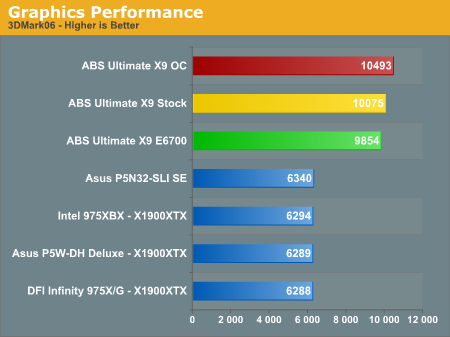
The results in 3DMark06 aren't particularly meaningful, as none of the other systems were tested with a CrossFire setup. Given that we consider 3DMark to be a synthetic GPU performance test, we're not too concerned with the numbers anyway. One thing that you can see with 3DMark06 is that we are almost completely GPU limited, gaining only 6% more performance with a 32 %CPU clock speed increase. We will see if that same pattern holds true for actual games on the coming pages.
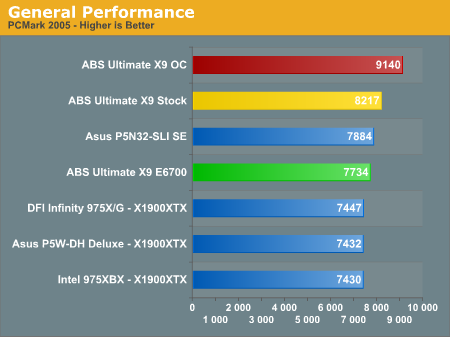
Performance results in PCMark05 are also slightly skewed by the CrossFire graphics configuration, not to mention the use of two Raptor drives in RAID 0. However, we feel these results are more real world, and the simple fact of the matter is that faster hard drives, GPUs, and processors can certainly improve the overall system performance to the point where it is noticeable by the end user. Increases in CPU speed come with a roughly 2-to-1 improvement in PCMark05 scores. The 20% OC is 11% faster than the stock X6800, and the X6800 is 6% faster than the E6700 while being clocked 10% higher.
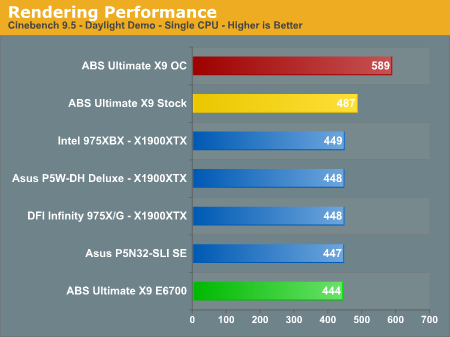
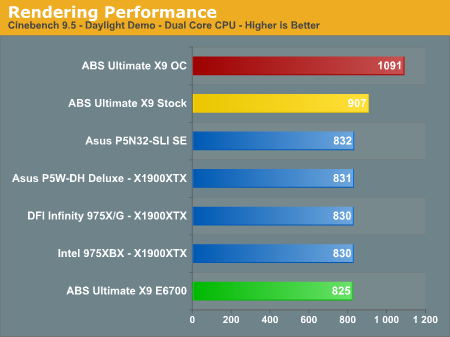
Closing up with Cinebench 9.5, we have an application that scales almost linearly with CPU clock speed. If your typical usage scenario consists of a lot of video encoding or 3D rendering, faster processors are extremely helpful, and that's what we see here. Cinebench also shows the advantage of multicore systems, improving rendering performance by over 85% when moving from a single core to dual cores. Unfortunately, not all commonly used tasks benefit that much from multiple processor cores, but heavy multitasking will certainly be faster.
We already knew that the Core 2 Extreme was fast, and overclocking it just makes it that much faster. Many commonly used tasks will benefit, particularly CPU-intensive tasks. Games are often considered CPU-intensive in nature, of course, so let's see what happens when we put the X1900 cards to good use.
We'll begin with a look at typical application performance. Results from PCMark05, 3DMark06, and Cinebench 9.5 were collected. As mentioned already, the higher clock speed of the ABS system should result in higher performance, particularly in situations where we are CPU limited. Those of you wondering how a 3.5 GHz Core 2 processor performs need look no further.
Performance results in PCMark05 are also slightly skewed by the CrossFire graphics configuration, not to mention the use of two Raptor drives in RAID 0. However, we feel these results are more real world, and the simple fact of the matter is that faster hard drives, GPUs, and processors can certainly improve the overall system performance to the point where it is noticeable by the end user. Increases in CPU speed come with a roughly 2-to-1 improvement in PCMark05 scores. The 20% OC is 11% faster than the stock X6800, and the X6800 is 6% faster than the E6700 while being clocked 10% higher.
Closing up with Cinebench 9.5, we have an application that scales almost linearly with CPU clock speed. If your typical usage scenario consists of a lot of video encoding or 3D rendering, faster processors are extremely helpful, and that's what we see here. Cinebench also shows the advantage of multicore systems, improving rendering performance by over 85% when moving from a single core to dual cores. Unfortunately, not all commonly used tasks benefit that much from multiple processor cores, but heavy multitasking will certainly be faster.
We already knew that the Core 2 Extreme was fast, and overclocking it just makes it that much faster. Many commonly used tasks will benefit, particularly CPU-intensive tasks. Games are often considered CPU-intensive in nature, of course, so let's see what happens when we put the X1900 cards to good use.
Originally published at https://www.anandtech.com/show/2066 (Wayback Machine).