
ASRock Core 2 Duo: AGP/PCI Express Graphics Performance, Part Tres
- Posted in
- Motherboards
Graphics Performance Comparison
While our previous articles concentrated on memory performance, today's article solely consists of gaming benchmarks and the synthetic 3DMark tests from Futuremark. The 3DMark series of benchmarks developed and provided by FutureMark are among the most widely used tools for benchmark reporting and comparisons. Although the benchmarks are very useful for providing consistent comparisons across a broad array of GPU and CPU configurations they are not a substitute for actual application and gaming benchmarks. In this sense we consider the 3DMark benchmarks to be purely synthetic in nature.
The gap between PCI-E and AGP solutions is less than 2% with both video card choices. Our first tests show AGP performing slightly better than PCI-E on the VIA platform with the Intel platform performing better overall. The 6800 Ultra series outperforms the 7600GS up to 38% in 3DMark05 and 26% in 3DMark06. Let's see if these differences carry over into our game benchmarks.
We utilized Far Cry, Half Life 2 and Quake 4 in our memory test articles because they are sensitive to memory changes and potentially bus throughput issues in our comparison. We added Prey and Serious Sam 2 to our benchmark mix because they are typically very GPU dependent and scale well. We originally tested at both 1024x768 and 1280x1024 resolutions at High Quality settings without anti-aliasing or antistrophic filtering enabled. We have also added 800x600 and 1600x1200 resolutions with the same settings.
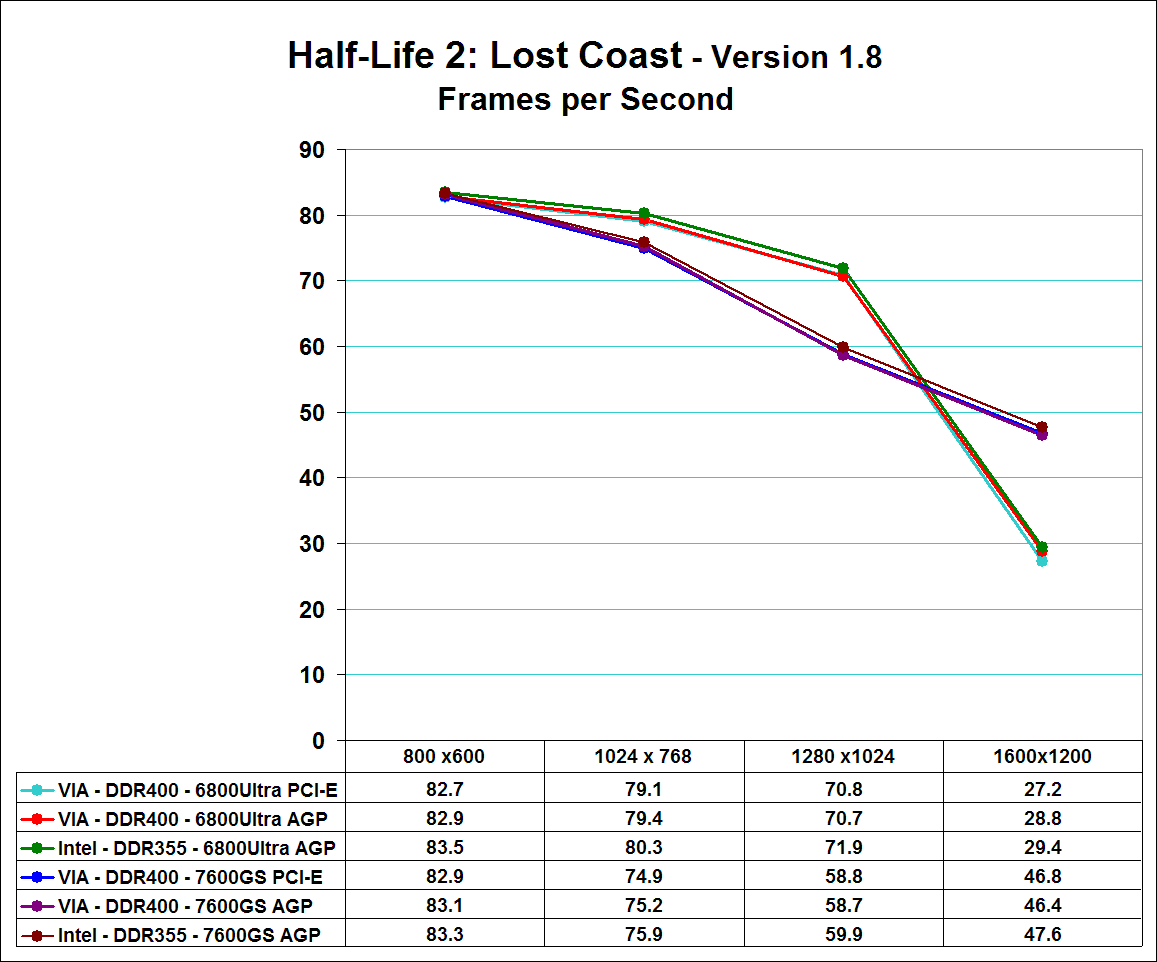
Our three memory sensitive games show a consistent pattern with the AGP capability of the ASRock 775Dual-VSTA performing up to 5% higher than the PCI-E version in our testing. Overall, the AGP slot performance is better than the PCI Express slot even in 800x600 testing where the X4 operation handicap should not make a difference. The Intel 865 chipset offers better AGP performance especially as the resolutions start to scale upward. Looking at the gaming results from our previous article, the X16 PCI-E solutions typically offer equal or better performance than the AGP offerings. Whether it's the extra bandwidth or simply a less-than-perfect PCI-E implementation on the 775Dual-VSTA we can't say without further testing. However, the bottom line is that AGP performance is better than PCI-E performance on this particular motherboard.
The 6800 Ultra is still a very competitive card when compared to the 7600GS in these particular benchmarks, although it stumbles at 1600x1200 in Half Life 2- Lost Coast. The ATI X850XT-PE would score in a similar fashion if not better than the 6800 Ultra, though of course it lacks SM3.0 support which can be useful in more recent titles. Those owners with a graphics card in this class can still get by with most of today's games. We will have Oblivion results in our final article although we highly suggest going with a different solution to play this game at decent settings
While our previous articles concentrated on memory performance, today's article solely consists of gaming benchmarks and the synthetic 3DMark tests from Futuremark. The 3DMark series of benchmarks developed and provided by FutureMark are among the most widely used tools for benchmark reporting and comparisons. Although the benchmarks are very useful for providing consistent comparisons across a broad array of GPU and CPU configurations they are not a substitute for actual application and gaming benchmarks. In this sense we consider the 3DMark benchmarks to be purely synthetic in nature.
 |
| Click to enlarge |
The gap between PCI-E and AGP solutions is less than 2% with both video card choices. Our first tests show AGP performing slightly better than PCI-E on the VIA platform with the Intel platform performing better overall. The 6800 Ultra series outperforms the 7600GS up to 38% in 3DMark05 and 26% in 3DMark06. Let's see if these differences carry over into our game benchmarks.
We utilized Far Cry, Half Life 2 and Quake 4 in our memory test articles because they are sensitive to memory changes and potentially bus throughput issues in our comparison. We added Prey and Serious Sam 2 to our benchmark mix because they are typically very GPU dependent and scale well. We originally tested at both 1024x768 and 1280x1024 resolutions at High Quality settings without anti-aliasing or antistrophic filtering enabled. We have also added 800x600 and 1600x1200 resolutions with the same settings.
 |
 |
 |
| Click to enlarge |
Our three memory sensitive games show a consistent pattern with the AGP capability of the ASRock 775Dual-VSTA performing up to 5% higher than the PCI-E version in our testing. Overall, the AGP slot performance is better than the PCI Express slot even in 800x600 testing where the X4 operation handicap should not make a difference. The Intel 865 chipset offers better AGP performance especially as the resolutions start to scale upward. Looking at the gaming results from our previous article, the X16 PCI-E solutions typically offer equal or better performance than the AGP offerings. Whether it's the extra bandwidth or simply a less-than-perfect PCI-E implementation on the 775Dual-VSTA we can't say without further testing. However, the bottom line is that AGP performance is better than PCI-E performance on this particular motherboard.
The 6800 Ultra is still a very competitive card when compared to the 7600GS in these particular benchmarks, although it stumbles at 1600x1200 in Half Life 2- Lost Coast. The ATI X850XT-PE would score in a similar fashion if not better than the 6800 Ultra, though of course it lacks SM3.0 support which can be useful in more recent titles. Those owners with a graphics card in this class can still get by with most of today's games. We will have Oblivion results in our final article although we highly suggest going with a different solution to play this game at decent settings
Originally published at https://www.anandtech.com/show/2062 (Wayback Machine).