
Corsair and OCZ: New Standards in Fast DDR2
- Posted in
- Memory
Corsair CM2X1024-6400C3: Memory Performance
Most top Intel motherboards provide a wide range of memory ratios that match available DDR2 memory. Most end-users select the memory ratio that matches their DDR2 memory speed. For those reasons, we first test all of the stock ratios at the fastest stable timings we can achieve at the given ratio. With ratios, CPU speed remains the same at 2.93GHz in our memory test bed, and memory speed is then changed by selecting different ratios.
There are some downsides to this approach. With the memory controller in the chipset, instead of part of the processor as in AM2 systems, there is a small performance penalty for speeds other than a 1:1 ratio (DDR2-533 in this case). However the penalty is in reality very small and memory scales nicely through the various speed options.
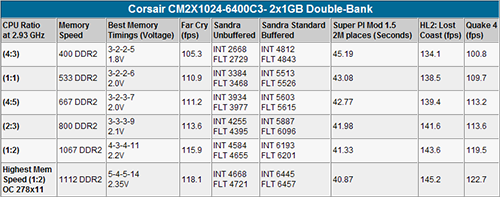
The performance of Micron DDR2 memory chips was already impressive in the high-performance DDR2 in the Conroe Buyers Guide, but Corsair takes the DDR2 performance standard even higher with their 6400C3. This memory is clearly the best of the best, allowing 3-2-2 timings to DDR2-533, 3-2-3 at DDR2-667, 3-3-3 at DDR2-800, and an astounding 4-3-4-11 at DDR2-1067. The base chips are from the same manufacturing lines, but Corsair binning and custom SPD programming have squeezed even more from these excellent memory chips. The only real concern, of course, is the very high cost, but that will not likely matter much if the absolute top performance is your system goal.
The fastest possible timings with today's DDR2 are 3-2-2. If you look closely you will see the Corsair 6400C3 works fine at the fastest timings that can be selected at both DDR2-400 and the 1:1 ratio of DDR2-533. Even at DDR2-667 only minor compromises are required, since the Corsair is completely stable at 3-2-3 timings. It is important to keep in mind that the first 5 table rows, from DDR2-400 to DDR2-1067 represent a constant CPU speed of 2.93GHz with memory running at faster speeds through ratios. Any performance increases over this DDR2-400 to DDR2-1067 range is therefore a result of increased memory speed. 1:1 should always have the least overhead in the current Intel universe, but this DDR2 memory still scales well by speed over the full range. Memory bandwidth improves with memory speed, as does raw calculation performance. However, this does not always translate into linear gaming performance. You can see this more clearly in the new performance scaling charts on page 7.
Corsair 6400C3 topped out at DDR2-1112, which is the second highest stable speed ever achieved with our DDR2 memory samples. This is particularly interesting when you consider that this Corsair memory, rated at DDR2-800, actually reaches a slightly higher top speed than we could achieve with Corsair DDR2-1067. Corsair clearly binned this memory for tight timings across the band and at a lower than average voltage in this class range. The 6400C3 achieves that design goal, and always does so with tighter timings than we would expect.
Most top Intel motherboards provide a wide range of memory ratios that match available DDR2 memory. Most end-users select the memory ratio that matches their DDR2 memory speed. For those reasons, we first test all of the stock ratios at the fastest stable timings we can achieve at the given ratio. With ratios, CPU speed remains the same at 2.93GHz in our memory test bed, and memory speed is then changed by selecting different ratios.
There are some downsides to this approach. With the memory controller in the chipset, instead of part of the processor as in AM2 systems, there is a small performance penalty for speeds other than a 1:1 ratio (DDR2-533 in this case). However the penalty is in reality very small and memory scales nicely through the various speed options.
 |
| Click to enlarge |
The performance of Micron DDR2 memory chips was already impressive in the high-performance DDR2 in the Conroe Buyers Guide, but Corsair takes the DDR2 performance standard even higher with their 6400C3. This memory is clearly the best of the best, allowing 3-2-2 timings to DDR2-533, 3-2-3 at DDR2-667, 3-3-3 at DDR2-800, and an astounding 4-3-4-11 at DDR2-1067. The base chips are from the same manufacturing lines, but Corsair binning and custom SPD programming have squeezed even more from these excellent memory chips. The only real concern, of course, is the very high cost, but that will not likely matter much if the absolute top performance is your system goal.
The fastest possible timings with today's DDR2 are 3-2-2. If you look closely you will see the Corsair 6400C3 works fine at the fastest timings that can be selected at both DDR2-400 and the 1:1 ratio of DDR2-533. Even at DDR2-667 only minor compromises are required, since the Corsair is completely stable at 3-2-3 timings. It is important to keep in mind that the first 5 table rows, from DDR2-400 to DDR2-1067 represent a constant CPU speed of 2.93GHz with memory running at faster speeds through ratios. Any performance increases over this DDR2-400 to DDR2-1067 range is therefore a result of increased memory speed. 1:1 should always have the least overhead in the current Intel universe, but this DDR2 memory still scales well by speed over the full range. Memory bandwidth improves with memory speed, as does raw calculation performance. However, this does not always translate into linear gaming performance. You can see this more clearly in the new performance scaling charts on page 7.
Corsair 6400C3 topped out at DDR2-1112, which is the second highest stable speed ever achieved with our DDR2 memory samples. This is particularly interesting when you consider that this Corsair memory, rated at DDR2-800, actually reaches a slightly higher top speed than we could achieve with Corsair DDR2-1067. Corsair clearly binned this memory for tight timings across the band and at a lower than average voltage in this class range. The 6400C3 achieves that design goal, and always does so with tighter timings than we would expect.
Originally published at https://www.anandtech.com/show/2057 (Wayback Machine).