
Western Digital and Seagate: 320GB Grudge Match
- Posted in
- Storage
Hard Drive Acoustics
Our acoustic test utilizes our standard test bed components but we enable AMD's Cool'n'Quiet technology and turn off the case fans to isolate as much case noise as possible during testing. Our OCZ power supply is virtually silent in these tests along with our fanless Asus 7600GS video card providing a further decrease in our case's acoustical ambience. Our drives are attached to the drive cage with rubber bushings to assist in isolating the noise of the drive without creating harmonic changes due to the case design
Our acoustic tests are designed to measure the decibel levels while the system is at idle and also under load while running the General Hard Disk Drive Usage benchmark within PCMark 2005. We found through trial and error this particular benchmark produces controlled readings across a wide range of applications within the benchmark. This particular benchmark utilizes 60% reads and 40% writes within the trace playback file.
The measurements are taken at a distance of 5 millimeters from the rear and front of the drive being tested in order to minimize surrounding environmental noise. The reported measurements are based on an A-weighted decibel score that measures frequencies similar to the way the human ear responds to sound. We take a total of three measurements for each test. We then subtract the high and low scores and arrive at our findings by reporting the remaining score.
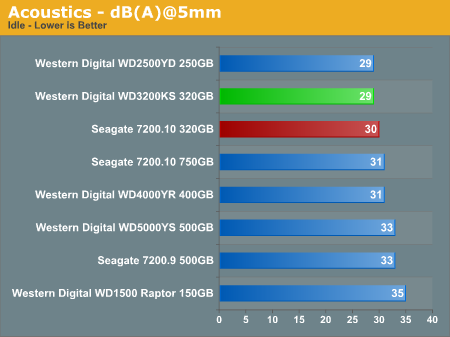
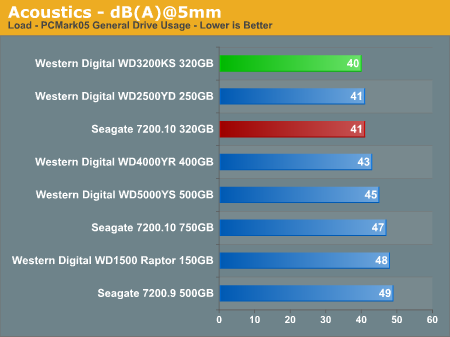
The WD3200KS is overall the quietest drive we have tested to date. The Seagate 7200.10 320GB drive follows closely behind and improves upon the 750GB drive in the objective test results. Our subjective opinion is that the seek requests are very muted for both drives and it was difficult to near impossible to notice the drive's noise levels over the power supply fan during the majority of intensive read/write requests. The Seagate 320GB drive did not generate the thumping noise we encountered with the 7200.10 750GB drive. Our base db(A) level in the room at time of testing was 24 db(A).
Hard Drive Thermals
Our thermal tests utilize sensor readings via the S.M.A.R.T. (Self-Monitoring, Analysis and Reporting Technology) capability of the drives and are reported by utilizing the Active SMART 2.42 utility. We test our drives in an enclosed case environment without the front fan operational to simulate temperatures that could conceivably be reached in a SFF or HTPC case design. We typically find the reported numbers drop anywhere from 18% to 25% on average when the front fan is operational.
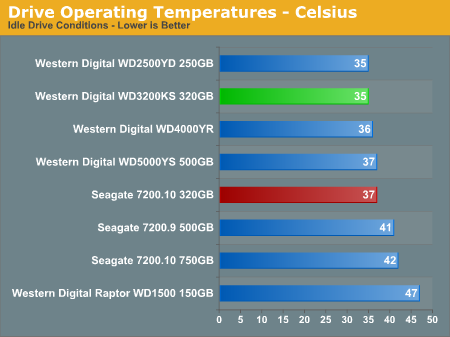
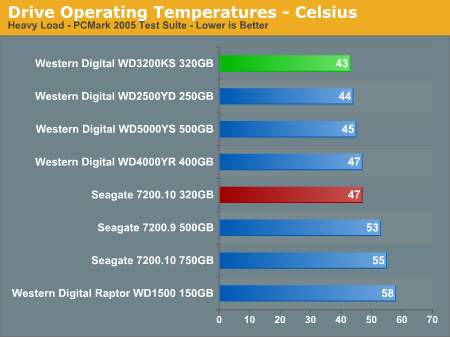
We expected the WD3200KS to run cool based upon our test results with the other Western Digital drives. It did not disappoint us in either test as even the casing remained somewhat cool to the touch after hours of continuous testing. As already stated, these results were recorded in our enclosed Gigabyte case without the front fan operating and represent something of a worst-case scenario. Our base temperature level in the lab at time of testing was 23 degrees Celsius.
The Seagate 7200.10 320GB improves significantly upon the 750GB version in thermals and makes a respectable showing against the Western Digital drives. However, at idle the Seagate is 2 degrees Celsius and under load 4 degrees Celsius hotter than the WD 320GB drive with the casing becoming hot to the touch after continuous usage. Looking strictly at the acoustic and thermal benchmarks we definitely would recommend the Western Digital drive for a silent or HTPC system.
Our acoustic test utilizes our standard test bed components but we enable AMD's Cool'n'Quiet technology and turn off the case fans to isolate as much case noise as possible during testing. Our OCZ power supply is virtually silent in these tests along with our fanless Asus 7600GS video card providing a further decrease in our case's acoustical ambience. Our drives are attached to the drive cage with rubber bushings to assist in isolating the noise of the drive without creating harmonic changes due to the case design
Our acoustic tests are designed to measure the decibel levels while the system is at idle and also under load while running the General Hard Disk Drive Usage benchmark within PCMark 2005. We found through trial and error this particular benchmark produces controlled readings across a wide range of applications within the benchmark. This particular benchmark utilizes 60% reads and 40% writes within the trace playback file.
The measurements are taken at a distance of 5 millimeters from the rear and front of the drive being tested in order to minimize surrounding environmental noise. The reported measurements are based on an A-weighted decibel score that measures frequencies similar to the way the human ear responds to sound. We take a total of three measurements for each test. We then subtract the high and low scores and arrive at our findings by reporting the remaining score.
The WD3200KS is overall the quietest drive we have tested to date. The Seagate 7200.10 320GB drive follows closely behind and improves upon the 750GB drive in the objective test results. Our subjective opinion is that the seek requests are very muted for both drives and it was difficult to near impossible to notice the drive's noise levels over the power supply fan during the majority of intensive read/write requests. The Seagate 320GB drive did not generate the thumping noise we encountered with the 7200.10 750GB drive. Our base db(A) level in the room at time of testing was 24 db(A).
Hard Drive Thermals
Our thermal tests utilize sensor readings via the S.M.A.R.T. (Self-Monitoring, Analysis and Reporting Technology) capability of the drives and are reported by utilizing the Active SMART 2.42 utility. We test our drives in an enclosed case environment without the front fan operational to simulate temperatures that could conceivably be reached in a SFF or HTPC case design. We typically find the reported numbers drop anywhere from 18% to 25% on average when the front fan is operational.
We expected the WD3200KS to run cool based upon our test results with the other Western Digital drives. It did not disappoint us in either test as even the casing remained somewhat cool to the touch after hours of continuous testing. As already stated, these results were recorded in our enclosed Gigabyte case without the front fan operating and represent something of a worst-case scenario. Our base temperature level in the lab at time of testing was 23 degrees Celsius.
The Seagate 7200.10 320GB improves significantly upon the 750GB version in thermals and makes a respectable showing against the Western Digital drives. However, at idle the Seagate is 2 degrees Celsius and under load 4 degrees Celsius hotter than the WD 320GB drive with the casing becoming hot to the touch after continuous usage. Looking strictly at the acoustic and thermal benchmarks we definitely would recommend the Western Digital drive for a silent or HTPC system.
Originally published at https://www.anandtech.com/show/2052 (Wayback Machine).