
Conroe vs. AM2: Memory & Performance
- Posted in
- Memory
A Closer Look at Latency and Scaling
As was explained in the Core 2 Duo launch review, Core 2 Duo has not physically added a memory controller on the processor. The memory controller is still part of the motherboard chipset that drives Core 2 Duo. Intel added features that perform intelligent look-aheads on the memory controller to behave like lower latency. As you saw on pages 2 and 3, ScienceMark 2.0 shows the "intelligent look-aheads" in Core 2 Duo to be extremely effective, with Core 2 Duo memory now exhibiting lower apparent latency than AM2. However, not all latency benchmarks show the same results. Everest from Lavalys shows latency improvements in the new CPU revisions, but it shows Latency more as we would expect in evaluating Conroe. For that reason, our detailed benchmarks for latency will use both Everest 1.51.195, which fully supports the Core 2 Duo processor, and ScienceMark 2.0.
Latency, or how fast memory is accessed, is not a static measurement. It varies with memory speed and generally improves (goes down) as memory speed increases. To better understand what is happening with memory accesses we first looked at Sciencemark 2.0 Latency on both AM2 and Conroe.
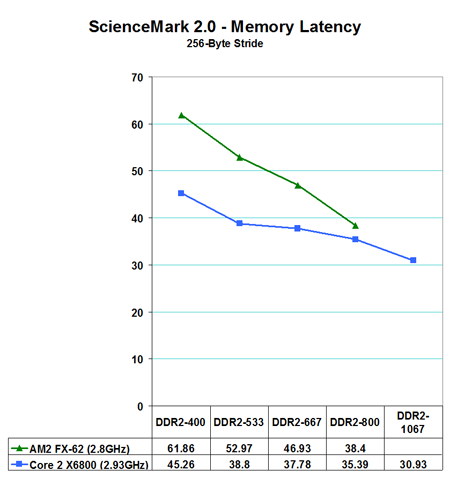
ScienceMark shows Conroe Latency with a 45ns to 61ns lead at DDR2-400. Latency continues to decrease as memory speed increases with Core 2 Duo, reaching a value of about 30ns at DDR2-1067. The Trend line for AM2 is steeper than Core 2 Duo, increasing at a rapid rate until latency is virtually the same at DDR2-800.
It is very interesting that ScienceMark shows lower latency on Core 2 Duo than AM2, since we all know the on-chip AM2 controller has to be faster. We thought perhaps it was because all of the tested memory accesses could be contained in the shared 4MB cache of Core 2 Duo, but Alex Goodrich,one of the authors of ScienceMark, states that Version 2 is designed to test up to 16MB of memory, forseeing the day of larger caches. In addition he states the Core 2 duo prefetcher is clever enough to pick up all the patterns ScienceMark uses to "fool" hardware prefetchers. ScienceMark plans a revision with an algoritm that is harder to fool, but Alex commented that Conroe fooling their benchmark was "in itself a great indicator of performance".
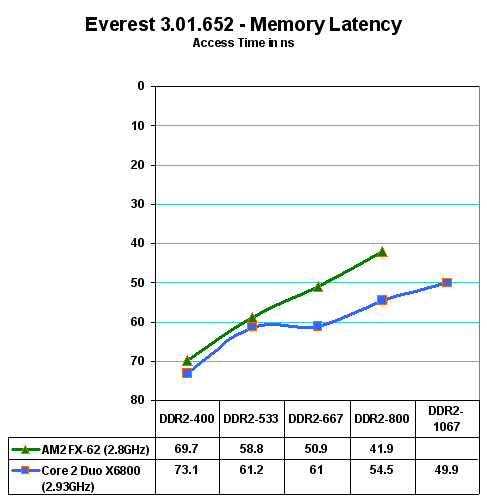
Everest uses a different algorithm for measuring Latency, and it shows the on-chip AM2 DDR2 controller in the lead at all memory speeds, with Latency almost the same at the Core 2 Duo memory speed range of DDR2-400 to DDR2-533. However, the Everest trend lines are similar to those in ScienceMark, in that AM2 latency improves at a steeper rate than Core 2 Duo as memory speed increases.
The point to the Latency discussion is that, as expected, AMD has much more opportunity for performance improvement with memory speed increases in AM2. Intel will eventually reach the point, if the lines were extended, where they would have to move to an on-chip memory controller to further improve latency. This is not to take anything away from Intel's intelligent design on Core 2 Duo. They have found a solution that fixes a performance issue without requiring an on-chip controller - for now.
As was explained in the Core 2 Duo launch review, Core 2 Duo has not physically added a memory controller on the processor. The memory controller is still part of the motherboard chipset that drives Core 2 Duo. Intel added features that perform intelligent look-aheads on the memory controller to behave like lower latency. As you saw on pages 2 and 3, ScienceMark 2.0 shows the "intelligent look-aheads" in Core 2 Duo to be extremely effective, with Core 2 Duo memory now exhibiting lower apparent latency than AM2. However, not all latency benchmarks show the same results. Everest from Lavalys shows latency improvements in the new CPU revisions, but it shows Latency more as we would expect in evaluating Conroe. For that reason, our detailed benchmarks for latency will use both Everest 1.51.195, which fully supports the Core 2 Duo processor, and ScienceMark 2.0.
Latency, or how fast memory is accessed, is not a static measurement. It varies with memory speed and generally improves (goes down) as memory speed increases. To better understand what is happening with memory accesses we first looked at Sciencemark 2.0 Latency on both AM2 and Conroe.
ScienceMark shows Conroe Latency with a 45ns to 61ns lead at DDR2-400. Latency continues to decrease as memory speed increases with Core 2 Duo, reaching a value of about 30ns at DDR2-1067. The Trend line for AM2 is steeper than Core 2 Duo, increasing at a rapid rate until latency is virtually the same at DDR2-800.
It is very interesting that ScienceMark shows lower latency on Core 2 Duo than AM2, since we all know the on-chip AM2 controller has to be faster. We thought perhaps it was because all of the tested memory accesses could be contained in the shared 4MB cache of Core 2 Duo, but Alex Goodrich,one of the authors of ScienceMark, states that Version 2 is designed to test up to 16MB of memory, forseeing the day of larger caches. In addition he states the Core 2 duo prefetcher is clever enough to pick up all the patterns ScienceMark uses to "fool" hardware prefetchers. ScienceMark plans a revision with an algoritm that is harder to fool, but Alex commented that Conroe fooling their benchmark was "in itself a great indicator of performance".
Everest uses a different algorithm for measuring Latency, and it shows the on-chip AM2 DDR2 controller in the lead at all memory speeds, with Latency almost the same at the Core 2 Duo memory speed range of DDR2-400 to DDR2-533. However, the Everest trend lines are similar to those in ScienceMark, in that AM2 latency improves at a steeper rate than Core 2 Duo as memory speed increases.
The point to the Latency discussion is that, as expected, AMD has much more opportunity for performance improvement with memory speed increases in AM2. Intel will eventually reach the point, if the lines were extended, where they would have to move to an on-chip memory controller to further improve latency. This is not to take anything away from Intel's intelligent design on Core 2 Duo. They have found a solution that fixes a performance issue without requiring an on-chip controller - for now.
Originally published at https://www.anandtech.com/show/2050 (Wayback Machine).