
Foxconn and Gigabyte Tackle Socket AM2
- Posted in
- Motherboards
Overclocking
Our previous experiences with overclocking Foxconn motherboards have been disappointing at best, and we have taken Foxconn to task over the matter. Have things improved with their latest and easiest offering? Take a look at the results below.
We wouldn't worry too much about maximum CPU clock attained, as that will vary from CPU to CPU, and cooling solutions and other factors come into play. Motherboard quality will also affect overclocking, but other results we've seen from around the web generally support our experience with this Foxconn board. We were able to run at a maximum HyperTransport bus speed of 320 MHz without difficulties, though it did require some adjustment of the chipset voltages. The active cooling of our Northbridge definitely helped matters, however, as we experienced periodic instability above 260 MHz without the extra fan.
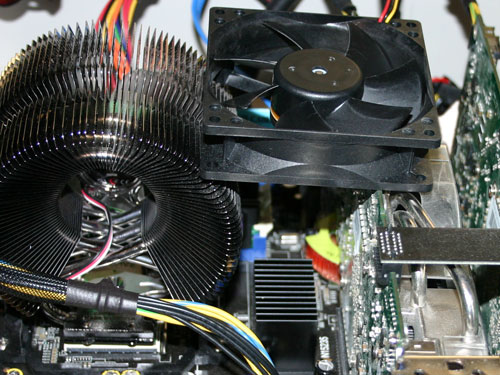
Active cooling requirements aside (yes, we realize that the above isn't an ideal mechanism for mounting a fan), a 320 MHz HTT bus with a 4X HyperTransport multiplier is a stellar result in comparison to previous Foxconn boards. True, most AM2 motherboards are easily pulling 300 MHz, but at least we don't have to make any apologies for Foxconn this time. The BIOS supports bus frequencies up to 500 MHz, but it would probably take a lot more than just an extra fan to reach any of them with stability. If you're looking for the absolute best overclocking AM2 motherboard, Foxconn still falls behind a few other offerings (maximum theoretical HTT setting notwithstanding), but for more typical overclocking the 320 MHz bus speed achieved should be more than sufficient. Just get a CPU that supports at least a 10X multiplier and you will almost certainly hit the limits of your processor before you are able to max out the Foxconn motherboard.
Memory Stress Testing
The wide range of voltage controls for most of the critical components help users to get the most out of overclocking attempts as well as memory modules. Most DDR2-800 memory is rated at conservative 5-5-5-15 timings, but that's also assuming you only run with the default 1.8 V. We have found in our DDR2 testing that many modules are easily able to run 4-4-4-12 timings at 2.0 V, and the Corsair modules we are testing with (rated at 5-5-5-18 DDR2-1066) are generally able to run with 3-3-3-9 timings with approximately 2.2 V. This Foxconn board supports all the necessary voltages to get the most out of DDR2 memory, and we were able to match the results of most other AM2 motherboards when it came to memory timings.
With two DIMMs installed, testing was completely stable at 3-3-3-9 2T timings at DDR2-800. We could also run 3-3-3-9 1T timings at DDR2-667, but performance was slightly better at DDR2 800 with the 2T command rate. The voltage required for complete stability was 2.1V, which is slightly lower than on other competing motherboards. We're not going to worry about an extra 0.05 V, as variability in memory modules could account for that margin of error, but the fine 0.0250V adjustment granularity that the Foxconn board offers should allow you to tweak your RAM for optimal performance.
Installing four DIMMs stresses the memory subsystem further, and you can see that we had to drop the tRCD setting to 4 in order to get the system to run stably. The difference in performance between tRCD 3 and tRCD 4 is negligible, however, and our 3-4-3-10 2T results are similar to what many other AM2 motherboards are achieving with four DIMMs. (Changes to the tRAS setting have an even smaller effect on performance, and so far we have determined that a tRAS value of 9-14 is optimal with DDR2-800.) We also had to add another 0.100 V, but we're not too concerned about that, as this merely brings the Foxconn RAM voltage up to the level of most other AM2 motherboards.
Our previous experiences with overclocking Foxconn motherboards have been disappointing at best, and we have taken Foxconn to task over the matter. Have things improved with their latest and easiest offering? Take a look at the results below.
| Foxconn C51-XEM2AA | |
| Processor: | AMD Athlon 64 X2 - 4800+ (AM2) |
| Chipset: | nForce 590SLI |
| CPU Voltage: | 1.600V (1.300V default) |
| Memory Settings: | 5-5-5-15 2T 12x Multiplier 3-3-3-9 1T 9x Multiplier |
| DDR2 Results: | 12 x 256HTT = DDR2 1024 9 x 320HTT = DDR2 640 |
| HT Multiplier: | 5x below 300HTT, 4x above 300HTT |
| Memory Voltage: | 2.2V |
| Chipset Voltage: | 1.65V |
| HT Voltage: | 1.35V |
| Cooling: | Zalman CNPS9500 AM2 |
| Power Supply: | OCZ GamexStream 700W |
| Maximum CPU OverClock: | 256HTT x 12 (3072MHz) +28% |
| Maximum FSB OverClock: | 320HTT x 9 (2880MHz) +60% |
We wouldn't worry too much about maximum CPU clock attained, as that will vary from CPU to CPU, and cooling solutions and other factors come into play. Motherboard quality will also affect overclocking, but other results we've seen from around the web generally support our experience with this Foxconn board. We were able to run at a maximum HyperTransport bus speed of 320 MHz without difficulties, though it did require some adjustment of the chipset voltages. The active cooling of our Northbridge definitely helped matters, however, as we experienced periodic instability above 260 MHz without the extra fan.
Active cooling requirements aside (yes, we realize that the above isn't an ideal mechanism for mounting a fan), a 320 MHz HTT bus with a 4X HyperTransport multiplier is a stellar result in comparison to previous Foxconn boards. True, most AM2 motherboards are easily pulling 300 MHz, but at least we don't have to make any apologies for Foxconn this time. The BIOS supports bus frequencies up to 500 MHz, but it would probably take a lot more than just an extra fan to reach any of them with stability. If you're looking for the absolute best overclocking AM2 motherboard, Foxconn still falls behind a few other offerings (maximum theoretical HTT setting notwithstanding), but for more typical overclocking the 320 MHz bus speed achieved should be more than sufficient. Just get a CPU that supports at least a 10X multiplier and you will almost certainly hit the limits of your processor before you are able to max out the Foxconn motherboard.
Memory Stress Testing
The wide range of voltage controls for most of the critical components help users to get the most out of overclocking attempts as well as memory modules. Most DDR2-800 memory is rated at conservative 5-5-5-15 timings, but that's also assuming you only run with the default 1.8 V. We have found in our DDR2 testing that many modules are easily able to run 4-4-4-12 timings at 2.0 V, and the Corsair modules we are testing with (rated at 5-5-5-18 DDR2-1066) are generally able to run with 3-3-3-9 timings with approximately 2.2 V. This Foxconn board supports all the necessary voltages to get the most out of DDR2 memory, and we were able to match the results of most other AM2 motherboards when it came to memory timings.
| Foxconn C51-XEM2AA Stable DDR2-800 Timings - 2 DIMMs (2/4 slots populated - 1 Dual-Channel Bank) |
|
| Clock Speed: | 200MHz |
| Timing Mode: | 800MHz - Default |
| CAS Latency: | 3 |
| RAS to CAS Delay: | 3 |
| RAS Precharge: | 3 |
| RAS Cycle Time: | 9 |
| Command Rate: | 2T |
| Voltage: | 2.1V |
With two DIMMs installed, testing was completely stable at 3-3-3-9 2T timings at DDR2-800. We could also run 3-3-3-9 1T timings at DDR2-667, but performance was slightly better at DDR2 800 with the 2T command rate. The voltage required for complete stability was 2.1V, which is slightly lower than on other competing motherboards. We're not going to worry about an extra 0.05 V, as variability in memory modules could account for that margin of error, but the fine 0.0250V adjustment granularity that the Foxconn board offers should allow you to tweak your RAM for optimal performance.
| Foxconn C51-XEM2AA Stable DDR2-800 Timings - 4 DIMMs (4/4 slots populated - 2 Dual-Channel Banks) |
|
| Clock Speed: | 200MHz |
| Timing Mode: | 800MHz - Default |
| CAS Latency: | 3 |
| RAS to CAS Delay: | 4 |
| RAS Precharge: | 3 |
| RAS Cycle Time: | 10 |
| Command Rate: | 2T |
| Voltage: | 2.2V |
Installing four DIMMs stresses the memory subsystem further, and you can see that we had to drop the tRCD setting to 4 in order to get the system to run stably. The difference in performance between tRCD 3 and tRCD 4 is negligible, however, and our 3-4-3-10 2T results are similar to what many other AM2 motherboards are achieving with four DIMMs. (Changes to the tRAS setting have an even smaller effect on performance, and so far we have determined that a tRAS value of 9-14 is optimal with DDR2-800.) We also had to add another 0.100 V, but we're not too concerned about that, as this merely brings the Foxconn RAM voltage up to the level of most other AM2 motherboards.
Originally published at https://www.anandtech.com/show/2033 (Wayback Machine).