
Foxconn and Gigabyte Tackle Socket AM2
- Posted in
- Motherboards
Audio Performance
Both the Gigabyte and Foxconn motherboards include high-definition audio chipsets, but Foxconn has opted for the ALC882D while Gigabyte is using the newer ALC888. There are a few differences between the two chips, but few people will actually notice a difference in normal use. The ALC882D does feature Dolby Digital Live support, so despite the lower model number it is technically superior. However, if you absolutely require the best possible audio from your computer, you'll still want to add in a discrete sound card. Before you go that route, though, you might also want to make sure you're using high-quality speakers/headphones.
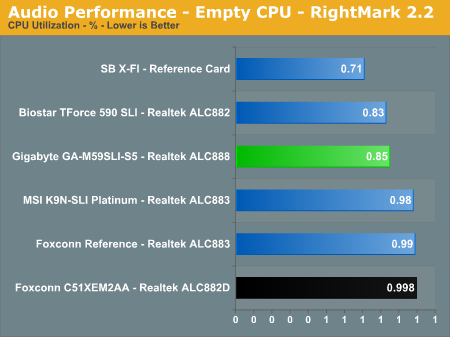
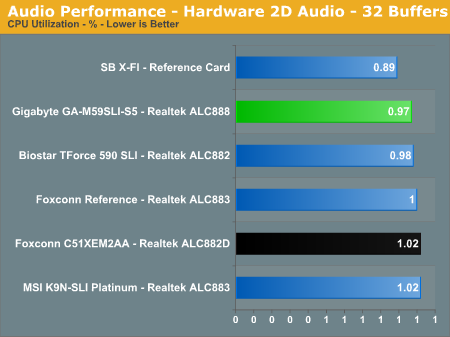
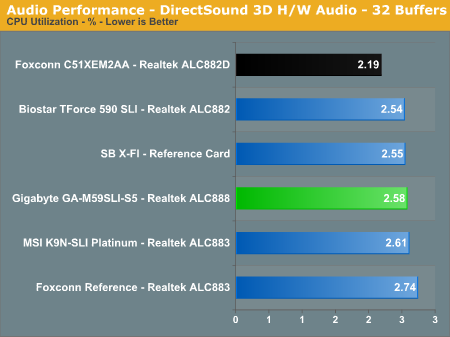
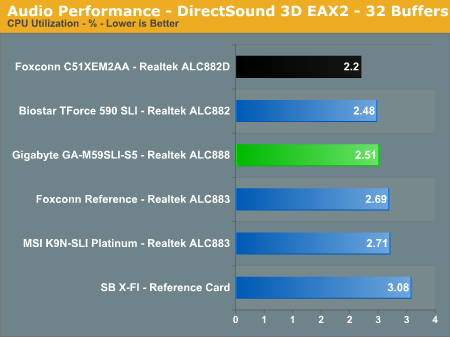
In terms of RightMark CPU utilization, all of the audio solutions appear similar. It should also be noted that the Realtek solutions only support up to 32 hardware streams, whereas X-Fi supports 64. Either way, it's hard to be concerned with a 1-2% increase in CPU utilization caused by audio driver overhead. As you will find in our gaming audio results, most games do a lot of the work internally, so you will experience a significant performance hit by enabling audio regardless of what soundcard you use.
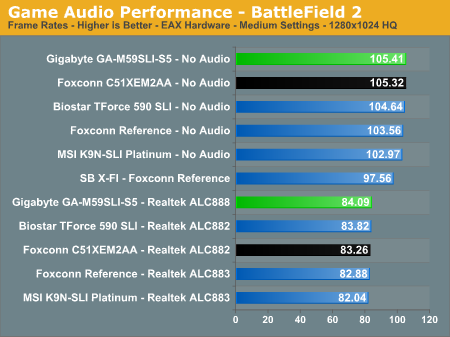
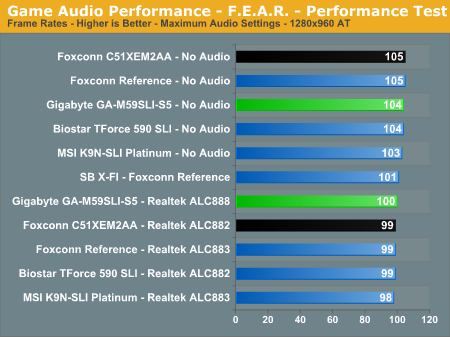
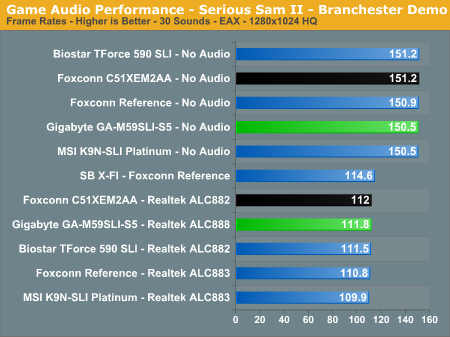
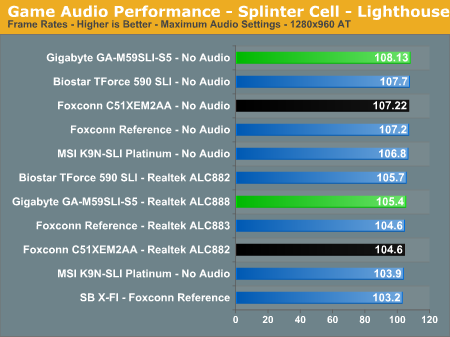
There are minor differences in performance with audio enabled, and in many of the games you will incur a significant performance hit. Of course, few gamers would want to play with the audio disabled, but testing without audio at least allows us to isolate system performance. What we would really like to see is games beginning to use multiple threads for handling audio, so that at least on dual core systems you would be far less likely to incur a performance hit. That may be easier said than done, but you only need to look at the 32% performance increase Serious Sam 2 could get or the 25% performance increase Battlefield 2 could get to understand why this would be desirable.
Why don't all games show as much of a performance hit? Because some of them are already GPU limited, so the processor has extra time that it can spend working on audio. If you happen to run multiple graphics cards, the performance hit of audio can be even more substantial. Here are some reference numbers using the Foxconn system in SLI mode. (Note that these scores are not run with identical settings compared to the earlier results, but they are internally consistent.)
Some games are still GPU limited, but a few of the games (BF2, HL2) almost entirely eliminate the benefit a running multiple graphics cards in the first place. With multiple processing cores becoming the way of the future, it is imperative that applications begin to make use of multiple threads if they're going to substantially increase performance. Call of Duty 2 and Quake 4 have both managed to benefit from SMP, and Oblivion also has at least some support for SMP. We can only hope that future games will begin to show real benefit for dual core and the upcoming quad core processors, as clock speed increases seem to be becoming far less frequent or significant.
Both the Gigabyte and Foxconn motherboards include high-definition audio chipsets, but Foxconn has opted for the ALC882D while Gigabyte is using the newer ALC888. There are a few differences between the two chips, but few people will actually notice a difference in normal use. The ALC882D does feature Dolby Digital Live support, so despite the lower model number it is technically superior. However, if you absolutely require the best possible audio from your computer, you'll still want to add in a discrete sound card. Before you go that route, though, you might also want to make sure you're using high-quality speakers/headphones.
In terms of RightMark CPU utilization, all of the audio solutions appear similar. It should also be noted that the Realtek solutions only support up to 32 hardware streams, whereas X-Fi supports 64. Either way, it's hard to be concerned with a 1-2% increase in CPU utilization caused by audio driver overhead. As you will find in our gaming audio results, most games do a lot of the work internally, so you will experience a significant performance hit by enabling audio regardless of what soundcard you use.
There are minor differences in performance with audio enabled, and in many of the games you will incur a significant performance hit. Of course, few gamers would want to play with the audio disabled, but testing without audio at least allows us to isolate system performance. What we would really like to see is games beginning to use multiple threads for handling audio, so that at least on dual core systems you would be far less likely to incur a performance hit. That may be easier said than done, but you only need to look at the 32% performance increase Serious Sam 2 could get or the 25% performance increase Battlefield 2 could get to understand why this would be desirable.
Why don't all games show as much of a performance hit? Because some of them are already GPU limited, so the processor has extra time that it can spend working on audio. If you happen to run multiple graphics cards, the performance hit of audio can be even more substantial. Here are some reference numbers using the Foxconn system in SLI mode. (Note that these scores are not run with identical settings compared to the earlier results, but they are internally consistent.)
| SLI Audio Performance - 1600x1200 4xAA/8xAF | ||
| No Sound | Sound | |
| Battlefield 2 | 101.48 | 78.13 |
| Call of Duty 2 | 75.7 | 74.3 |
| Day of Defeat: Source | 67.79 | 57.68 |
| Far Cry | 70.84 | 70.26 |
| F.E.A.R. | 80 | 76 |
| Half-Life 2: Lost Coast | 99.6 | 72.57 |
| Serious Sam 2 | 151.3 | 115.1 |
| Splinter Cell: Chaos Theory | 108.6 | 108.2 |
Some games are still GPU limited, but a few of the games (BF2, HL2) almost entirely eliminate the benefit a running multiple graphics cards in the first place. With multiple processing cores becoming the way of the future, it is imperative that applications begin to make use of multiple threads if they're going to substantially increase performance. Call of Duty 2 and Quake 4 have both managed to benefit from SMP, and Oblivion also has at least some support for SMP. We can only hope that future games will begin to show real benefit for dual core and the upcoming quad core processors, as clock speed increases seem to be becoming far less frequent or significant.
Originally published at https://www.anandtech.com/show/2033 (Wayback Machine).