
NVIDIA nForce 500: Biostar and MSI Aim for the Gold
- Posted in
- Motherboards
CPU/HTT Overclocking Results
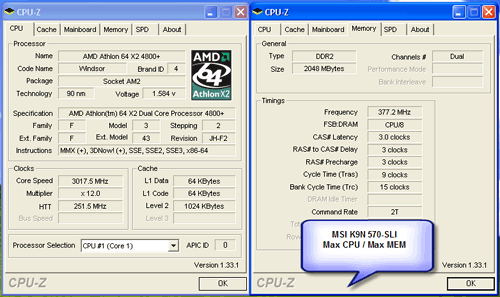
This board is a good overclocker although it seemed to become unstable very quickly when pushed beyond its limits. For example, the board was extremely stable at 12x251HTT setting but this stability trailed off quickly and at 12x255HTT the board would no longer boot.
We did notice in our overclocking testing the board was very sensitive to memory settings and seemed to perform better with the memory between DDR2-667 and DDR2-800 at faster timings than increasing the memory speeds up to DDR2-1000 with relaxed timings.
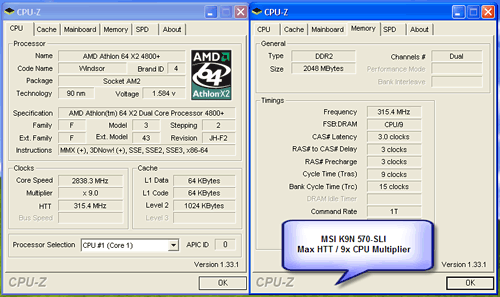
The ability to hit and remain stable at 9x315HTT would normally be a joyous event but after the results of our Biostar board this result seems normal now. The ability of a board to exceed 300HTT and maintain excellent stability is now expected for a performance oriented board and MSI delivers in this case.
Memory Stress Testing
Memory stress tests look at the ability of the MSI K9N-SLI Platinum to operate at the officially supported memory frequencies of 800MHz DDR2 at the best performing memory timings the Corsair Twin2X2048-8500C5 revision will support.
The MSI board was very stable with two (1GB) DDR2 modules in Dual-Channel mode at the settings of 3-3-3-8 2T at 2.1V. The board would set 5-5-5-15 2T if the memory selection was left on auto. We did not notice any issues throughout our testing with our settings provided the voltage was set to 2.1V. Unlike the Biostar board we were unable to run the board at DDR2-667 with 1T timings in a stable fashion.
With four (1GB) Corsair modules in all four available memory slots, the MSI board was completely stable in Dual-Channel operation at the settings of 3-4-4-9 2T with the voltage set at 2.1V. Driving 4 DIMMs is much more stressful on the memory subsystem than the more common 2 DIMM configuration. These are very good results and the board performed admirably throughout our memory testing regimen that included eight to twelve hour runs of MemTest86, Prime95, and our benchmarks suites along with numerous iterations of SuperPI set at 32m.
| MSI K9N SLI Platinum | |
| Processor: | AMD Athlon 64 X2 - 4800+ (AM2) |
| Chipset: | nForce 570SLI |
| CPU Voltage: | 1.600V (1.300V default) |
| Memory Settings: | 3-3-3-9 2T 12x Multiplier 3-3-3-9 1T 9x Multiplier |
| DDR2 Results: | 12 x 251HTT = DDR2 754 9 x 315HTT = DDR2 631 |
| HT Multiplier: | 5x below 300HTT, 4x above 300HTT |
| Memory Voltage: | 2.3V |
| Chipset Voltage: | Auto |
| HT Voltage: | Auto |
| Cooling: | Zalman CNPS9500 AM2 |
| Power Supply: | OCZ GamexStream 700W |
| Maximum CPU OverClock: | 251HTT x 12 (3017MHz) +25% |
| Maximum FSB OverClock: | 315HTT x 9 (2838MHz) +57% |
This board is a good overclocker although it seemed to become unstable very quickly when pushed beyond its limits. For example, the board was extremely stable at 12x251HTT setting but this stability trailed off quickly and at 12x255HTT the board would no longer boot.
We did notice in our overclocking testing the board was very sensitive to memory settings and seemed to perform better with the memory between DDR2-667 and DDR2-800 at faster timings than increasing the memory speeds up to DDR2-1000 with relaxed timings.
The ability to hit and remain stable at 9x315HTT would normally be a joyous event but after the results of our Biostar board this result seems normal now. The ability of a board to exceed 300HTT and maintain excellent stability is now expected for a performance oriented board and MSI delivers in this case.
Memory Stress Testing
Memory stress tests look at the ability of the MSI K9N-SLI Platinum to operate at the officially supported memory frequencies of 800MHz DDR2 at the best performing memory timings the Corsair Twin2X2048-8500C5 revision will support.
| MSI K9N-SLI Platinum Stable DDR2-800 Timings - 2 DIMMs (2/4 slots populated - 1 Dual-Channel Bank) |
|
| Clock Speed: | 200MHz |
| Timing Mode: | 800MHz - Default |
| CAS Latency: | 3 |
| RAS to CAS Delay: | 3 |
| RAS Precharge: | 3 |
| RAS Cycle Time: | 8 |
| Command Rate: | 2T |
| Voltage: | 2.1V |
The MSI board was very stable with two (1GB) DDR2 modules in Dual-Channel mode at the settings of 3-3-3-8 2T at 2.1V. The board would set 5-5-5-15 2T if the memory selection was left on auto. We did not notice any issues throughout our testing with our settings provided the voltage was set to 2.1V. Unlike the Biostar board we were unable to run the board at DDR2-667 with 1T timings in a stable fashion.
| MSI K9N-SLI Platinum Stable DDR2-800 Timings - 4 DIMMs (4/4 slots populated - 2 Dual-Channel Banks) |
|
| Clock Speed: | 200MHz |
| Timing Mode: | 800MHz - Default |
| CAS Latency: | 3 |
| RAS to CAS Delay: | 4 |
| RAS Precharge: | 4 |
| RAS Cycle Time: | 9 |
| Command Rate: | 2T |
| Voltage: | 2.1V |
With four (1GB) Corsair modules in all four available memory slots, the MSI board was completely stable in Dual-Channel operation at the settings of 3-4-4-9 2T with the voltage set at 2.1V. Driving 4 DIMMs is much more stressful on the memory subsystem than the more common 2 DIMM configuration. These are very good results and the board performed admirably throughout our memory testing regimen that included eight to twelve hour runs of MemTest86, Prime95, and our benchmarks suites along with numerous iterations of SuperPI set at 32m.
Originally published at https://www.anandtech.com/show/2023 (Wayback Machine).